Loading...
Done
The “Lost” Steve Jobs Time Capsule

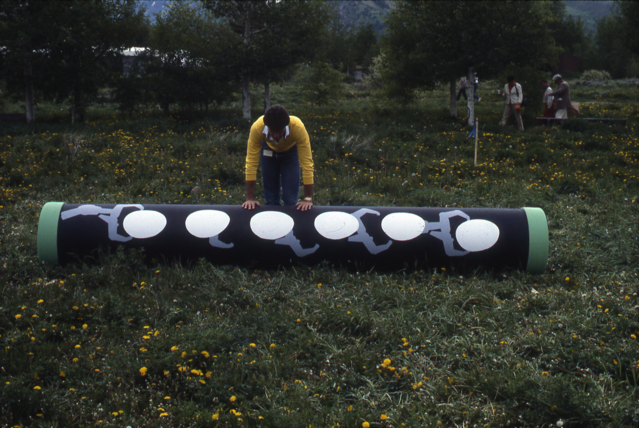
In 1983, Steve Jobs and his team who were attending a conference in Aspen, decided to bury a capsule that could be opened by future generations or roughly twenty years later. However, they forgot where the capsule was buried and therefore could not follow through with this plan. Recently, National Geographic’s TV Show, “Diggers” inadvertently discovered the capsule.
Details
24 Sep 2013 10:58:00
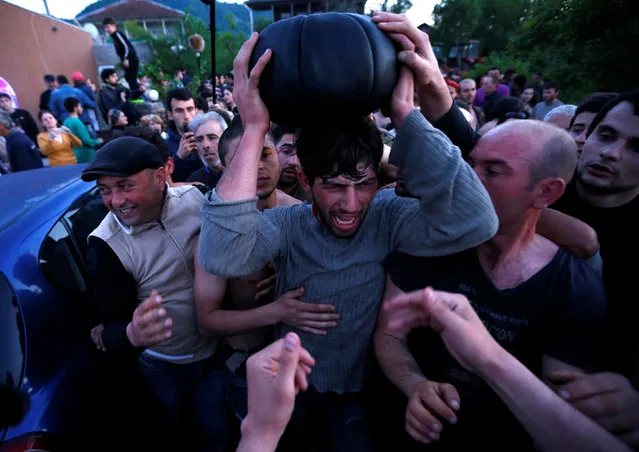
Winners celebrate after the annual Lelo match in the village of Shukhuti, Georgia, May 1, 2016. (Photo by David Mdzinarishvili/Reuters)

Winners celebrate after the annual Lelo match in the village of Shukhuti, Georgia, May 1, 2016. The villagers of Zemo (upper) Shukhuti and Kvemo (lower) Shukhuti have played the game every Easter Sunday for generations, with each side trying to carry the 16-kilogram ball to their end of the neighbouring villages. (Photo by David Mdzinarishvili/Reuters)
Details
02 May 2016 11:01:00
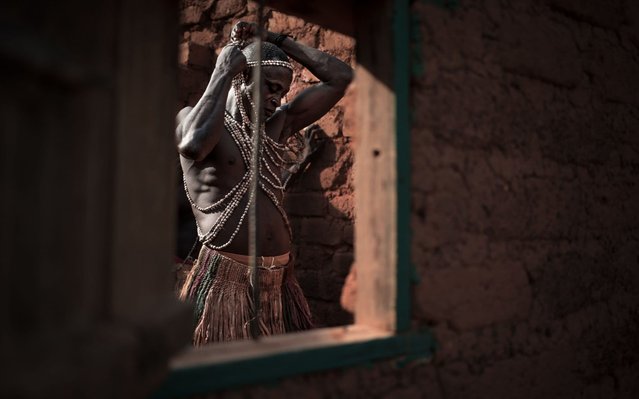
A Broto dancer prepares himself in a disused house of Bambari, in the centre of Central African Republic, before performing on March 14, 2019. The Broto, belonging to the Banda ethnic group, are known for their traditional dances accompanied by heavy horns made of tree roots. Today this tradition falls into disuse and its history is now forgotten by the new generations. (Photo by Florent Vergnes/AFP Photo)

A Broto dancer prepares himself in a disused house of Bambari, in the centre of Central African Republic, before performing on March 14, 2019. The Broto, belonging to the Banda ethnic group, are known for their traditional dances accompanied by heavy horns made of tree roots. Today this tradition falls into disuse and its history is now forgotten by the new generations. (Photo by Florent Vergnes/AFP Photo)
Details
05 Apr 2019 00:01:00
Two displaced Tigrayan girls giggle next to their mother, left, as their photograph is taken outside the Hadnet General Secondary School which has become a makeshift home to thousands displaced by the conflict, in Mekele, in the Tigray region of northern Ethiopia Wednesday, May 5, 2021. The Tigray conflict has displaced more than 1 million people, the International Organization for Migration reported in April, and the numbers continue to rise. (Photo by Ben Curtis/AP Photo)

Two displaced Tigrayan girls giggle next to their mother, left, as their photograph is taken outside the Hadnet General Secondary School which has become a makeshift home to thousands displaced by the conflict, in Mekele, in the Tigray region of northern Ethiopia Wednesday, May 5, 2021. The Tigray conflict has displaced more than 1 million people, the International Organization for Migration reported in April, and the numbers continue to rise. (Photo by Ben Curtis/AP Photo)
Details
15 May 2021 08:13:00
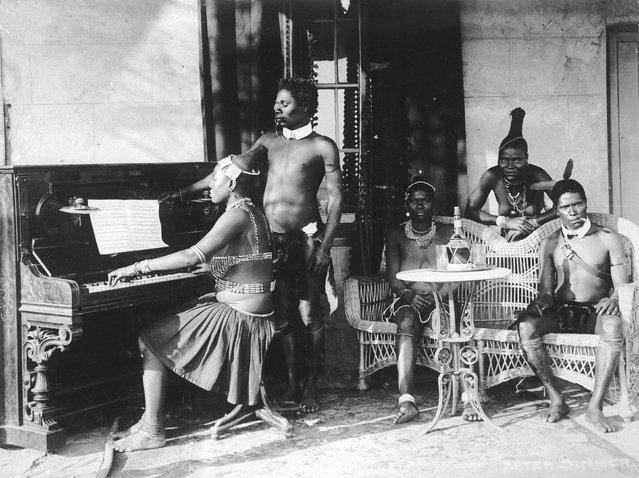
circa 1925:  A Zulu woman playing the piano while a group of others sit and listen.  (Photo by General Photographic Agency/Getty Images)

“The Zulu are the largest South African ethnic group, with an estimated 10–11 million people living mainly in the province of KwaZulu-Natal. Small numbers also live in Zimbabwe, Zambia, and Mozambique. Their language, Zulu, is a Bantu language; more specifically, part of the Nguni subgroup. The Zulu Kingdom played a major role in South African history during the 19th and 20th centuries. Under apartheid, Zulu people were classed as third-class citizens and suffered from state-sanctioned discrimination. They remain today the most numerous ethnic group in South Africa, and now have equal rights along with all other citizens”. – Wikipedia.

Photo: A Zulu woman playing the piano while a group of others sit and listen (to put it briefly, Englishmen scoff over Zulu). South Africa, circa 1925. (Photo by General Photographic Agency)

Details
03 Feb 2014 09:40:00
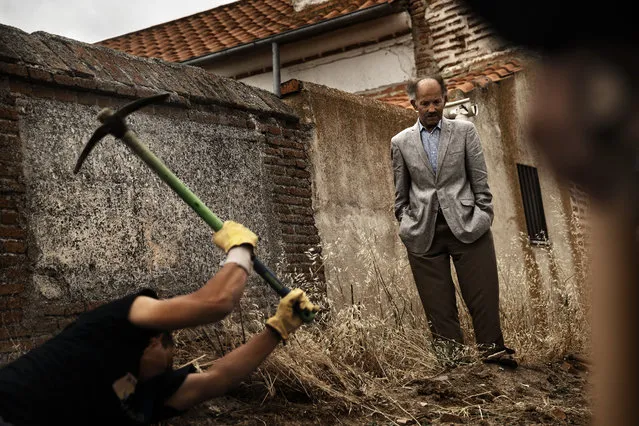
In this photo taken on July 19, 2014, a man looks at an excavation as an A.R.M.H., Association for the Recovery of Historical Memory, volunteer digs on the search for the body of Perfecto de Dios, in a hidden grave in Chaherrero, Spain. Across Spain, volunteer teams of archeologists, anthropologists and forensic scientists head out every year on expeditions to dig for suspected mass graves – a legacy of Spain's fascist past during the time of General Francisco Franco. (Photo by Daniel Ochoa de Olza/AP Photo)

In this photo taken on July 19, 2014, a man looks at an excavation as an A.R.M.H., Association for the Recovery of Historical Memory, volunteer digs on the search for the body of Perfecto de Dios, in a hidden grave in Chaherrero, Spain. Across Spain, volunteer teams of archeologists, anthropologists and forensic scientists head out every year on expeditions to dig for suspected mass graves – a legacy of Spain's fascist past during the time of General Francisco Franco. (Photo by Daniel Ochoa de Olza/AP Photo)
Details
26 Dec 2014 14:54:00
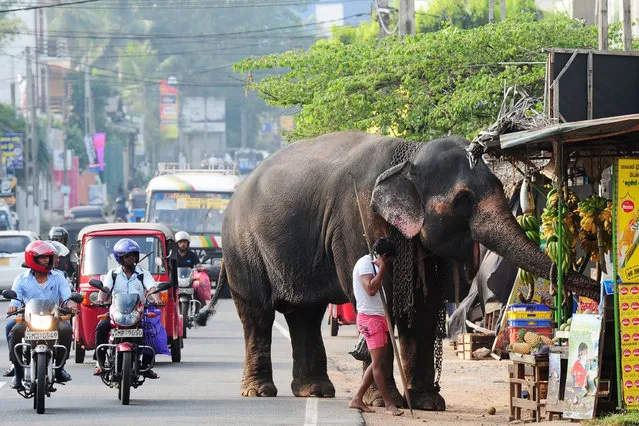
A Sri Lankan elephant, accompanied by his mahout, browse through a roadside fruit stall in Colombo on January 19, 2015. The Sri Lankan elephant is listed as endangered by the International Union for Conservation of Nature (IUCN) as the population has declined by at least 50 percent over the last three generations, with the species threatened by habitat loss, degradation and fragmentation. (Photo by Lakruwan Wanniarachchi/AFP Photo)

A Sri Lankan elephant, accompanied by his mahout, browse through a roadside fruit stall in Colombo on January 19, 2015. The Sri Lankan elephant is listed as endangered by the International Union for Conservation of Nature (IUCN) as the population has declined by at least 50 percent over the last three generations, with the species threatened by habitat loss, degradation and fragmentation. (Photo by Lakruwan Wanniarachchi/AFP Photo)
Details
23 Jan 2015 13:21:00
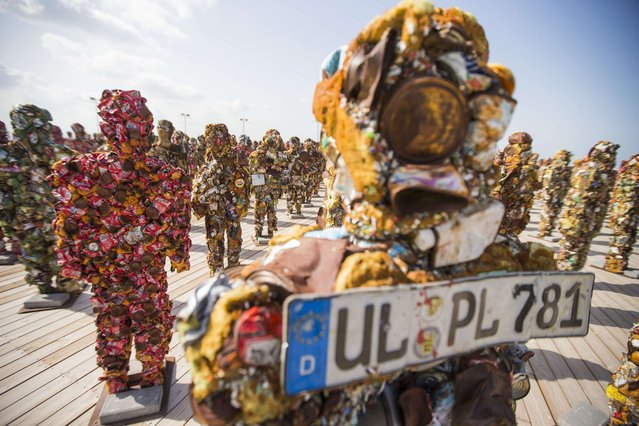
A general view shows sculptures made of waste material titled “Trash People” by German Artist HA Schult (unseen), on April 2, 2014 in Ariel Sharon Park, in the suburbs of Tel Aviv. Hundreds of human-size figures constructed from 20 tons of recycled material, including iron, glass, computer parts, cans and more, will dominate the sky line of Tel-Aviv city and be placed in the park. (Photo by Jack Guez/AFP Photo)

A general view shows sculptures made of waste material titled “Trash People” by German Artist HA Schult (unseen), on April 2, 2014 in Ariel Sharon Park, in the suburbs of Tel Aviv. Hundreds of human-size figures constructed from 20 tons of recycled material, including iron, glass, computer parts, cans and more, will dominate the sky line of Tel-Aviv city and be placed in the park. (Photo by Jack Guez/AFP Photo)
Details
03 Apr 2014 10:53:00