Loading...
Done
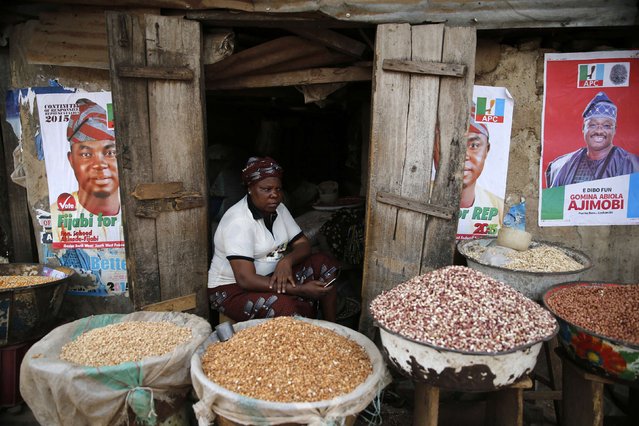
Latefat Alao, 56, a ethnic Yoruba Muslim woman, waits for customers in front of her in Beere market in Ibadan, southwest Nigeria, January 29, 2015. Much of the grain and wheat traders like Alao sell comes from the north and Boko Haram's campaign has negatively affected farmers and food markets. (Photo by Akintunde Akinleye/Reuters)

Latefat Alao, 56, a ethnic Yoruba Muslim woman, waits for customers in front of her in Beere market in Ibadan, southwest Nigeria, January 29, 2015. Much of the grain and wheat traders like Alao sell comes from the north and Boko Haram's campaign has negatively affected farmers and food markets. Reuters photographer Akintunde Akinleye photographed Nigerians and asked them about their views on the elections as well as their hopes and concerns for the country. (Photo by Akintunde Akinleye/Reuters)
Details
12 Feb 2015 12:44:00
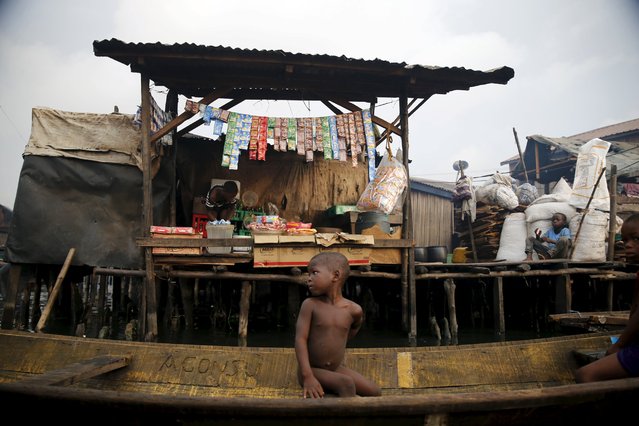
A boy sits in a canoe in front of a shed built on a raft in the Makoko fishing community on the Lagos Lagoon, Nigeria February 29, 2016. Makoko, a vast slum of houses on stilts in a Lagos lagoon, now boasts a new school – pyramid-shaped, floating and capable of withstanding the waterways' extreme weather, it is a beacon of hope for the nearly 100,000 Nigerians who live there.  (Photo by Akintunde Akinleye/Reuters)

A boy sits in a canoe in front of a shed built on a raft in the Makoko fishing community on the Lagos Lagoon, Nigeria February 29, 2016. In Makoko, a sprawling slum of Nigeria's megacity Lagos, a floating school capable of holding up to a hundred pupils has since November brought free education to the waterways known as the Venice of Lagos. It offers the chance of social mobility for youngsters who, like most of the city's 21 million inhabitants, lack a reliable electricity and water supply and whose water-based way of life is threatened by climate change as well as rapid urbanisation. (Photo by Akintunde Akinleye/Reuters)
Details
05 Mar 2016 12:01:00
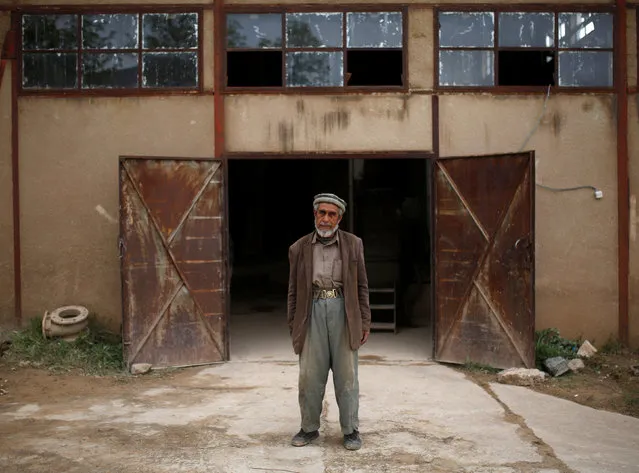
A worker at the Jabal Saraj cement factory poses for a photograph in Jabal Saraj, north of Kabul, Afghanistan April 19, 2016. (Photo by Ahmad Masood/Reuters)

A worker at the Jabal Saraj cement factory poses for a photograph in Jabal Saraj, north of Kabul, Afghanistan April 19, 2016. In an area desperately short of industry and jobs, local workers hope that the relaunch of the plant in Jabal Saraj, built by Czech engineers in 1957 and closed down by the Taliban in 1995, can show that Afghanistan's shattered industry can climb back to its feet after decades of war and destruction. But the outdated state-owned plant some 75 kilometres outside Kabul also shows how far it has to go before that promise can be achieved and there are serious questions over whether it has a viable future unless a new, modern facility is built to replace it. (Photo by Ahmad Masood/Reuters)
Details
31 May 2016 11:29:00
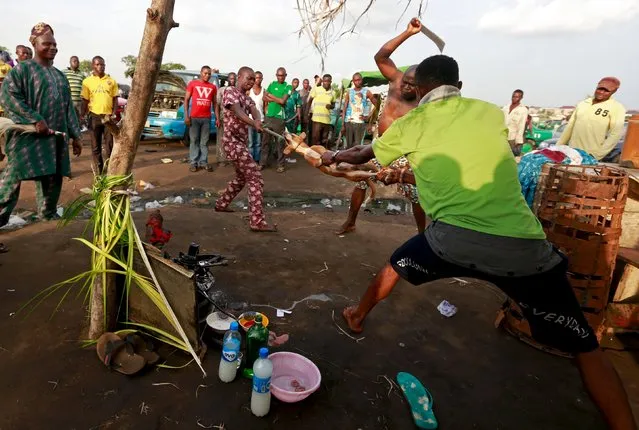
Chief priest Gbenga Saala raises a cutlass to kill a dog during an annual prayer and sacrifice celebration of the iron god Ogun in Abuja, Nigeria, June 23, 2015. (Photo by Afolabi Sotunde/Reuters)

Chief priest Gbenga Saala raises a cutlass to kill a dog during an annual prayer and sacrifice celebration of the iron god Ogun in Abuja, Nigeria, June 23, 2015. Every year worshippers offer a dog as sacrifice to Ogun, a traditional Nigerian deity, in hope of an auspicious year ahead. Taxi drivers, blacksmiths, panel beaters and mechanics – trades that depend on metal for their livelihood – pay homage to Ogun, led by high priest Gbenga Saala. As part of the ceremony, the priest pours the dog’s blood on symbols of these workers’ trade: keys, spanners and other tools piled up in a metal barrel. (Photo by Afolabi Sotunde/Reuters)
Details
15 Sep 2015 13:56:00
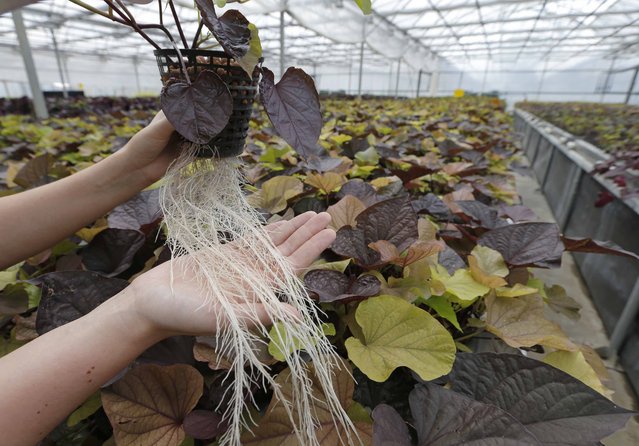
An employee holds a plant with roots at the Plant Advanced Technologies (PAT) company greenhouse in Laronxe near Nancy, Eastern France, June 19, 2015. The farmers employed at the site in Laronxe are growing plants in a special way with a view to “milking” them for use in medicines, cosmetics and agrochemicals. (Photo by Vincent Kessler/Reuters)

An employee holds a plant with roots at the Plant Advanced Technologies (PAT) company greenhouse in Laronxe near Nancy, Eastern France, June 19, 2015. The farmers employed at the site in Laronxe are growing plants in a special way with a view to “milking” them for use in medicines, cosmetics and agrochemicals. Several major brands, including Germany's BASF and France's Chanel, have teamed up with Plant Advanced Technologies (PAT) in the hope of securing privileged access to the so-called “biomolecules” it extracts through the use of a patented technique. (Photo by Vincent Kessler/Reuters)
Details
23 Jul 2015 10:56:00
Meerim Momunova wrestles with her fellow Kyrgyz teammate Anara Ryskulova during a performance of a traditional style of wrestling called “Alysh”. Momunova is a champion in Asia and has been competing since 2015, after a background in judo. According to Momunova, one of the advantages of “Alysh” is the ease of the uniform for women – even Muslim women who cover their faces can compete. Momunova holds a degree in sports coaching and hopes to see more women come into this sport. (Photo by Eleanor Moseman/The Guardian)

This year’s World Nomad Games, a celebration of nomadic heritage, took place in the Issyk-Kul province of Kyrgyzstan. Eleanor Moseman photographed female competitors who had travelled from all over central Asia and eastern Europe, and explored the difficulties and challenges they face as competitors. (Photo by Eleanor Moseman/The Guardian)
Details
20 Sep 2018 00:05:00
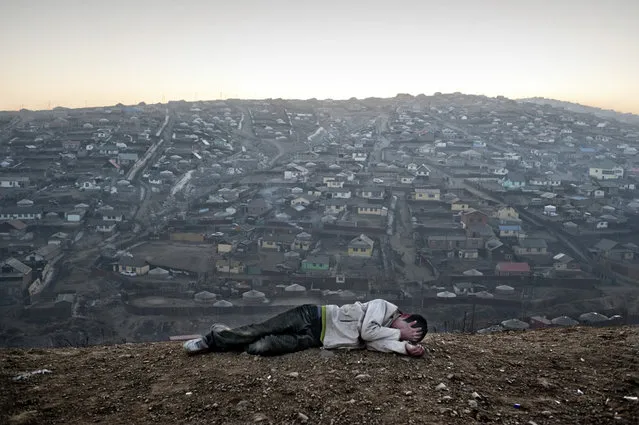
Asia, Mongolia, March 27, 2011. A view of Ulaan Baator over the shoulder of a slumbering drunk. Alcoholism is a huge problem in the city, home to almost half of Mongolia's people. The capital's population has doubled in the past two years, expanding outward in a haphazard sprawl, and many inhabitants live in slums known as the “Gher District”. (Photo by Alessandro Grassani)

“Environmental Migrants: The Last Illusion” by photographer Alessandro Grassani, documents the life of people in Kenya, Mongolia and Bangladesh who migrate to escape environmental stresses to the city of their own countries in hopes for a better life. Here: Asia, Mongolia, March 27, 2011. A view of Ulaan Baator over the shoulder of a slumbering drunk. Alcoholism is a huge problem in the city, home to almost half of Mongolia's people. The capital's population has doubled in the past two years. High levels of unemployment and poverty await herders who abandon rural areas and arrive in the city, illiterate and untrained in any skills necessary for urban jobs. (Photo by Alessandro Grassani)
Details
21 Jul 2015 10:10:00
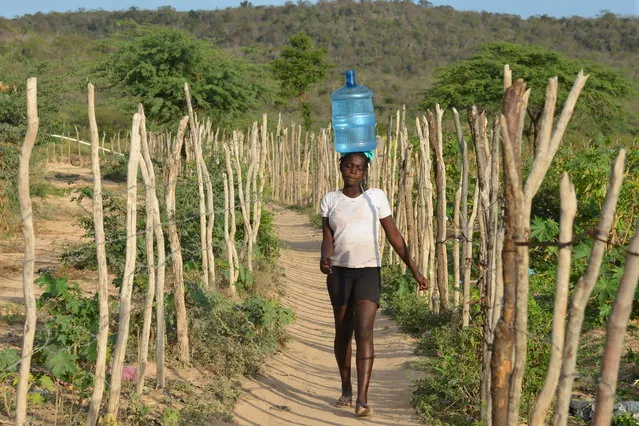
In this March 21, 2015 photo, 15-year-old Guerline Augustin carries river water on her head, back to a borderland encampment outside the southeast Haitian town of Anse-a-Pitres, Haiti. (Photo by David McFadden/AP Photo)

In this March 21, 2015 photo, 15-year-old Guerline Augustin carries river water on her head, back to a borderland encampment outside the southeast Haitian town of Anse-a-Pitres, Haiti. The encampment is filled with people who either fled or were forcibly removed from the neighboring Dominican Republic amid an immigration crackdown. Within the next month, authorities hope to move nearly 2,400 people out of six encampments by providing subsidies for them to rent homes for a year in southeastern Haiti. The International Organization for Migration is coordinating the effort with $2 million from a U.N. emergency fund. (Photo by David McFadden/AP Photo)
Details
31 Mar 2016 11:20:00