Loading...
Done
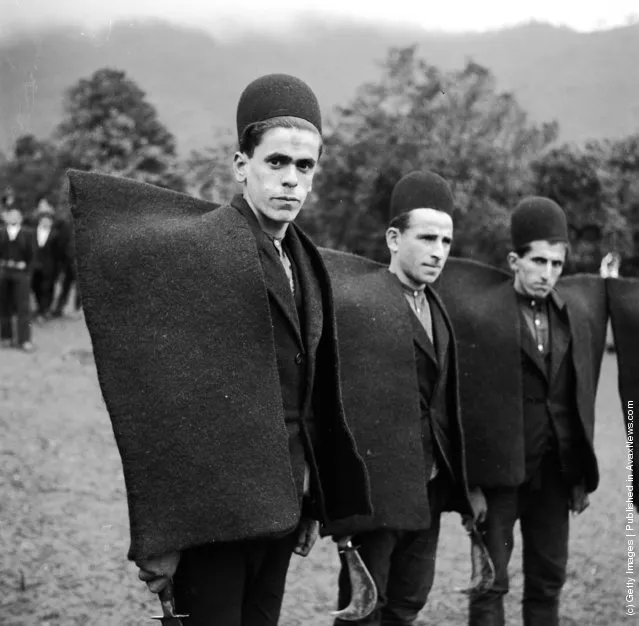
1952:  Shepherds from the north wear their traditional heavy woollen mantles as they stand ready to shear sheep with sycthe-like shears

Shepherds from the north wear their traditional heavy woollen mantles as they stand ready to shear sheep with sycthe-like shears. (Photo by Three Lions/Getty Images). Circa 1952
Details
03 Dec 2011 13:34:00
An artist has discovered a bizarre way to create his work – by coating the feet of insects with paint who then crawl across the canvas creating intricate pieces of art. (Photo by Caters News)

An artist has discovered a bizarre way to create his work – by coating the feet of insects with paint who then crawl across the canvas creating intricate pieces of art. (Photo by Caters News)
Details
16 Feb 2014 12:54:00
A woman is consoled by her relative as she mourns after seeing her house getting burned during a fire that broke out in one of the houses and got spread in more adjoining houses, in a residential locality in Srinagar, November 21, 2016. (Photo by Danish Ismail/Reuters)

A woman is consoled by her relative as she mourns after seeing her house getting burned during a fire that broke out in one of the houses and got spread in more adjoining houses, in a residential locality in Srinagar, November 21, 2016. (Photo by Danish Ismail/Reuters)
Details
22 Nov 2016 11:08:00
A timber truck driver (L) dressed as Father Frost is saluted by a soldier at the Kremlin's Spasskiye (Saviour) Gate in Moscow, Russian Federation, on December 24, 2013. (Photo by Vyacheslav Prokofyev/ITAR-TASS/ZUMA Press)

A timber truck driver (L) dressed as Father Frost is saluted by a soldier at the Kremlin's Spasskiye (Saviour) Gate in Moscow, Russian Federation, on December 24, 2013. (Photo by Vyacheslav Prokofyev/ITAR-TASS/ZUMA Press)
Details
25 Dec 2013 09:51:00
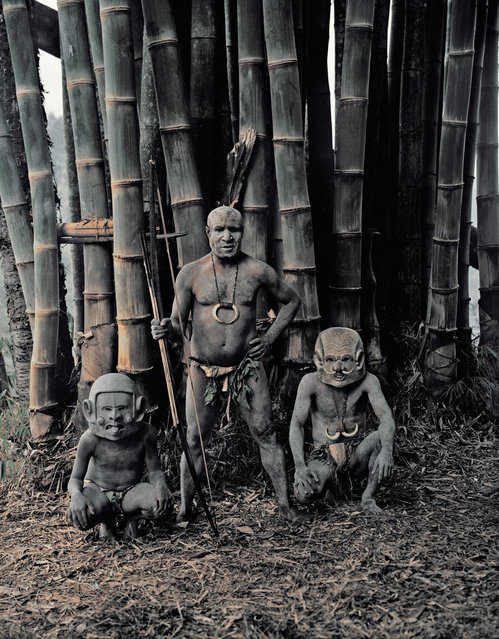
“Asaro from the Eastern Highlands”. The mudmen could not cover their faces with mud because the people of Papua New Guinea thought that the mud from the Asaro river was poisonous. So instead of covering their faces with this alleged poison, they made masks from pebbles that they heated and water from the waterfall, with unusual designs such as long or very short ears either going down to the chin or sticking up at the top, long joined eyebrows attached to the top of the ears, horns and sideways mouths. (Jimmy Nelson)

“Asaro from the Eastern Highlands”. The mudmen could not cover their faces with mud because the people of Papua New Guinea thought that the mud from the Asaro river was poisonous. So instead of covering their faces with this alleged poison, they made masks from pebbles that they heated and water from the waterfall, with unusual designs such as long or very short ears either going down to the chin or sticking up at the top, long joined eyebrows attached to the top of the ears, horns and sideways mouths. (Photo and caption by Jimmy Nelson)
Details
20 Oct 2013 08:54:00
Young woman, 20+, with goose bumps, standing on the beach, Niendorf at the Baltic Sea, Schleswig-Holstein, Germany, Europe on September 1, 2016. (Photo by Alamy Stock Photo)

Young woman, 20+, with goose bumps, standing on the beach, Niendorf at the Baltic Sea, Schleswig-Holstein, Germany, Europe on September 1, 2016. (Photo by Alamy Stock Photo)
Details
06 Sep 2016 10:37:00
A man and a dog bathe in a fountain during celebrations of Paratroopers' Day in Moscow' s Gorky Park on August 2, 2017. Russia' s Airborne Troops (Blue Berets) celebrate their professional holiday on the Day of Elijah the Prophet, their Patron. (Photo by Stanislav Krasilnikov/TASS)

A man and a dog bathe in a fountain during celebrations of Paratroopers' Day in Moscow' s Gorky Park on August 2, 2017. Russia' s Airborne Troops (Blue Berets) celebrate their professional holiday on the Day of Elijah the Prophet, their Patron. (Photo by Stanislav Krasilnikov/TASS)
Details
03 Aug 2017 09:15:00
In this November 27, 2019 photo, Wadlande Pierre, right, talks on her mobile phone as she helps her mother, Vanlancia Julien, center, at their fruit and vegetable stand on a sidewalk in Delmas, a district of in Port-au-Prince, Haiti. Pierre, 23, said she temporarily moved in with her aunt in the southwest town of Les Cayes to escape the violent protests in Port-au-Prince. However, she had to move back to the capital because there was no gas, power or water in Les Cayes, and food was becoming scarce. (Photo by Dieu Nalio Chery/AP Photo)

In this November 27, 2019 photo, Wadlande Pierre, right, talks on her mobile phone as she helps her mother, Vanlancia Julien, center, at their fruit and vegetable stand on a sidewalk in Delmas, a district of in Port-au-Prince, Haiti. Pierre, 23, said she temporarily moved in with her aunt in the southwest town of Les Cayes to escape the violent protests in Port-au-Prince. However, she had to move back to the capital because there was no gas, power or water in Les Cayes, and food was becoming scarce. (Photo by Dieu Nalio Chery/AP Photo)

Details
01 Feb 2020 00:05:00