Soldiers ask a tourist to evacuate Mirador beach ahead of Hurricane Beryl's expected arrival in Tulum, Mexico, July 4, 2024. (Photo by Fernando Llano/AP Photo)
On the 6th October 2024, tourists visiting Cheongsan Arboretum in Taean-gun, Chungcheongnam-doon, South Korea are walking among pampas grass, also known as Western silver grass. (Photo by Shin Hyeon-jong)
Chinese tourists make a toast with canned drinks and fried chicken pieces during an event organized by a Chinese company at a park in Incheon, South Korea, March 28, 2016. (Photo by Kim Hong-Ji/Reuters)
Indian tourists walks during heavy snowfall by Dal Lake in Srinagar on January 6, 2017. The sub-zero temperatures has frozen many water bodies in Kashmir and even drinking water taps have frozen at some places. (Photo by Tauseef Mustafa/AFP Photo)
A reflection on waste liquid shows a tourist walking near the Blue mosque at the Sultanahmet Square on the first day of the Muslim fasting month of Ramadan in Istanbul on April 13, 2021. (Photo by Ozan Kose/AFP Photo)
Tourists ride in inflatable boats as they go rafting down a river at Buyun Mountain Scenic Spot on July 10, 2020 in Dalian, Liaoning Province of China. (Photo by Wang Hua/VCG via Getty Images)
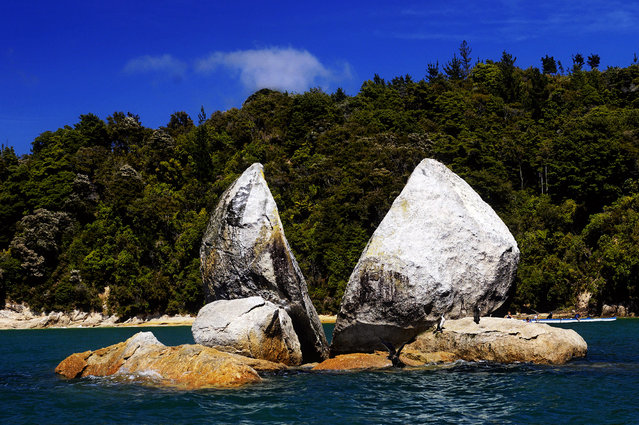
Split Apple Rock is a geological rock formation in The Tasman Bay off the northern coast of the South Island of New Zealand. Made of granite, it is in the shape of an apple which has been cut in half. It is a popular tourist attraction in the waters of the Tasman Sea approximately 50 metres off the coast between Kaiteriteri and Marahau. The rock sits in shallow water at low tide and is accessible by wading. It is also a point of interest for the many tourist boats and pleasure craft which operate along the shores of the Abel Tasman National Park. The cleft to produce two sides of the 'apple' was a natural occurrence. It is unknown when this happened and therefore the cleaving of the rock has attracted mythological explanations.
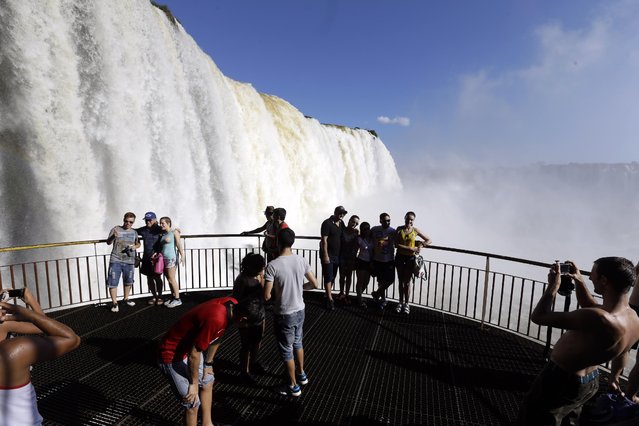
In this March 14, 2015 photo, tourists take pictures from a viewing area at Iguazu Falls in Brazil. From walkways and bridges, viewers can count 270 water falls almost 100 meters (330 feet) high. (Photo by Jorge Saenz/AP Photo)