Loading...
Done
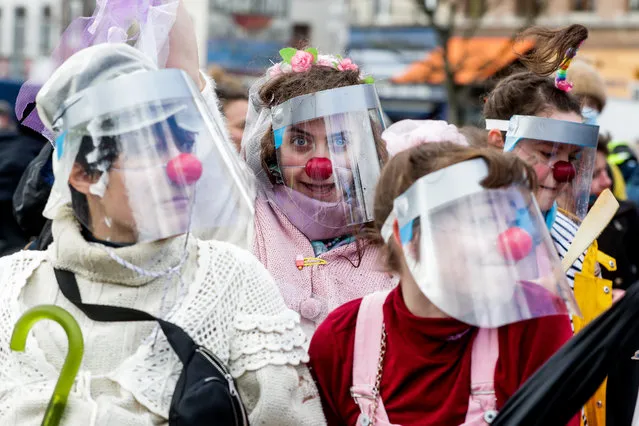
Participants of the “Still Standing for Culture” action of the cultural sector rally in Les Marolles neighborhood of Brussels, Belgium, 13 March 2021. Workers of the cultural sector along with second-hand dealers of the Jeu de Balle place gathered in Les Marolles to denounce the lack of financial support and call for solutions to the impact of the coronavirus crisis on culture professionals and the sector as a whole one year after the Covid-19 pandemic lockdowns started. (Photo by Stephanie Lecocq/EPA/EFE)

Participants of the “Still Standing for Culture” action of the cultural sector rally in Les Marolles neighborhood of Brussels, Belgium, 13 March 2021. Workers of the cultural sector along with second-hand dealers of the Jeu de Balle place gathered in Les Marolles to denounce the lack of financial support and call for solutions to the impact of the coronavirus crisis on culture professionals and the sector as a whole one year after the Covid-19 pandemic lockdowns started. (Photo by Stephanie Lecocq/EPA/EFE)
Details
14 Mar 2021 09:19:00
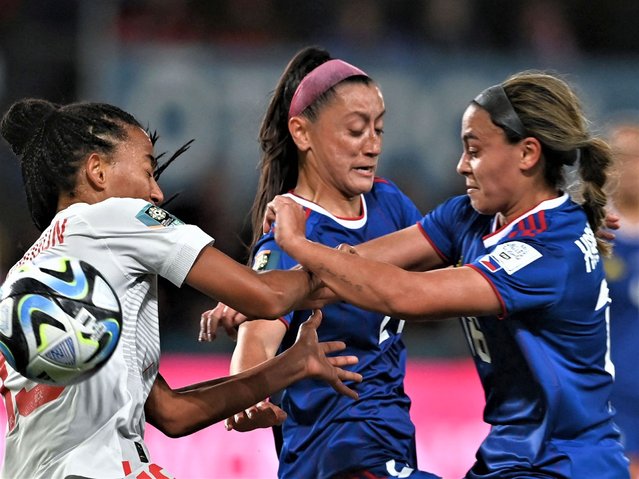
Switzerland's forward #19 Eseosa Aigbogun (L) fights for the ball with Philippines' defender #16 Sofia Harrison (R) and Philippines' forward #21 Katrina Guillou during the Australia and New Zealand 2023 Women's World Cup Group A football match between the Philippines and Switzerland at Dunedin Stadium in Dunedin on July 21, 2023. (Photo by Sanka Vidanagama/AFP Photo)

Switzerland's forward #19 Eseosa Aigbogun (L) fights for the ball with Philippines' defender #16 Sofia Harrison (R) and Philippines' forward #21 Katrina Guillou during the Australia and New Zealand 2023 Women's World Cup Group A football match between the Philippines and Switzerland at Dunedin Stadium in Dunedin on July 21, 2023. (Photo by Sanka Vidanagama/AFP Photo)
Details
31 Jul 2023 03:16:00
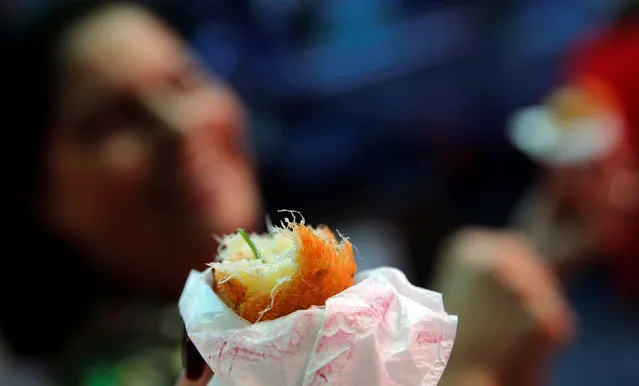
A view of traditional bolinhos de bacalhau (fried codfish balls) in Rio de Janeiro, Brazil, May 7, 2016. (Photo by Sergio Moraes/Reuters)

If the most popular foods of Rio de Janeiro have one thing in common, it is their informality. You can find fine restaurants in the city, but they do not set Rio apart from other places. What does set it apart, and what invariably brings its residents, known as "Cariocas," together is the unpretentious food they eat in bright, loud, crowded bars and restaurants, on busy street corners, or after a day at the beach. Here: A view of traditional bolinhos de bacalhau (fried codfish balls) in Rio de Janeiro, Brazil, May 7, 2016. (Photo by Sergio Moraes/Reuters)
Details
05 Aug 2016 13:20:00
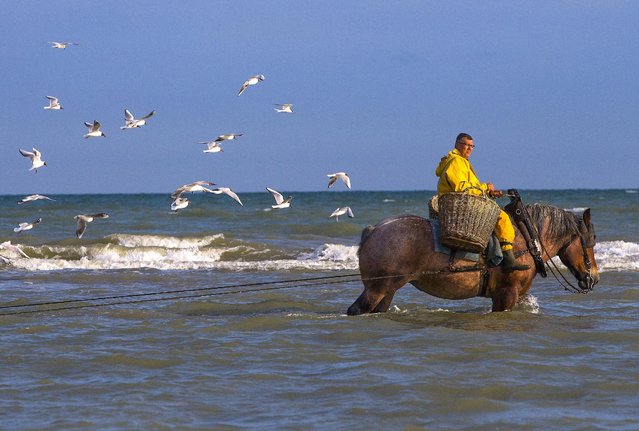
A Belgian shrimp fisherman rides a carthorse to haul a net out in the sea to catch shrimps during low tide at the coastal town of Oostduinkerke, Belgium July 3, 2015. (Photo by Yves Herman/Reuters)

A Belgian shrimp fisherman rides a carthorse to haul a net out in the sea to catch shrimps during low tide at the coastal town of Oostduinkerke, Belgium July 3, 2015. At the end of each fishing session, the fishermen and their mounts leave the water to empty the net's contents into two wicker baskets fixed on each side of the horse. This traditional method of catching shrimps along the North Sea coast, which dates back to some 500 years, attracts tourists every summer. In 2013, Unesco recognized shrimp fishing on horseback as an intangible cultural heritage. (Photo by Yves Herman/Reuters)
Details
04 Jul 2015 11:29:00


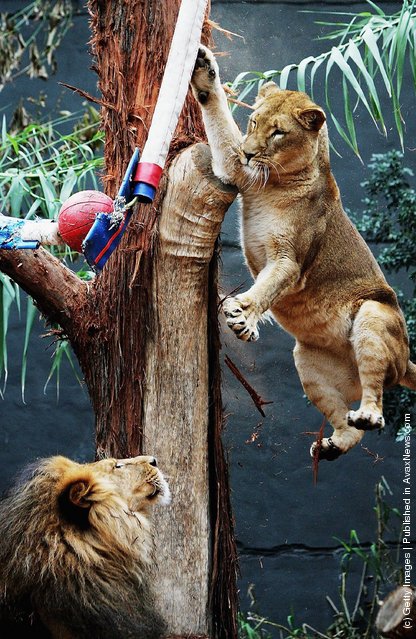
Young African lion Asali (R) jumps for a bungee-ball toy as her father Jambo or “Bruiser” looks on at the opening of a savannah-themed makeover of the lion enclosure at Taronga Zoo August 29, 2006 in Sydney, Australia. The renovation includes sandstone rock features, a wading pool, and red ochre crushed granite substrate in a move to make the enclosure more closely resemble the natural habitat of the African savannah. (Photo by Ian Waldie/Getty Images)
Details
15 Apr 2011 10:12:00
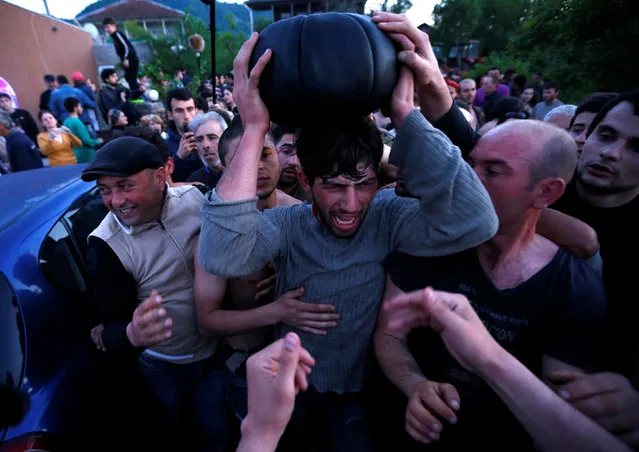
Winners celebrate after the annual Lelo match in the village of Shukhuti, Georgia, May 1, 2016. (Photo by David Mdzinarishvili/Reuters)

Winners celebrate after the annual Lelo match in the village of Shukhuti, Georgia, May 1, 2016. The villagers of Zemo (upper) Shukhuti and Kvemo (lower) Shukhuti have played the game every Easter Sunday for generations, with each side trying to carry the 16-kilogram ball to their end of the neighbouring villages. (Photo by David Mdzinarishvili/Reuters)
Details
02 May 2016 11:01:00
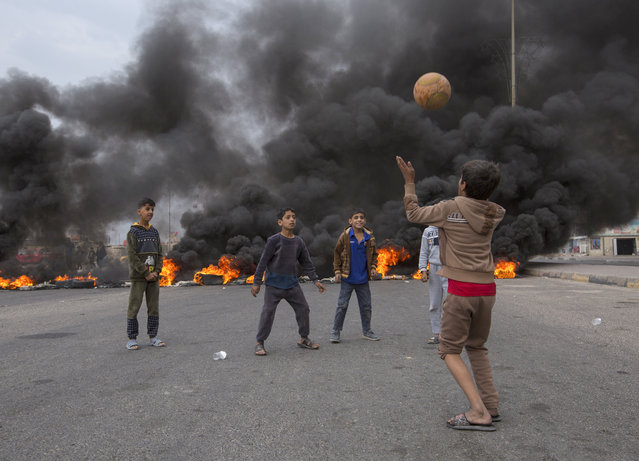
Iraqi children play with a ball on a street blocked with burning tyres, amid a general strike in the southern city of Basra, on November 25, 2019. The demonstrations rocking the capital and Shiite-majority south since October 1 are the biggest grassroots movement the country has seen in decades. Sparked by outrage over rampant government corruption, poor services and lack of jobs, they have since gone straight to the source: calling out the ruling system as inherently flawed and in need of a total overhaul. (Photo by Hussein Faleh/AFP Photo)

Iraqi children play with a ball on a street blocked with burning tyres, amid a general strike in the southern city of Basra, on November 25, 2019. The demonstrations rocking the capital and Shiite-majority south since October 1 are the biggest grassroots movement the country has seen in decades. Sparked by outrage over rampant government corruption, poor services and lack of jobs, they have since gone straight to the source: calling out the ruling system as inherently flawed and in need of a total overhaul. (Photo by Hussein Faleh/AFP Photo)
Details
03 Jan 2020 00:01:00
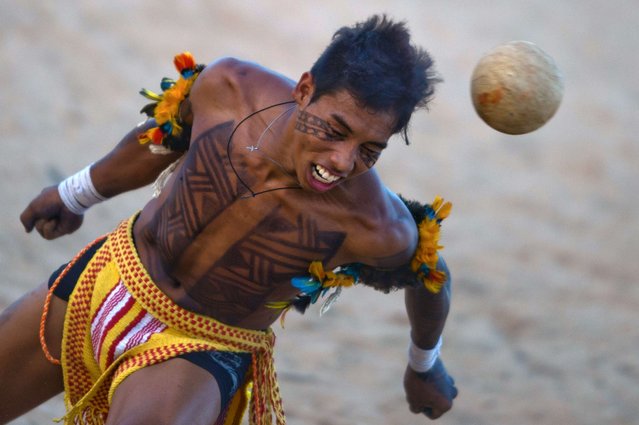
Brazilian natives of the Pareci tribe play head football with a hand-made ball for a demonstration, during the first day of the International Games of Indigenous Peoples, in Cuiaba, state of Mato Grosso, on November 10, 2013. 1500 natives from 49 Brazilian ethnic groups and from another 17 countries are gathering in Cuiaba until November 16 to compete in some 30 athletic disciplines, many of their own. (Photo by Christophe Simon/AFP Photo)

Brazilian natives of the Pareci tribe play head football with a hand-made ball for a demonstration, during the first day of the International Games of Indigenous Peoples, in Cuiaba, state of Mato Grosso, on November 10, 2013. 1500 natives from 49 Brazilian ethnic groups and from another 17 countries are gathering in Cuiaba until November 16 to compete in some 30 athletic disciplines, many of their own. (Photo by Christophe Simon/AFP Photo)
Details
13 Nov 2013 11:50:00