Netherlands Antilles Sint Maarten – Boeing 747-400 of KLM in approach for the “Princess Juliana” airport on July 2, 2002. (Photo by LUPOO/Ullstein Bild via Getty Images)
A participant stands next to a robot during the St. Petersburg International Economic Forum (SPIEF) in Saint Petersburg, Russia on June 15, 2022. (Photo by Maxim Shemetov/Reuters)
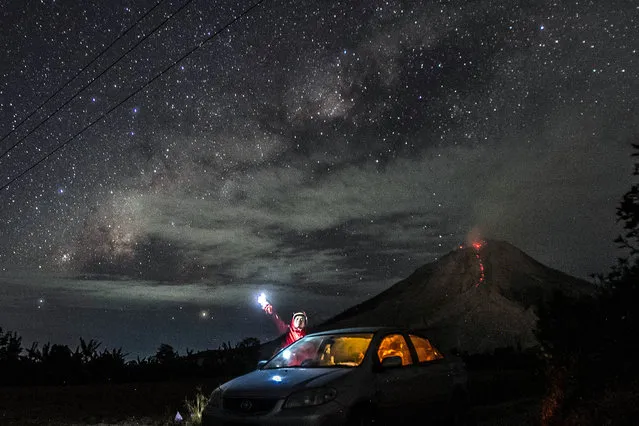
Long Exposure pictures showing Mount Sinabung spewing out hot lava on August 2, 2017 in Karo, Indonesia. Sinabung located in North Sumatra Province roared back to life in 2010 for the first time in 400 years. After another period of inactivity it erupted once more in 2013, and has remained highly active since. (Photo by Albert Damanik/Barcroft Images)
From the “Paradise Revisited” story in the November 2013 issue of National Geographic magazine, this image is a beautiful vision of father and son fishermen as they move through the multicolored coral gardens of Kembe Bay, Papua New Guinea, in a traditional outrigger canoe. (Photo by David Doubilet/National Geographic Creative)
A Taliban security personnel stands guard as Afghan burqa-clad women wait in queue in the midst of a downpour to receive food supplies donated during the Islamic holy fasting month of Ramadan, in Kabul on March 25, 2025. (Photo by Wakil Kohsar/AFP Photo)
Air France airplane from Air France-KLM Group arrives at Princess Juliana international airport on the Caribbean island of Saint Martin at Maho Beach, Sint Maarten on February 12, 2023. (Photo by Rex Features/Shutterstock)
On August 31, 2012, a long filament of solar material that had been hovering in the sun's atmosphere, the corona, erupted out into space at 4:36 p.m. EDT. The coronal mass ejection, or CME, traveled at over 900 miles per second. The CME did not travel directly toward Earth, but did connect with Earth's magnetic environment, or magnetosphere, causing aurora to appear on the night of Monday, September 3. (Photo by NASA/GSFC/SDO via The Atlantic)
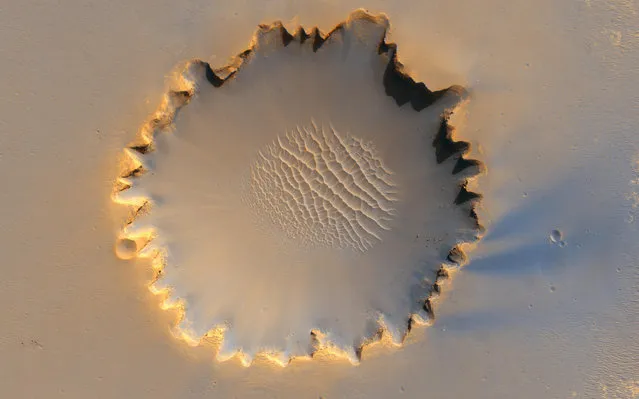
“NASA's Mars rover Opportunity just celebrated its ninth anniversary on Mars – a mission that was originally meant to last just 90 days...” – The Atlantic. Photo: NASA's rover Opportunity visits Victoria Crater, viewed from orbit by the High Resolution Imaging Science Experiment on NASA's Mars Reconnaissance Orbiter in october of 2006. Opportunity is a small dot on the crater's lip, at top right. Opportunity first reached the crater's rim on September 27, 2006. (Photo by NASA/JPL-Caltech/University of Arizona via The Atlantic)