Loading...
Done
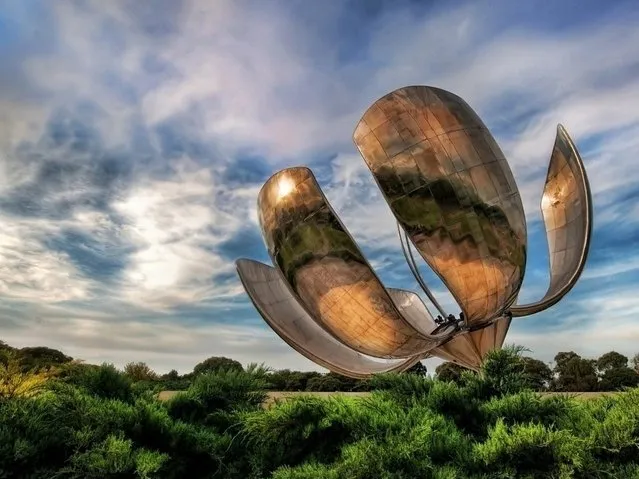
Floralis Generica - Buenos Aires

Floralis Genérica is a sculpture made of steel and aluminum located in Plaza de las Naciones Unidas, Avenida Figueroa Alcorta, Buenos Aires, a gift to the city by the Argentine architect Eduardo Catalano. Catalano once said that the flower "is a synthesis of all the flowers and is both a hope that is reborn every day to open." It was created in 2002. The sculpture moves closing its petals in the evening and opening them in the morning, although this mechanism is currently disabled. The sculpture is located in the center of a park of four acres of wooded boundaries, surrounded by paths that get closer and provide different perspectives of the monument, and placed above a reflecting pool, which apart from fulfilling its aesthetic function, protects it. It represents a large flower made of stainless steel with aluminum skeleton and reinforced concrete, which looks at the sky, extending to it its six petals. Weighs eighteen tons and is 23 meters high.
Details
20 Oct 2013 18:32:00
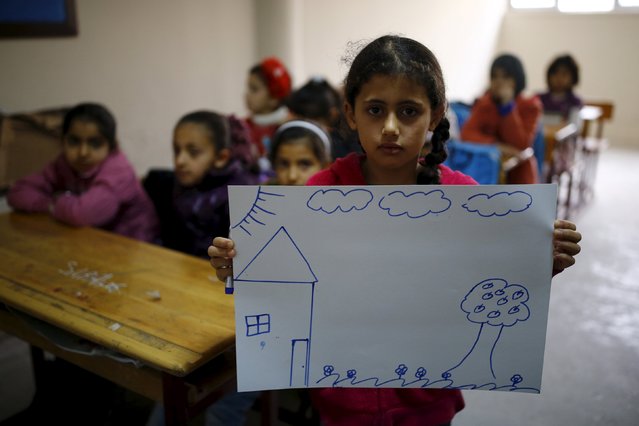
Syrian refugee girl Nur El-Huda, 9, shows a drawing of her home in Syria, in her classroom in Yayladagi refugee camp in Hatay province near the Turkish-Syrian border, Turkey, December 16, 2015. (Photo by Umit Bektas/Reuters)

Syrian refugee girl Nur El-Huda, 9, shows a drawing of her home in Syria, in her classroom in Yayladagi refugee camp in Hatay province near the Turkish-Syrian border, Turkey, December 16, 2015. Syria's conflict has left hundreds of thousands dead, pushed millions more into exile, and had a profound effect on children who lost their homes or got caught up in the bloodletting. The drawings of young refugees living in Turkey show their memories of home and hopes for its future. The pictures also point to the mental scars borne by 2.3 million Syrian refugees living in Turkey, more than half of them children. (Photo by Umit Bektas/Reuters)
Details
16 Jan 2016 08:05:00
This year's Republican National Convention and Democratic National Convention both saw passionate delegates in outrageous costumes – but that's where the similarities mostly end. Reuters photographer Jim Young gives a look at what it's like to be on the convention floor and talks to the delegates who make the conventions memorable. Here: George Engelbach, delegate from Missouri, Impersonator of former U.S. President Abraham Lincoln, poses for a photograph at the Republican National Convention in Cleveland, Ohio, United States July 20, 2016. Engelbach's message to the presidential nominee is: “I hope you will appoint all Conservative Supreme Court Justices”. (Photo by Jim Young/Reuters)

This year's Republican National Convention and Democratic National Convention both saw passionate delegates in outrageous costumes – but that's where the similarities mostly end. Reuters photographer Jim Young gives a look at what it's like to be on the convention floor and talks to the delegates who make the conventions memorable. (Photo by Jim Young/Reuters)
Details
29 Jul 2016 12:10:00
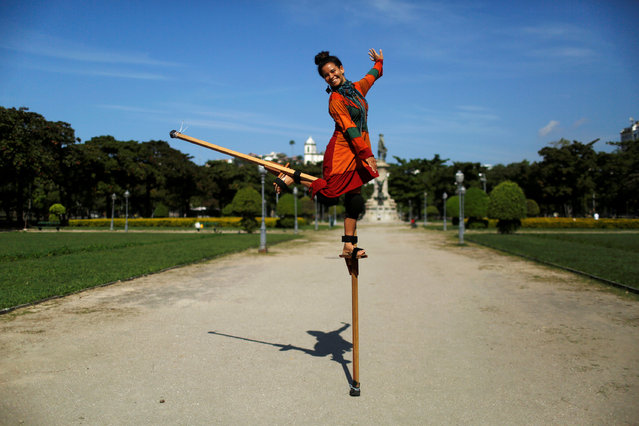
Raquel Poti, a 32-year-old street artist, poses at a park in Rio de Janeiro, Brazil, June 25, 2016. Raquel thinks the Olympics promotes a lifestyle that combines sports, culture and education. She is concerned about the large investment for the event while the population needs improvements in basic services. (Photo by Pilar Olivares/Reuters)

Just a week before Rio de Janeiro hosts South America's first Olympics, city residents expressed mixed feelings about the cost and security of the Games, while holding out hope they will bring joy to a nation facing economic and political crises. The conflicted thoughts mirror a recent survey by the Datafolha polling group showing that half of Brazilians were opposed to holding the Games, while 63 percent think the costs of hosting the event will outweigh benefits. (Photo by Pilar Olivares/Reuters)
Details
03 Aug 2016 11:51:00
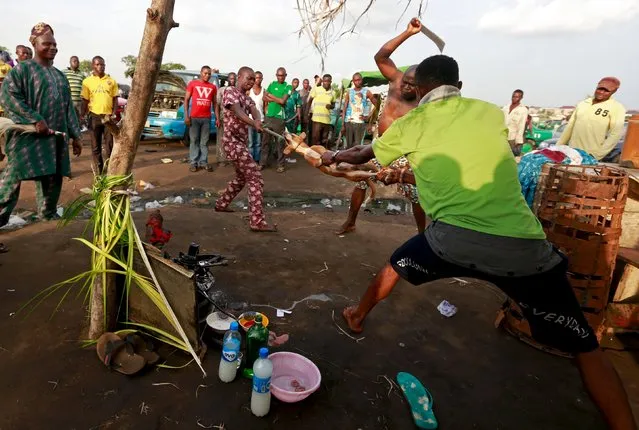
Chief priest Gbenga Saala raises a cutlass to kill a dog during an annual prayer and sacrifice celebration of the iron god Ogun in Abuja, Nigeria, June 23, 2015. (Photo by Afolabi Sotunde/Reuters)

Chief priest Gbenga Saala raises a cutlass to kill a dog during an annual prayer and sacrifice celebration of the iron god Ogun in Abuja, Nigeria, June 23, 2015. Every year worshippers offer a dog as sacrifice to Ogun, a traditional Nigerian deity, in hope of an auspicious year ahead. Taxi drivers, blacksmiths, panel beaters and mechanics – trades that depend on metal for their livelihood – pay homage to Ogun, led by high priest Gbenga Saala. As part of the ceremony, the priest pours the dog’s blood on symbols of these workers’ trade: keys, spanners and other tools piled up in a metal barrel. (Photo by Afolabi Sotunde/Reuters)
Details
15 Sep 2015 13:56:00
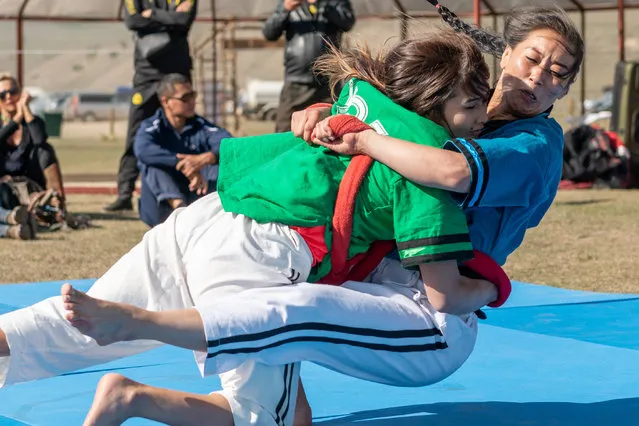
Meerim Momunova wrestles with her fellow Kyrgyz teammate Anara Ryskulova during a performance of a traditional style of wrestling called “Alysh”. Momunova is a champion in Asia and has been competing since 2015, after a background in judo. According to Momunova, one of the advantages of “Alysh” is the ease of the uniform for women – even Muslim women who cover their faces can compete. Momunova holds a degree in sports coaching and hopes to see more women come into this sport. (Photo by Eleanor Moseman/The Guardian)

This year’s World Nomad Games, a celebration of nomadic heritage, took place in the Issyk-Kul province of Kyrgyzstan. Eleanor Moseman photographed female competitors who had travelled from all over central Asia and eastern Europe, and explored the difficulties and challenges they face as competitors. (Photo by Eleanor Moseman/The Guardian)
Details
20 Sep 2018 00:05:00
Military Woman Part 3

'Military woman' is a constantly updated gallery of images of women wearing uniform: military, police and so on. We truly hope that our beloved visitors won't remain passive and will take part in this project making it even more interesting! Note that all the images featured in the gallery are taken from publically available sources: their copyright belongs to their respective creators and the trade mark to the owners. ...

See also:Part 1 _ Part 2
Details
11 Mar 2015 10:29:00
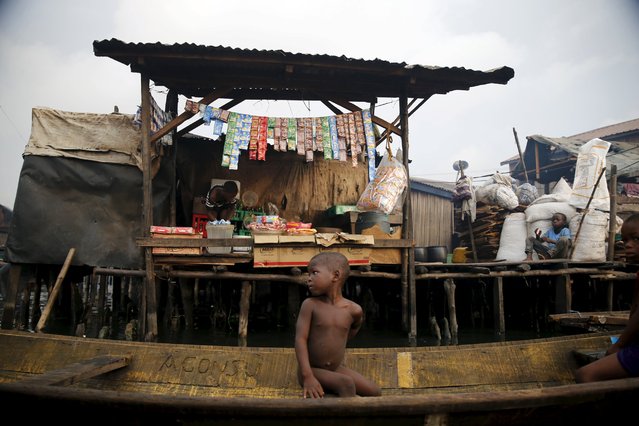
A boy sits in a canoe in front of a shed built on a raft in the Makoko fishing community on the Lagos Lagoon, Nigeria February 29, 2016. Makoko, a vast slum of houses on stilts in a Lagos lagoon, now boasts a new school – pyramid-shaped, floating and capable of withstanding the waterways' extreme weather, it is a beacon of hope for the nearly 100,000 Nigerians who live there.  (Photo by Akintunde Akinleye/Reuters)

A boy sits in a canoe in front of a shed built on a raft in the Makoko fishing community on the Lagos Lagoon, Nigeria February 29, 2016. In Makoko, a sprawling slum of Nigeria's megacity Lagos, a floating school capable of holding up to a hundred pupils has since November brought free education to the waterways known as the Venice of Lagos. It offers the chance of social mobility for youngsters who, like most of the city's 21 million inhabitants, lack a reliable electricity and water supply and whose water-based way of life is threatened by climate change as well as rapid urbanisation. (Photo by Akintunde Akinleye/Reuters)
Details
05 Mar 2016 12:01:00