Loading...
Done
Image of the Clouds taken in August 2014 by astronauts on board the International Space Station (ISS).  A year from space photographs of hurricanes, typhoons and meteorite craters show an astronauts-eye view of our planet from hundreds of miles above the earth. The illuminating images were taken by astronauts onboard the International Space Station (ISS) over the course of 2014. (Photo by NASA/SPL/Barcroft Media)

Image of the Clouds taken in August 2014 by astronauts on board the International Space Station (ISS). A year from space photographs of hurricanes, typhoons and meteorite craters show an astronauts-eye view of our planet from hundreds of miles above the earth. The illuminating images were taken by astronauts onboard the International Space Station (ISS) over the course of 2014. (Photo by NASA/SPL/Barcroft Media)
Details
31 Dec 2014 14:47:00
Dhofar Region, Oman. Much of Oman is desert, but the Arabian Sea coast in the Dhofar region represents a startling difference in climate. This coastal region catches the monsoon rains, or khareef, during the summer months. Drenching rains fall primarily on the mountainous ridge that separates the lush, fertile areas along the coast from the arid interior, recharging streams, waterfalls and springs that provide plentiful water supplies in the fertile lowlands for the remainder of the year. Image taken by Landsat 5 on April 2, 2005. (Photo by USGS/NASA)

Dhofar Region, Oman. Much of Oman is desert, but the Arabian Sea coast in the Dhofar region represents a startling difference in climate. This coastal region catches the monsoon rains, or khareef, during the summer months. Drenching rains fall primarily on the mountainous ridge that separates the lush, fertile areas along the coast from the arid interior, recharging streams, waterfalls and springs that provide plentiful water supplies in the fertile lowlands for the remainder of the year. Image taken by Landsat 5 on April 2, 2005. (Photo by USGS/NASA)
Details
25 Dec 2012 11:13:00
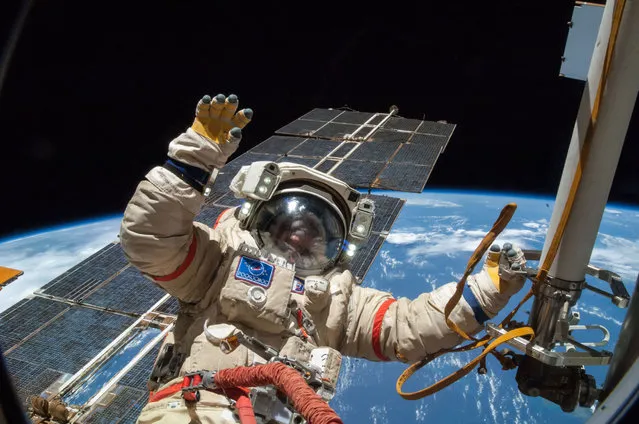
Russian cosmonaut Alexander Skvortsov, Expedition 40 flight engineer, attired in a Russian Orlan spacesuit, participates in a session of extravehicular activity (EVA) in support of science and maintenance on the International Space Station on August 18, 2014. During the five-hour, 11-minute spacewalk, Skvortsov and cosmonaut Oleg Artemyev (out of frame) deployed a small science satellite, retrieved and installed experiment packages and inspected components on the exterior of the orbital laboratory. (Photo by NASA)

Russian cosmonaut Alexander Skvortsov, Expedition 40 flight engineer, attired in a Russian Orlan spacesuit, participates in a session of extravehicular activity (EVA) in support of science and maintenance on the International Space Station on August 18, 2014. During the five-hour, 11-minute spacewalk, Skvortsov and cosmonaut Oleg Artemyev (out of frame) deployed a small science satellite, retrieved and installed experiment packages and inspected components on the exterior of the orbital laboratory. (Photo by NASA)
Details
13 Apr 2022 06:53:00
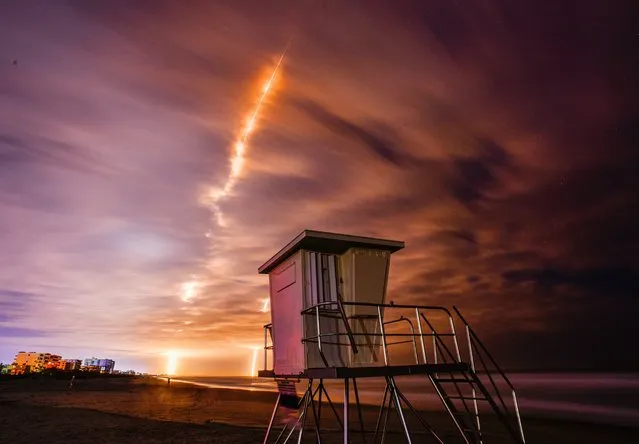
SpaceX and NASA Launch of the PACE spacecraft atop a Falcon 9 rocket from Launch Complex 40 at Cape Canaveral Space Force Station in Brevard County, Florida on February 8, 2024. Photo shows launch and booster landing back at CCSFS about 7 minutes 30 seconds after launch. In the foreground is one the new modular lifeguard stands at Minuteman Causeway, replacing the old wooden tower. (Photo by Malcolm Denemark/Florida Today via USA Today Network)

SpaceX and NASA Launch of the PACE spacecraft atop a Falcon 9 rocket from Launch Complex 40 at Cape Canaveral Space Force Station in Brevard County, Florida on February 8, 2024. Photo shows launch and booster landing back at CCSFS about 7 minutes 30 seconds after launch. In the foreground is one the new modular lifeguard stands at Minuteman Causeway, replacing the old wooden tower. (Photo by Malcolm Denemark/Florida Today via USA Today Network)
Details
19 Feb 2024 08:45:00
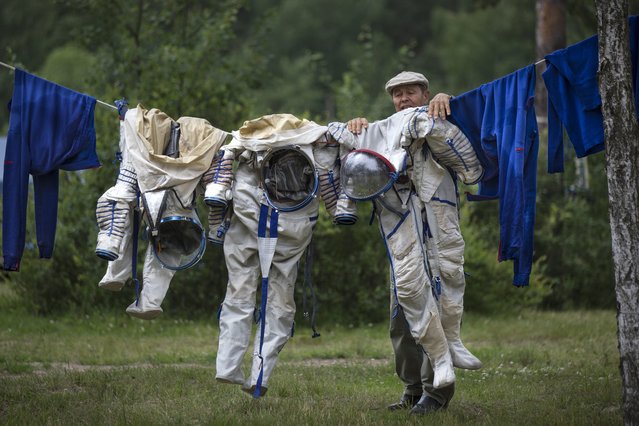
An employe of Russian Space Training Center hangs out to dry space suits of Russian cosmonaut Anatoly Ivanishin, NASA's U.S. flight engineer Kathleen Rubins, and Japanese space agency's flight engineer Takuya Onishi, right, after their undergoing  training near in Noginsk, 60 km (38 miles) east of Moscow, Russia, Wednesday, July 2, 2014. (Photo by Alexander Zemlianichenko/AP Photo)

An employe of Russian Space Training Center hangs out to dry space suits of Russian cosmonaut Anatoly Ivanishin, NASA's U.S. flight engineer Kathleen Rubins, and Japanese space agency's flight engineer Takuya Onishi, right, after their undergoing training near in Noginsk, 60 km (38 miles) east of Moscow, Russia, Wednesday, July 2, 2014. The training was intended to simulate the capsule landing on water. Russian cosmonaut Anatoly Ivanishin, Japanese space agency's flight engineer Takuya Onishi, and NASA's U.S. flight engineer Kathleen Rubins are being trained for a future mission to the International Space Station. (Photo by Alexander Zemlianichenko/AP Photo)
Details
05 Jul 2014 11:47:00
Employees cover bacon on fried dranik, a potato pancake that is the national dish of Belarus, in the Sula History Park near the village of Sula, Belarus March 7, 2016. (Photo by Vasily Fedosenko/Reuters)

Employees cover bacon on fried dranik, a potato pancake that is the national dish of Belarus, in the Sula History Park near the village of Sula, Belarus March 7, 2016. According to the park's representatives, the two-metre-wide pancake was an attempt to enter the Guinness World Records as the world's largest dranik. (Photo by Vasily Fedosenko/Reuters)
Details
08 Mar 2016 13:41:00
This photo provided by Netflix/naturepl.com and WWF-International shows an African Elephant (Loxodonta africana) in front of double rainbow, in Masai Mara, Kenya, included in the Netflix natural history series, “Our Planet”, in collaboration with Silverback Films and WWF. The eight-part series debuts in 2019. (Photo by Andy Rouse/Naturepl.com/WWF-International/Netflix via AP Photo)

This photo provided by Netflix/naturepl.com and WWF-International shows an African Elephant (Loxodonta africana) in front of double rainbow, in Masai Mara, Kenya, included in the Netflix natural history series, “Our Planet”, in collaboration with Silverback Films and WWF. The eight-part series debuts in 2019. (Photo by Andy Rouse/Naturepl/WWF-International/Netflix via AP Photo)
Details
09 Oct 2015 08:05:00
Women wearing braided straw hats dance as the Owara Kaze-no-Bon dance festival begins on September 1, 2025 in Toyama, Japan. The festival, believed to have more than 300 years history, continues till September 3. (Photo by The Asahi Shimbun via Getty Images)

Women wearing braided straw hats dance as the Owara Kaze-no-Bon dance festival begins on September 1, 2025 in Toyama, Japan. The festival, believed to have more than 300 years history, continues till September 3. (Photo by The Asahi Shimbun via Getty Images)
Details
20 Sep 2025 03:35:00