Loading...
Done
Gavin Worth's Steel Wire Sculptures

“I was born in Zimbabwe, Africa in 1981 and grew up in Las Cruces, New Mexico. I graduated with a degree in Acting, and after college, worked as an actor and musician for the Santa Fe Shakespeare Festival, the San Francisco Shakespeare Festival, and the California Shakespeare Theater. I have had a lifelong passion for drawing, painting, and sculpture since I first saw Michelangelo's “Head of Leda” in a book in the library”.

Gavin Worth
Details
09 Mar 2013 10:54:00
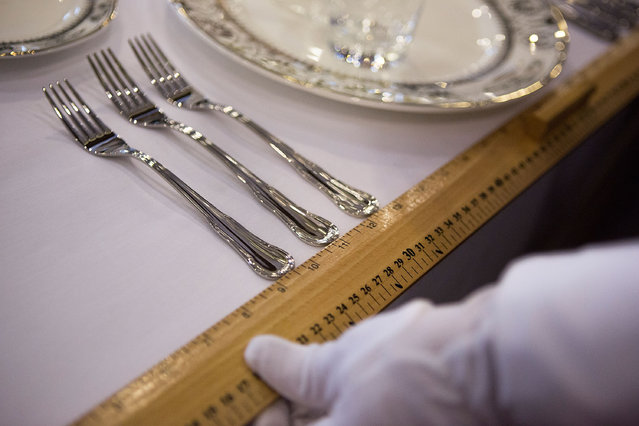
A student uses a ruler to measure the distance between forks before a formal dinner at The International Butler Academy China on September 16, 2014 in Chengdu, China. (Photo by Taylor Weidman/Getty Images)

A student uses a ruler to measure the distance between forks before a formal dinner at The International Butler Academy China on September 16, 2014 in Chengdu, China. Over the last several years, there has been a surge in demand among China's wealthy for Western-trained butlers, with many academies seeing large portions of their graduating classes hired by Chinese families or companies. (Photo by Taylor Weidman/Getty Images)
Details
18 Sep 2014 11:13:00
Auxiliary Territorial Service (ATS) plotters at work at Coastal Artillery Headquarters in Dover, December 1942. (Photo by Ted Dearberg/IWM/PA Wire)

Auxiliary Territorial Service (ATS) plotters at work at Coastal Artillery Headquarters in Dover, December 1942. The Auxiliary Territorial Service was the women's branch of the British Army during the Second World War. It was formed on 9 September 1938, initially as a women's voluntary service, and existed until 1 February 1949, when it was merged into the Women's Royal Army Corps. The ATS had its roots in the Women's Auxiliary Army Corps (WAAC), which was formed in 1917 as a voluntary service. During the First World War its members served in a number of jobs including clerks, cooks, telephonists and waitresses. The WAAC was disbanded after four years in 1921. (Photo by Ted Dearberg/IWM/PA Wire)
Details
13 Jul 2017 07:52:00
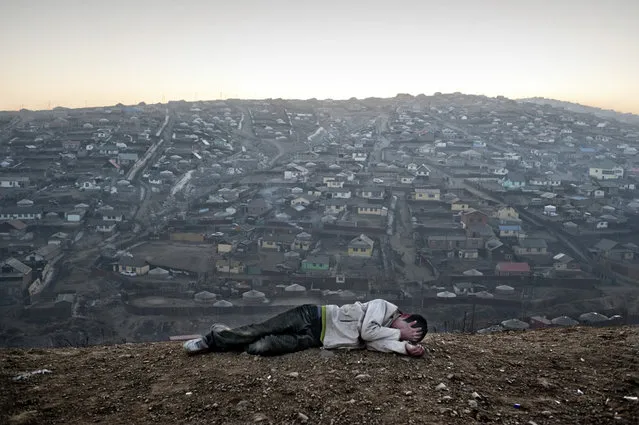
Asia, Mongolia, March 27, 2011. A view of Ulaan Baator over the shoulder of a slumbering drunk. Alcoholism is a huge problem in the city, home to almost half of Mongolia's people. The capital's population has doubled in the past two years, expanding outward in a haphazard sprawl, and many inhabitants live in slums known as the “Gher District”. (Photo by Alessandro Grassani)

“Environmental Migrants: The Last Illusion” by photographer Alessandro Grassani, documents the life of people in Kenya, Mongolia and Bangladesh who migrate to escape environmental stresses to the city of their own countries in hopes for a better life. Here: Asia, Mongolia, March 27, 2011. A view of Ulaan Baator over the shoulder of a slumbering drunk. Alcoholism is a huge problem in the city, home to almost half of Mongolia's people. The capital's population has doubled in the past two years. High levels of unemployment and poverty await herders who abandon rural areas and arrive in the city, illiterate and untrained in any skills necessary for urban jobs. (Photo by Alessandro Grassani)
Details
21 Jul 2015 10:10:00
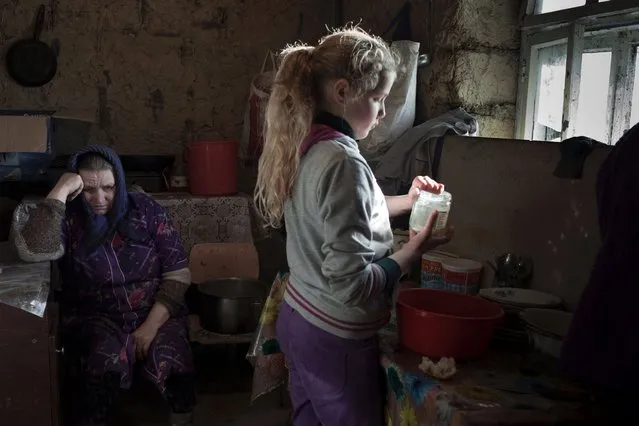
According to the U.S. government, Moldova, one of the poorest countries in Europe, depends on about $1.6 billion annually sent back from the roughly one million Moldovans who left for work in in Europe, Russia, and other former Soviet Bloc countries. Photographer Myriam Meloni went to Moldova to document what she refers to as “social orphans” – children whose parents have emigrated to another country in search of a job and a better future for their families. Here: Lulia is seen washing dishes in her grandmother's house, where she lives. (Photo by Myriam Meloni)

According to the U.S. government, Moldova, one of the poorest countries in Europe, depends on about $1.6 billion annually sent back from the roughly one million Moldovans who left for work in in Europe, Russia, and other former Soviet Bloc countries. Photographer Myriam Meloni went to Moldova to document what she refers to as “social orphans” – children whose parents have emigrated to another country in search of a job and a better future for their families. Here: Lulia is seen washing dishes in her grandmother's house, where she lives. (Photo by Myriam Meloni)
Details
12 Mar 2016 14:57:00
Vinyl Clock By Pavel Sidorenko Part 2

Pavel Sidorenko is an award winning Estonian designer who was born in 1980 in Tallinn and studied product design at Estonian Academy of Arts and Graduated in 2006. Not only does he incorporate pragmatic necessity, but also transmits an emotional qualities within the everyday environment. His fantastic collection of Re Vinyl designs are a result of upcycling a product fashioned from old vinyl records. Beautifully crafted and working with a range of themes from scenography to animal creatures, there is sure to be something for everyone with these stylish selection of recycled vinyl clocks!


See also: Part 1
Details
01 Mar 2014 11:09:00
A Flemish demonstrator, one of thousands who gathered for a march through Brussels to protest against what the Flemings call their subjucation by the French-speaking Walloons, draws back as he is jeered by a crowd of Walloons on the pavement in a Brussels Street, on October 14, 1962. The Flemish demonstrators clashed with Walloon counter demonstrators as riot police sought to maintain order. (Photo by AP Photo)

A Flemish demonstrator, one of thousands who gathered for a march through Brussels to protest against what the Flemings call their subjucation by the French-speaking Walloons, draws back as he is jeered by a crowd of Walloons on the pavement in a Brussels Street, on October 14, 1962. The Flemish demonstrators clashed with Walloon counter demonstrators as riot police sought to maintain order. The Flemings claim that although they form 60% of the population in Belgium, they are inadequately represented in the government, and they say, the Walloons get most of the top jobs in the armed forces and the diplomatic service. (Photo by AP Photo)
Details
16 Oct 2015 08:05:00
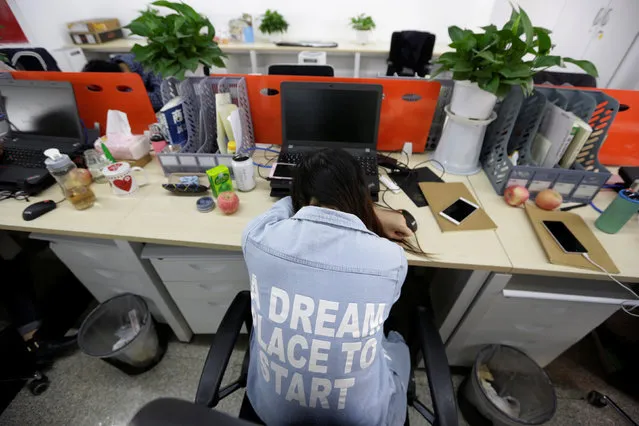
Yang Juan, an employee at Goopal Group, takes a nap in her seat after lunch, in Beijing, China, April 21, 2016. (Photo by Jason Lee/Reuters)

Yang Juan, an employee at Goopal Group, takes a nap in her seat after lunch, in Beijing, China, April 21, 2016. Office workers sleeping on the job is a common sight in China, where a surplus of cheap labour can lead to downtime at work. But in China's technology sector, where business is growing faster than many start-up firms can hire new staff, workers burn the midnight oil to meet deadlines and compete with their rivals. Some companies provide sleeping areas and beds for workers to rest during late nights. (Photo by Jason Lee/Reuters)
Details
12 May 2016 14:53:00