Waxworks artists retouch the wax figures at the unveiling of Little Mix waxwork figures at Madame Tussauds, in London, Britain, July 28, 2021. (Photo by Aaron Chown/PA Images via Getty Images)
Participants during the Whitby Krampus Run street parade in Whitby, Yorkshire on Saturday, December 3, 2022, which celebrates the Krampus, a horned creature which accompanies Saint Nicholas on his rounds. (Photo by Danny Lawson/PA Images/Profimedia)
Britain's Catherine, Duchess of Cambridge, shelters from the rain under an umbrella as she arrives at the London School of Economics to mark the launch of The Royal Foundation Centre for Early Childhood, where she took part in a roundtable discussion on the Centre's inaugural report, “Big Change Starts Small” which was released today, in London on June 18, 2021. (Photo by Richard Pohle/Pool via AFP Photo)
A kid casts his hand's shadow as kids play with light in “L'art dans la nature, Dali universe” an open air light show at Parc de la Villette in Paris, France on November 19, 2023. (Photo by Gonzalo Fuentes/Reuters)
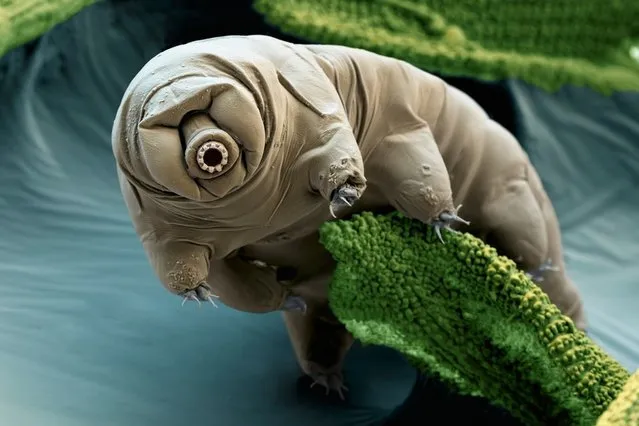
“Tardigrades (commonly known as waterbears or moss piglets) are small, water-dwelling, segmented animals with eight legs. Tardigrades were first discovered in 1773 by Johann August Ephraim Goeze, who called them kleiner Wasserbär, meaning “little water bear” in German. The name Tardigrada means “slow walker” and was given by Lazzaro Spallanzani in 1777. The name water bear comes from the way they walk, reminiscent of a bear's gait. The biggest adults may reach a body length of 1.5 millimetres (0.059 in), the smallest below 0.1 mm. Freshly hatched tardigrades may be smaller than 0.05 mm”. – Wikipedia. Photo: Tardigrades. (Photo by SPL/East News)
A boat sails behind a woman looking through binoculars as she sits on a cliff on a sunny day in Sydney, Australia, May 29, 2016. (Photo by David Gray/Reuters)