Loading...
Done
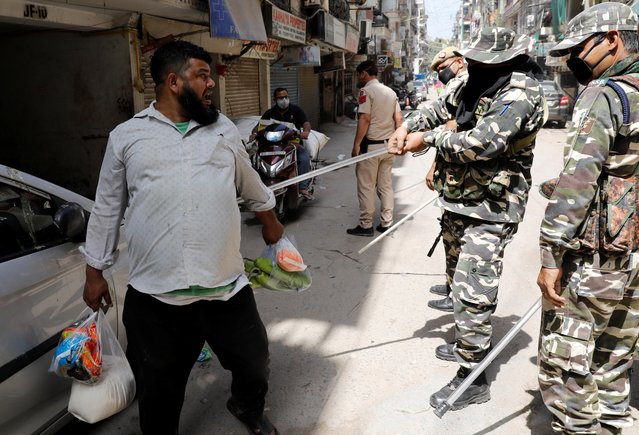
Police officers wield their batons against a man as a punishment for breaking the lockdown rules after India ordered a 21-day nationwide lockdown to limit the spread of coronavirus in New Delhi, India, March 25, 2020. (Photo by Adnan Abidi/Reuters)

Police officers wield their batons against a man as a punishment for breaking the lockdown rules after India ordered a 21-day nationwide lockdown to limit the spread of coronavirus in New Delhi, India, March 25, 2020. (Photo by Adnan Abidi/Reuters)
Details
05 Apr 2020 00:03:00
Roof-topping enthusiast Daniel Lau takes a selfie with high-rise buildings down below as he stands on the top of a skyscraper in Hong Kong, China on August 15, 2017. Welcome to “roof-topping”, where daredevils take pictures of themselves standing on the tops of tall buildings, or in some cases even dangling from them, without any safety equipment. A craze that began in Russia has now taken hold in Hong Kong, one of the world's most vertical cities, with dramatic results. “I'm an explorer”, said Daniel Lau, one of the three who climbed to the top of The Center. A student, he said roof-topping was “a getaway from my structured life”. “Before doing this, I lived like an ordinary person, having a boring life”, he said. “I wanted to do something special, something memorable. I want to let people see Hong Kong, the place they are living, from a new perspective”. Mr Lau said he had been inspired by Russian climbers and that he was unafraid of the vertiginous heights he scales. (Photo by ImagineChina/Rex Features/Shutterstock)

Roof-topping enthusiast Daniel Lau takes a selfie with high-rise buildings down below as he stands on the top of a skyscraper in Hong Kong, China on August 15, 2017. A craze that began in Russia has now taken hold in Hong Kong, one of the world's most vertical cities. Mr Lau said he had been inspired by Russian climbers and that he was unafraid of the vertiginous heights he scales. (Photo by ImagineChina/Rex Features/Shutterstock)
Details
16 Aug 2017 07:23:00
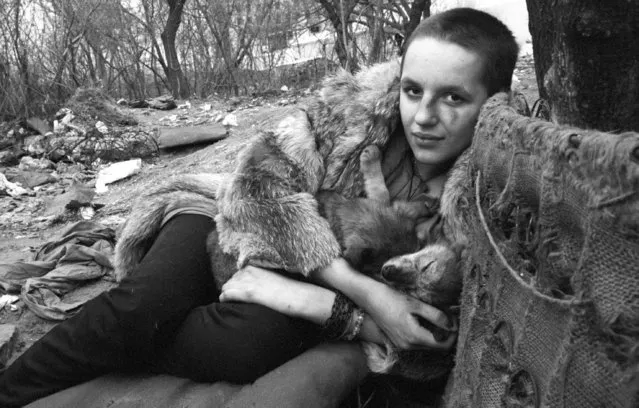
Suffering from a broken nose and bruised ribs Natasha Dzhuley, 16, relaxes after inhaling glue for the first time – something she swore she would never do, 2002. She was beaten by her pimps men in what Ruslana believes was a warning to other prostitutes to stay in line. Though another child believes her pimp had her beaten because she was pregnant. Less than a week after this picture of Natasha was taken she was dragged away by six men. She has not been heard or seen since. (Photo by Kurt Vinion /Getty Images)

Suffering from a broken nose and bruised ribs Natasha Dzhuley, 16, relaxes after inhaling glue for the first time – something she swore she would never do, 2002. She was beaten by her pimps men in what Ruslana believes was a warning to other prostitutes to stay in line. Though another child believes her pimp had her beaten because she was pregnant. Less than a week after this picture of Natasha was taken she was dragged away by six men. She has not been heard or seen since. (Photo by Kurt Vinion /Getty Images)
Details
18 Feb 2017 00:05:00
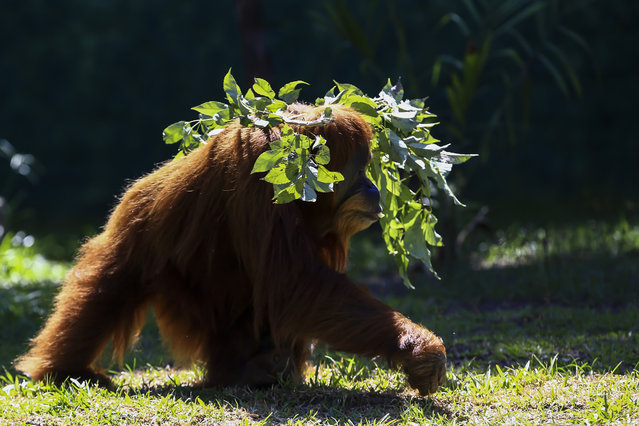
An Orangutan named Elze walks in the Biopark of Rio during a media tour in Rio de Janeiro, Brazil, Thursday, March 18, 2021. The park was closed to the public for renovations to convert the city zoo into a center for biodiversity conservation and will reopen to the general public at the end of March. (Photo by Bruna Prado/AP Photo)

An Orangutan named Elze walks in the Biopark of Rio during a media tour in Rio de Janeiro, Brazil, Thursday, March 18, 2021. The park was closed to the public for renovations to convert the city zoo into a center for biodiversity conservation and will reopen to the general public at the end of March. (Photo by Bruna Prado/AP Photo)
Details
28 Mar 2021 09:55:00
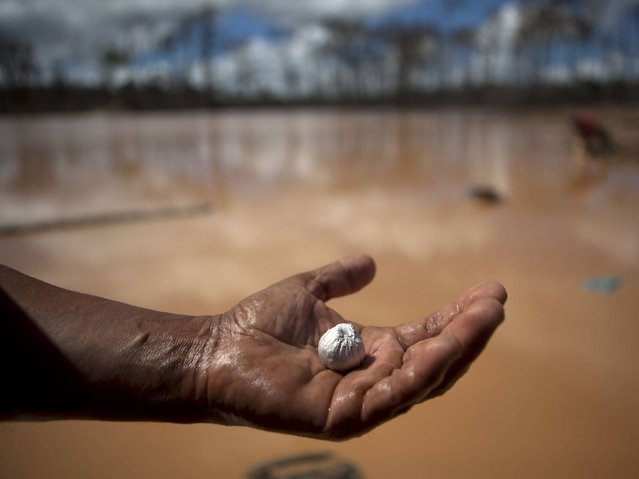
A miner holds an amalgam of mercury and gold he mined after working a 28-hour shift at an illegal gold mining process in La Pampa, in Peru's Madre de Dios region. (Photo by Rodrigo Abd/AP Photo)

In this May 4, 2014 photo, a miner holds an amalgam of mercury and gold he mined after working a 28-hour shift at an illegal gold mining process, in La Pampa, in Peru's Madre de Dios region. Thousands of artisanal gold miners sweat through the long shifts and endure, for a few grams of gold, the perils of collapsing earth, limb-crushing machinery and the toxic mercury used to bind gold flecks. (Photo by Rodrigo Abd/AP Photo)
Details
14 May 2014 10:05:00
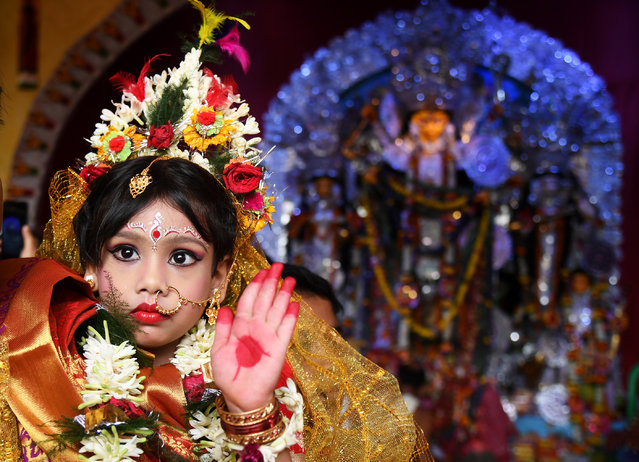
An Indian priest worships six-year-old Hindu girl Anushka Chetterjee (C) dressed as the Hindu goddess Durga at a “pandal” for the celebrations of the “Durga Puja” festival in Kolkata on September 28, 2017. The five-day Durga Puja festival, which commemorates the slaying of the demon king Mahishasur by the goddess Durga, marks the triumph of good over evil. (Photo by Dibyangshu Sarkar/AFP Photo)

An Indian priest worships six-year-old Hindu girl Anushka Chetterjee dressed as the Hindu goddess Durga at a “pandal” for the celebrations of the “Durga Puja” festival in Kolkata on September 28, 2017. The five-day Durga Puja festival, which commemorates the slaying of the demon king Mahishasur by the goddess Durga, marks the triumph of good over evil. (Photo by Dibyangshu Sarkar/AFP Photo)
Details
01 Oct 2017 06:52:00
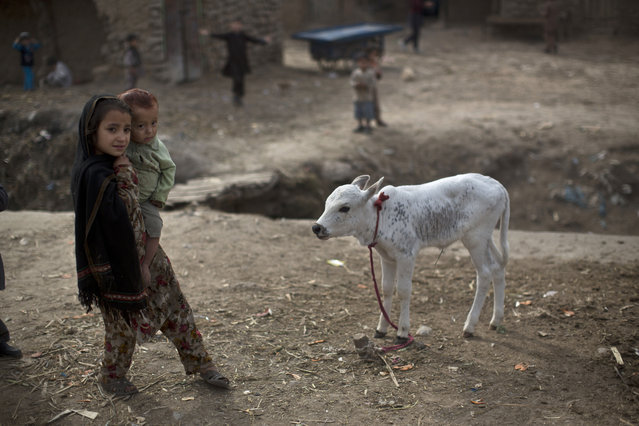
An Afghan refugee girl shows her younger brother a calf in a slum on the outskirts of Islamabad, Pakistan, Friday, February 6, 2015. (Photo by Muhammed Muheisen/AP Photo)

An Afghan refugee girl shows her younger brother a calf in a slum on the outskirts of Islamabad, Pakistan, Friday, February 6, 2015. (Photo by Muhammed Muheisen/AP Photo)
Details
12 Feb 2015 13:04:00
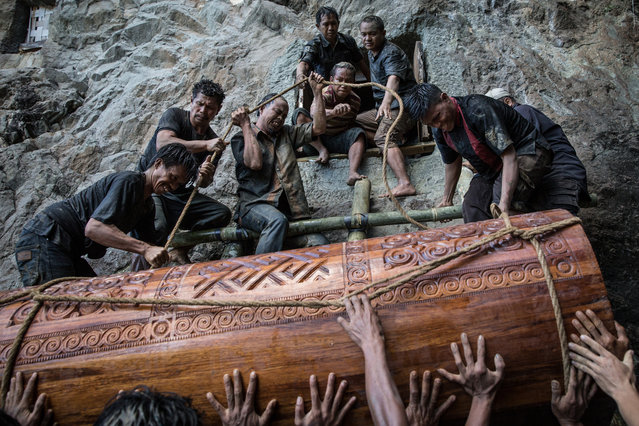
It is said that Torajans are people who “live to die”. For this Indonesian ethnic group, funerals are such extravagant events that they sometimes attract tourists. Families can postpone burials years (and the deceased are considered sick and hosted at home until the funeral) until the family can raise enough money and gather as many relatives as possible. And then it’s a jubilant multiday social event with a parade, dances and animal sacrifices. Agung Parameswara photographed these funerary practices when he traveled to South Sulawesi province, where the Torajans live. But often, their funeral isn’t the last time the dead are seen. In August, crypts are opened, coffins are slid back out and bodies delicately unsheathed. This tender ritual is known as Ma’Nene, which is customarily performed every few years. (Photo by Agung Parameswara/The Washington Post)

It is said that Torajans are people who “live to die”. For this Indonesian ethnic group, funerals are such extravagant events that they sometimes attract tourists. Families can postpone burials years (and the deceased are considered sick and hosted at home until the funeral) until the family can raise enough money and gather as many relatives as possible. And then it’s a jubilant multiday social event with a parade, dances and animal sacrifices. Agung Parameswara photographed these funerary practices when he traveled to South Sulawesi province, where the Torajans live. (Photo by Agung Parameswara/The Washington Post)
Details
06 Oct 2016 09:15:00