Loading...
Done
Dancing Cop Tony Lepore

“Tony Lepore (born October 17, 1947), aka the Dancing Cop, is a retired American police officer who has been entertaining on the streets of Providence, Rhode Island during the December holiday season by directing traffic using a dancing style since 1984”. – Wikipedia

Photo: Retired police officer Tony Lepore performs his dance routine while directing traffic December 14, 2004 in downtown Providence, Rhode Island. Lepore has been entertaining drivers and directing traffic at intersections around Providence for 20 years. He came upon the idea after seeing a “Candid Camera” clip of New York City police officers who flamboyantly directed traffic in the 1950's. (Photo by Darren McCollester/Getty Images)
Details
08 Aug 2011 11:06:00
A participant takes part in the Bristol Park and Slide project, an interactive temporary  installation by artist Luke Jerram set up in Park Street in the centre of Bristol, southwest England on May 4, 2014. Over 95,000 people applied for just 360 tickets to slide on inflatable lilos down a lubricated water slide in a town centre street. (Photo by Leon Neal/AFP Photo)

A participant takes part in the Bristol Park and Slide project, an interactive temporary installation by artist Luke Jerram set up in Park Street in the centre of Bristol, southwest England on May 4, 2014. Over 95,000 people applied for just 360 tickets to slide on inflatable lilos down a lubricated water slide in a town centre street. (Photo by Leon Neal/AFP Photo)
Details
07 May 2014 09:31:00
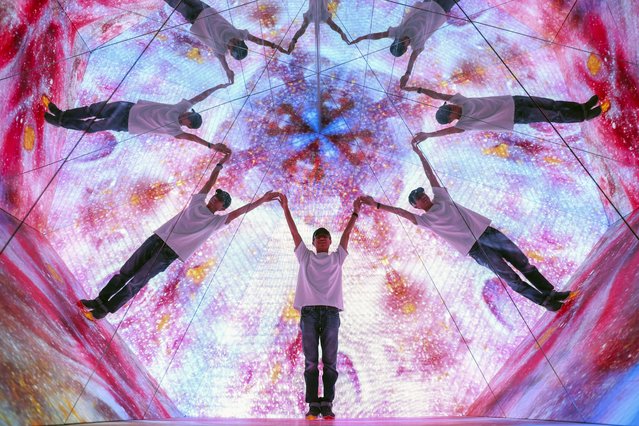
A man reacts inside the projection mapping and interactive installation known as “Illusion Road” at the multi-dimensional media art gallery Immersify KL in Kuala Lumpur, Malaysia, 04 March 2025. Immersify KL attracts visitors with interactive installations, high-definition visuals, and 3D spatial sound, creating breathtaking zones, including the country's first 360-degree, 12-meter-high projection space inside a 30,000-square-foot area with 11 sections of different immersive zones. (Photo by Fazry Ismail/EPA)

A man reacts inside the projection mapping and interactive installation known as “Illusion Road” at the multi-dimensional media art gallery Immersify KL in Kuala Lumpur, Malaysia, 04 March 2025. Immersify KL attracts visitors with interactive installations, high-definition visuals, and 3D spatial sound, creating breathtaking zones, including the country's first 360-degree, 12-meter-high projection space inside a 30,000-square-foot area with 11 sections of different immersive zones. (Photo by Fazry Ismail/EPA)
Details
03 Apr 2025 04:32:00
Customer Andreas Kroker looks at a 3D-printed figure of himself at the Twinkind 3D printing studio in Berlin, December 13, 2013. (Photo by Thomas Peter/Reuters)

Customer Andreas Kroker looks at a 3D-printed figure of himself at the Twinkind 3D printing studio in Berlin, December 13, 2013. A 3D-printed likeness is produced by taking a 360 degree photographic scan of a person, which is then rendered into a 3D digital model and retouched to meet the requirements for printing. The printing machine uses this digital model to produce a high-resolution solid figure. Twinkind co-founder Timo Schaedel said, people often come to the session well-groomed, with fresh hair-cuts and their best clothes, “just as they used to do in the past, when they had their portrait taken in a photo studio”. (Photo by Thomas Peter/Reuters)
Details
17 Jul 2014 11:22:00
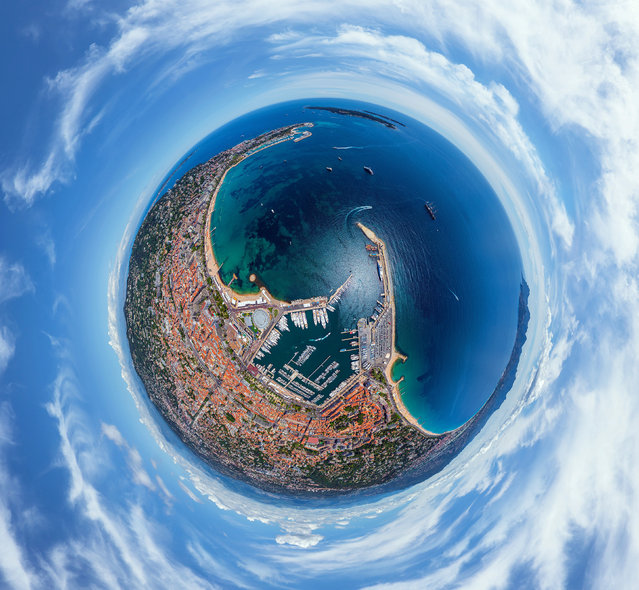
The French Riveria of Cannes, France. (Photo by Airpano/Caters News)

Some of the worlds most iconic cities have been photographed as youve never seen them before in the shape of tiny round planets. By using a pioneering method of aerial photography, each location can be now seen at a full 360 degree angle. After some skilful manipulation on Photoshop known technically as stereographic projection, each sweeping panorama is then turned into a small circular shaped image. Whether its the Eiffel Tower, The Empire State Building or the Shanghai Skyline, each image manages to show hundreds of miles of city landscape. Here: the French Riveria of Cannes, France. (Photo by Airpano/Caters News)
Details
25 Mar 2015 12:14:00
Pineapple

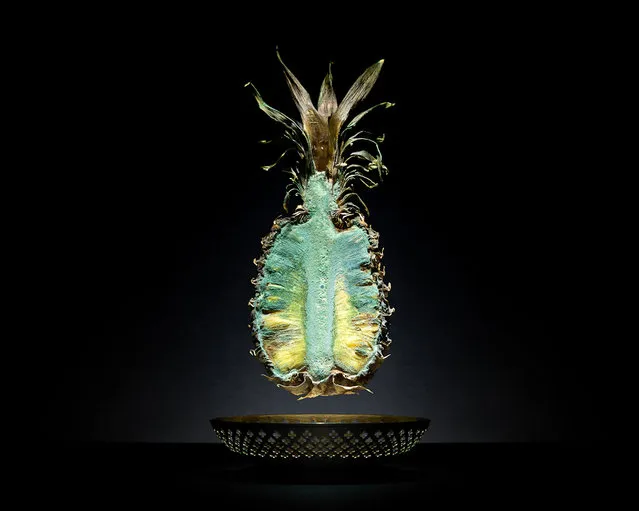
“One Third” – a project on food waste by an Austrian photography Klaus Pichler. According to a UN study one third of the world's food goes to waste – the largest part thereof in the industrialized nations of the global north. Equally, 925 million people around the world are threatened by starvation. The series “One Third” describes the connection between individual wastage of food and globalized food production.

Photo: Pineapple. Place of production: Guayaquil, Ecuador. Cultivation method: Outdoor plantation • Time of harvest: All- season. Transporting distance: 10.666 km (linear distance) • Means of transportation: Aircraft, truck. Carbon footprint (total) per kg: 11,94 kg • Water requirement (total) per kg: 360 l. Price: 2,10 € / kg. (Photo by Klaus Picher)
Details
02 May 2012 11:01:00
These are the explosive images of some of the world's most ASH-stonishing volcanic eruptions. Spectacular snaps capture lava spewing down the side of Kilauea, ash spitting from craters and plumes of smoke rising thousands of feet in the air. Here: Volcano Plosky Tolbachik, Kamchatcka, Russia. (Photo by Airpano/Caters News)

These are the explosive images of some of the world's most ASH-stonishing volcanic eruptions. Spectacular snaps capture lava spewing down the side of Kilauea, ash spitting from craters and plumes of smoke rising thousands of feet in the air. Russian non-profit AirPano travel the globe taking the breath-taking panoramic images, compiled in this series displaying their most stunning volcanic shoots. Included in the set – which spans four continents – are images from across the United States, Iceland, Russia, Ethiopia and Indonesia. To capture the 360-degree images, AirPano photographers spend around two hours in a helicopter, sending out drones to capture the action below. Here: Volcano Plosky Tolbachik, Kamchatcka, Russia. (Photo by Airpano/Caters News)
Details
15 Jul 2015 10:36:00
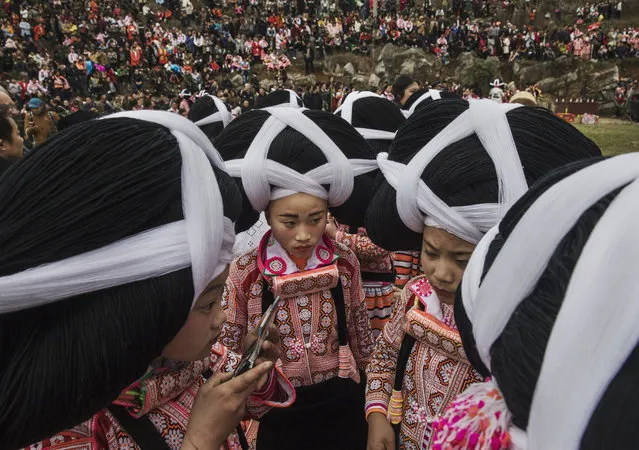
Girls of the Long Horn Miao ethnic minority group wear headdresses as they prepare gather for Tiaohua or Flower Festival as part of the Lunar New Year on February 6, 2017 in Longga village, Guizhou province, southern China. The Long Horn Miao are recognized for their declining practice of wrapping a blend of linen, wool, and the hair of their ancestors around animal horns or a wooden clip to make headdresses. Many young women say they now wear the headdresses only for special occasions and festivals, as the ornaments, which are attached by the horns to their real hair, have proved impractical for modern daily life in a fast changing world. China officially recognizes 56 different ethnic minorities, and statistics show over 7 million Chinese identifying themselves as Miao. But the small Long Horn Miao community counts only around 5000 people living in 12 villages, whose age-old traditions, language, and culture are fading. It is increasingly difficult in a modernizing China, as young people are drawn from remote rural villages to opportunities in bigger cities amongst wide-scale urbanization. Farming and labour remain the mainstays of life for the Long Horn Miao, leaving the area relatively poor in comparison with many parts of China. The government has invested significant amounts into local infrastructure and the tourism industry to try to bolster the local economy. (Photo by Kevin Frayer/Getty Images)

Girls of the Long Horn Miao ethnic minority group wear headdresses as they prepare gather for Tiaohua or Flower Festival as part of the Lunar New Year on February 6, 2017 in Longga village, Guizhou province, southern China. (Photo by Kevin Frayer/Getty Images)
Details
13 Feb 2017 00:01:00