Loading...
Done


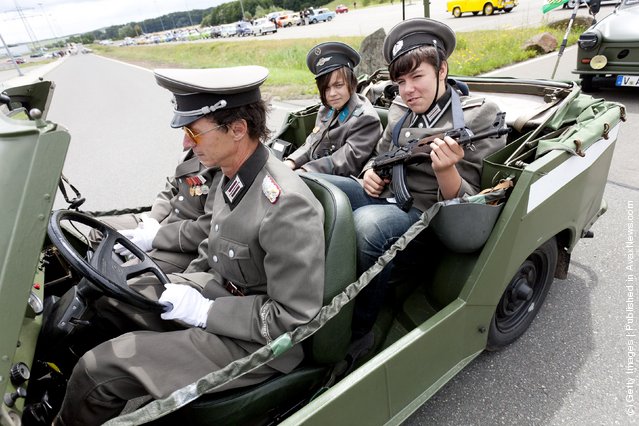
“The Trabant is a car that was produced by former East German auto maker VEB Sachsenring Automobilwerke Zwickau in Zwickau, Sachsen. It was the most common vehicle in East Germany, and was also exported to countries both inside and outside the communist bloc. The main selling points was that it had room for four adults and luggage in a compact, light and durable shell and that it was fast (when introduced) and durable. With its mediocre performance, smoky two-stroke engine, and production shortages, the Trabant is often cited as an example of the disadvantages of centralized planning; on the other hand, it is regarded with derisive affection as a symbol of the failed former East Germany and of the fall of communism (in former West Germany, as many East Germans streamed into West Berlin and West Germany in their Trabants after the opening of the Berlin Wall in 1989). It was in production without any significant changes for nearly 30 years with 3,096,099 Trabants produced in total”. – Wikipedia

Photo: Enthusiasts weared in uniforms of the former eastern german army trive in a military Trabant car as fans and owners of East German-era Trabant cars gather at the 2011 International Trabantfahrer Treffen (International Trabant Drivers Meeting) on June 26, 2011 in Zwickau, Germany. The Trabant, also known as the Trabi, was among the main cars produced in communist East Germany and built by VEB Sachsenring Automobilwerke in Zwickau for 30 years until 1989. Today the car has cult status for many followers and one company, IndiKar, is even seeking to revive the brand in a modern, electric version. (Photo by Carsten Koall/Getty Images)
Details
27 Jun 2011 12:21:00
Roof-topping enthusiast Daniel Lau takes a selfie with high-rise buildings down below as he stands on the top of a skyscraper in Hong Kong, China on August 15, 2017. Welcome to “roof-topping”, where daredevils take pictures of themselves standing on the tops of tall buildings, or in some cases even dangling from them, without any safety equipment. A craze that began in Russia has now taken hold in Hong Kong, one of the world's most vertical cities, with dramatic results. “I'm an explorer”, said Daniel Lau, one of the three who climbed to the top of The Center. A student, he said roof-topping was “a getaway from my structured life”. “Before doing this, I lived like an ordinary person, having a boring life”, he said. “I wanted to do something special, something memorable. I want to let people see Hong Kong, the place they are living, from a new perspective”. Mr Lau said he had been inspired by Russian climbers and that he was unafraid of the vertiginous heights he scales. (Photo by ImagineChina/Rex Features/Shutterstock)

Roof-topping enthusiast Daniel Lau takes a selfie with high-rise buildings down below as he stands on the top of a skyscraper in Hong Kong, China on August 15, 2017. A craze that began in Russia has now taken hold in Hong Kong, one of the world's most vertical cities. Mr Lau said he had been inspired by Russian climbers and that he was unafraid of the vertiginous heights he scales. (Photo by ImagineChina/Rex Features/Shutterstock)
Details
16 Aug 2017 07:23:00
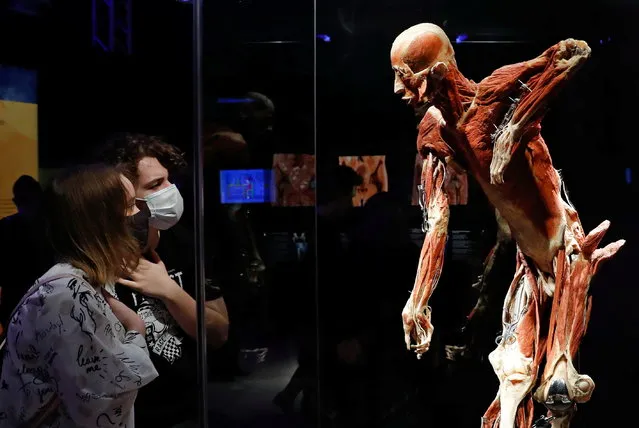
Visitors look at a plastinated human body during the “Body Worlds” exhibition by German anatomist Gunther von Hagens at a pavilion of the Exhibition of Achievements of National Economy (VDNKh) in Moscow, Russia on March 24, 2021. Head of Russian Investigative Committee Alexander Bastrykin ordered a probe of the exhibition after it sparked outrage among conservative religious groups and public figure. (Photo by Evgenia Novozhenina/Reuters)

Visitors look at a plastinated human body during the “Body Worlds” exhibition by German anatomist Gunther von Hagens at a pavilion of the Exhibition of Achievements of National Economy (VDNKh) in Moscow, Russia on March 24, 2021. Head of Russian Investigative Committee Alexander Bastrykin ordered a probe of the exhibition after it sparked outrage among conservative religious groups and public figure. (Photo by Evgenia Novozhenina/Reuters)
Details
25 Mar 2021 09:38:00
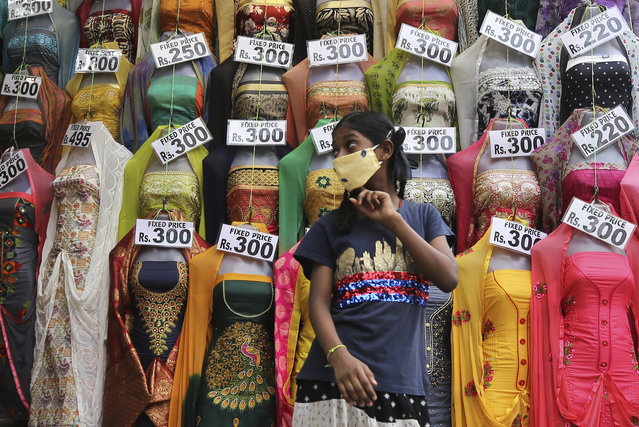
A girl wearing a face mask as a precaution against the coronavirus walks past a display of garments at a market in Bengaluru, India, Saturday, January 9, 2021. India will kick off the coronavirus vaccination drive on Jan. 16 to stem the pandemic in the world's second-most populous country. A Health Ministry statement says that priority will be given to the healthcare workers and the frontline workers, estimated around 30 million. (Photo by Aijaz Rahi/AP Photo)

A girl wearing a face mask as a precaution against the coronavirus walks past a display of garments at a market in Bengaluru, India, Saturday, January 9, 2021. India will kick off the coronavirus vaccination drive on Jan. 16 to stem the pandemic in the world's second-most populous country. A Health Ministry statement says that priority will be given to the healthcare workers and the frontline workers, estimated around 30 million. (Photo by Aijaz Rahi/AP Photo)
Details
19 Jan 2021 00:05:00
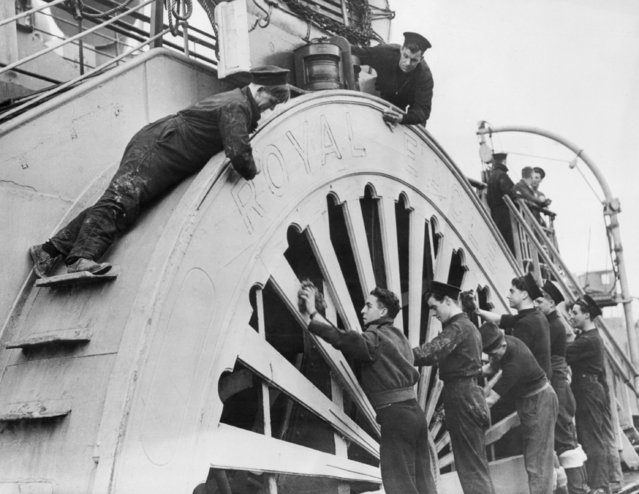
One of the largest paddle steamers afloat in Britain is the H.M.S. Royal Eagle, former peacetime excursion boat which carried passengers on pleasure jaunts from Tower Bridge to Southend, Ramscate and Margate. Commissioned two years ago as a warship of the Royal Navy, the craft has been in action 52 times against enemy aircraft. The Eagle took part in the evacuation from Dunkirk where she was dive-bombed 48 times and brought home nearly 3,000 British troops. Members of the crew cleaning the paddle boxes of H.M.S. Royal Eagle in London on January 18, 1943. (Photo by AP Photo)

One of the largest paddle steamers afloat in Britain is the H.M.S. Royal Eagle, former peacetime excursion boat which carried passengers on pleasure jaunts from Tower Bridge to Southend, Ramscate and Margate. Commissioned two years ago as a warship of the Royal Navy, the craft has been in action 52 times against enemy aircraft. The Eagle took part in the evacuation from Dunkirk where she was dive-bombed 48 times and brought home nearly 3,000 British troops. Members of the crew cleaning the paddle boxes of H.M.S. Royal Eagle in London on January 18, 1943. (Photo by AP Photo)
Details
21 Apr 2018 00:05:00
A child dressed as Hindu god Krishna watches a mobile phone as a woman gives finishing touches to his costume on the occasion of “Janmashtami” festival marking the birth of Krishna in Ajmer on August 30, 2021. (Photo by Himanshu Sharma/AFP Photo)

A child dressed as Hindu god Krishna watches a mobile phone as a woman gives finishing touches to his costume on the occasion of “Janmashtami” festival marking the birth of Krishna in Ajmer on August 30, 2021. (Photo by Himanshu Sharma/AFP Photo)
Details
07 Sep 2021 08:31:00
A woman cools off after taking a traditional steam bath (banya) at Sergei Benke's homestead in the village of Bobrovka, Tarsky District in Omsk Region, Russia on December 11, 2020. (Photo by Sergei Malgavko/TASS)

A woman cools off after taking a traditional steam bath (banya) at Sergei Benke's homestead in the village of Bobrovka, Tarsky District in Omsk Region, Russia on December 11, 2020. (Photo by Sergei Malgavko/TASS)
Details
23 Dec 2020 00:05:00


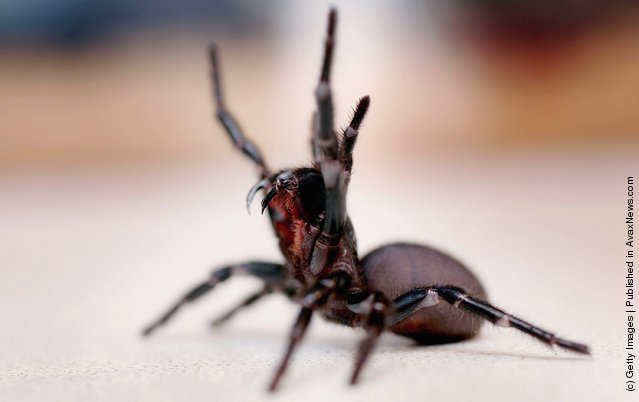
A Funnel Web spider is pictured at the Australian Reptile Park January 23, 2006 in Sydney, Australia. The Funnel Web is one of Australia's deadliest animals, with a venom that is packed with at least 40 different toxic proteins. A bite from a Funnel Web causes massive electrical over-load in the body's nervous system. Finally, fatalities occur from either heart attack or a pulmonary oedema, where the capillaries around the lungs begin to leak fluid and the patient effectively drowns. Death can come as quickly as two hours after a bite if no medical treatment is sought. Due to advances in anti-venom, there has been no death from a Funnel Web bite in Australia since 1980. Australia is home to some of the most deadly and poisonous animals on earth. (Photo by Ian Waldie/Getty Images)
Details
25 Apr 2011 07:49:00