Loading...
Done
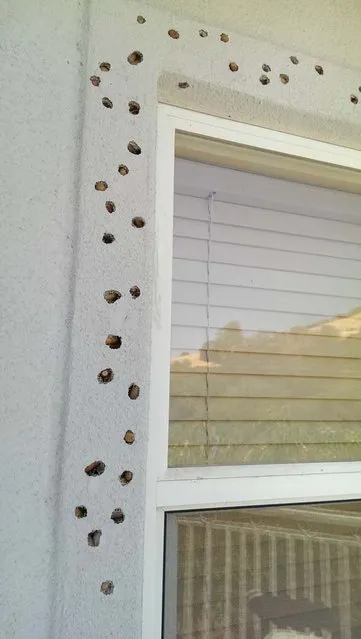
House After The Attack Of Woodpeckers

One morning, this Redditor woke up to his front porch completely riddled with holes. It looked like some gang members spewed buckshot at his doorstep during a drive-by. These holes were made by acorn woodpeckers. The little birds created their own granaries or “acorn trees” to store their food. They do so by drilling holes into whatever they can, sometimes resulting in this kind of damage.
Details
15 Jun 2014 11:33:00
These incredible pictures look like a bird's-eye view of a faraway alien planet – but they're actually hot springs. The amazing snaps are up-close shots of Iceland's hot springs, and the point-blank pictures produce a breathtaking array of colors and effects. Here: The amazing snaps are up-close shots of Icelandic hot springs. (Photo by Johann Vilhjalmsson/Caters News)

These incredible pictures look like a bird's-eye view of a faraway alien planet – but they're actually hot springs. The amazing snaps are up-close shots of Iceland's hot springs, and the point-blank pictures produce a breathtaking array of colors and effects. Here: The amazing snaps are up-close shots of Icelandic hot springs. (Photo by Johann Vilhjalmsson/Caters News)
Details
18 Jan 2016 08:04:00
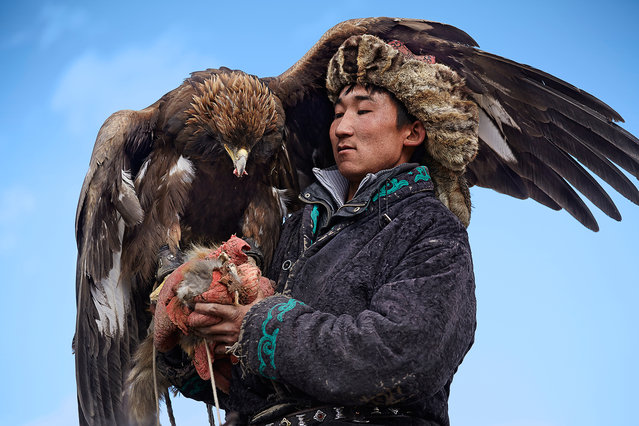
In one of the planet’s most desolate and harsh terrains, the Altai Mountains which run from Siberia in Russia down to Mongolia’s Gobi Desert, hunting with eagles is currently only practiced by a handful of Kyrgyz and Kazakhs. This form of falconry, the practice of hunting with the aid of birds of prey, can be traced back as far as 4,000 years in Central Asia. (Photo by Tariq Zaidi/The Washington Post)

In one of the planet’s most desolate and harsh terrains, the Altai Mountains which run from Siberia in Russia down to Mongolia’s Gobi Desert, hunting with eagles is currently only practiced by a handful of Kyrgyz and Kazakhs. This form of falconry, the practice of hunting with the aid of birds of prey, can be traced back as far as 4,000 years in Central Asia. Here: after a successful hunt, a proud hunter rewards his eagle by feeding it the lungs of the prey, which is considered the most highly prized part of the animal. (Photo by Tariq Zaidi/The Washington Post)
Details
22 Aug 2015 12:46:00
Omar Gamal, a 28-year-old pigeon keeper, stands next to his pigeon coop on his rooftop in the Egyptian capital's twin city of Giza on February 21, 2021, with the Pyramids of (R to L) Khufu (Cheops), Khafre (Chephren), and Menkaure (Menkheres) in the background. An ancient tradition handed down through the generations, the practice of domesticating pigeons stretches across borders from the banks of the Nile to north Africa and beyond, with people not only training birds for competitions, but also serving them up as a dining delicacy. (Photo by Khaled Desouki/AFP Photo)

Omar Gamal, a 28-year-old pigeon keeper, stands next to his pigeon coop on his rooftop in the Egyptian capital's twin city of Giza on February 21, 2021, with the Pyramids of (R to L) Khufu (Cheops), Khafre (Chephren), and Menkaure (Menkheres) in the background. An ancient tradition handed down through the generations, the practice of domesticating pigeons stretches across borders from the banks of the Nile to north Africa and beyond, with people not only training birds for competitions, but also serving them up as a dining delicacy. (Photo by Khaled Desouki/AFP Photo)
Details
27 Mar 2021 09:11:00
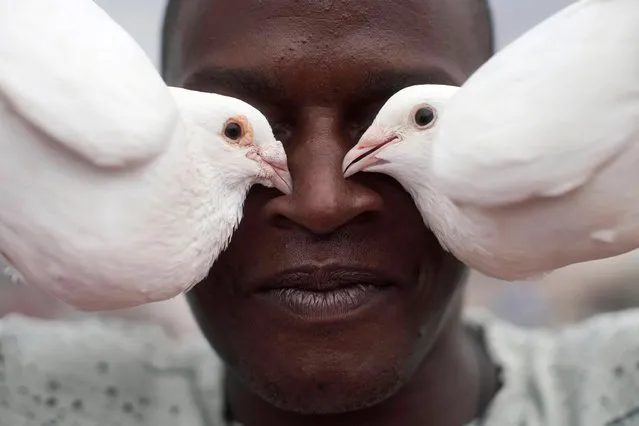
Pigeon fancier Yonisbel Santana poses for a photo at his rooftop in Havana, Cuba, May 18, 2021. Havana's pigeon keepers crane out of a window, intently watching the grey birds take flight. Mostly staying indoors due to the country's worst outbreak of COVID-19 since the coronavirus pandemic began in March last year, Cubans are increasingly breeding pigeons as a form of escape. (Photo by Alexandre Meneghini/Reuters)

Pigeon fancier Yonisbel Santana poses for a photo at his rooftop in Havana, Cuba, May 18, 2021. Havana's pigeon keepers crane out of a window, intently watching the grey birds take flight. Mostly staying indoors due to the country's worst outbreak of COVID-19 since the coronavirus pandemic began in March last year, Cubans are increasingly breeding pigeons as a form of escape. (Photo by Alexandre Meneghini/Reuters)
Details
13 Jul 2021 11:09:00
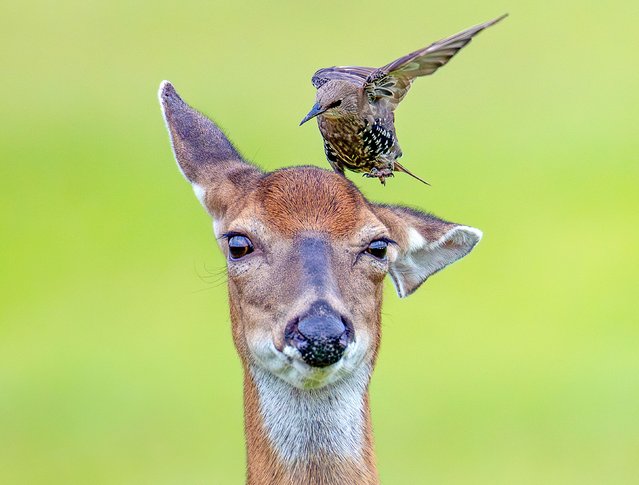
A juvenile European starling hops from deer to deer eating insects. The white-tailed deer did not seem at all bothered by the bird - who can be seen cleaning it of ticks and bugs. The starling was one of a flock near the herd of deer in Sandy Hook, New Jersey, USA in the last decade of November 2025. (Photo by Erik Kessler/Solent News & Photo Agency)

A juvenile European starling hops from deer to deer eating insects. The white-tailed deer did not seem at all bothered by the bird - who can be seen cleaning it of ticks and bugs. The starling was one of a flock near the herd of deer in Sandy Hook, New Jersey, USA in the last decade of November 2025. (Photo by Erik Kessler/Solent News & Photo Agency)
Details
14 Dec 2025 07:17:00
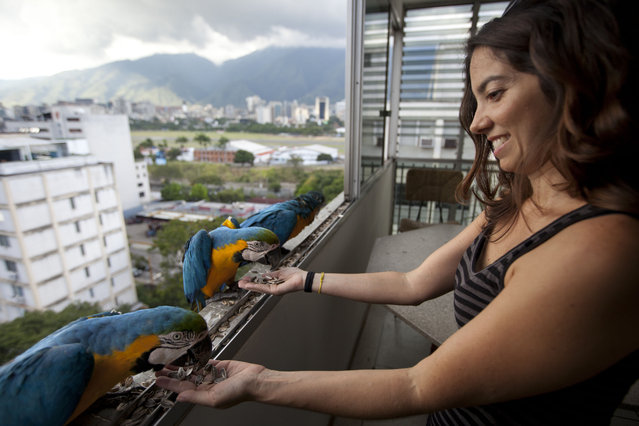
Vanessa Silva, 38, feeds macaws that fly to her apartment window every day looking for food, in Caracas, Venezuela. A group of gold-and-royal blue birds poked their heads through Silva’s window, as if saying “I’m here, is anyone home?” “I’d seen them flying when I was down on the street, and I thought ‘Oh how pretty,’” the 38-year-old said, a macaw eating out of her hand. (Photo by Ariana Cubillos/AP Photo)

Vanessa Silva, 38, feeds macaws that fly to her apartment window every day looking for food, in Caracas, Venezuela, on November 24, 2014. A group of gold-and-royal blue birds poked their heads through Silva’s window, as if saying “I’m here, is anyone home?” “I’d seen them flying when I was down on the street, and I thought ‘Oh how pretty,’” the 38-year-old said, a macaw eating out of her hand. (Photo by Ariana Cubillos/AP Photo)
Details
27 Nov 2014 15:27:00
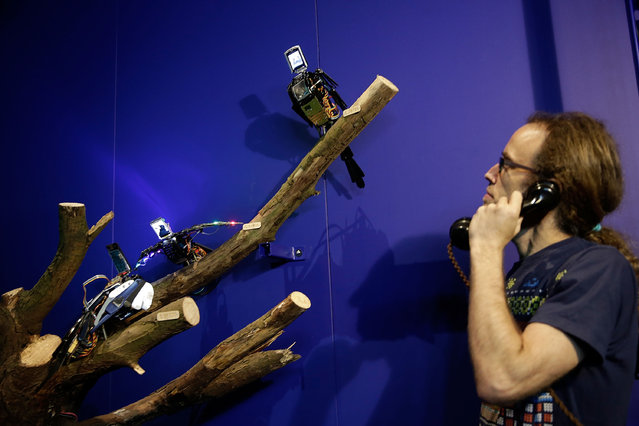
Unwanted phones recreated as interactive birds, part of "Escape III" by Anthony Goh and Neil Mendoza seen on display at the Barbican's Digital Revolution exhibition on July 2, 2014 in London, England. The exhibition brings together artists, designers, film makers, musicians and architects who push the boundaries of creativity that digitial technology can offer, and runs from July 3 until September 14, 2014.  (Photo by Matthew Lloyd/Getty Images for Barbican Art Gallery)

Unwanted phones recreated as interactive birds, part of “Escape III” by Anthony Goh and Neil Mendoza seen on display at the Barbican's Digital Revolution exhibition on July 2, 2014 in London, England. The exhibition brings together artists, designers, film makers, musicians and architects who push the boundaries of creativity that digitial technology can offer, and runs from July 3 until September 14, 2014. (Photo by Matthew Lloyd/Getty Images for Barbican Art Gallery)
Details
04 Jul 2014 10:18:00