Loading...
Done
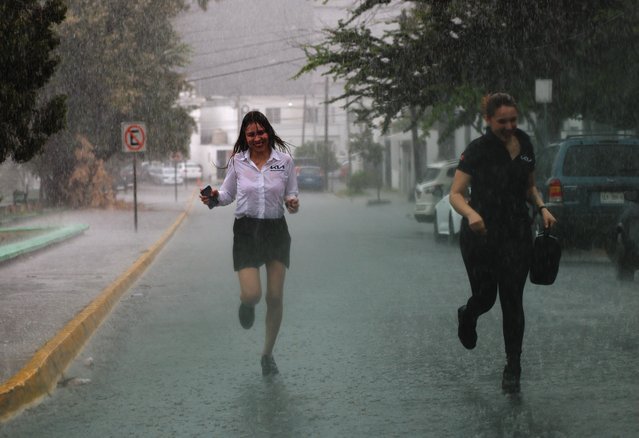
People run along a street as rain caused by tropical storm Alberto, the first named storm of 2024 Atlantic hurricane season, falls, in Monterrey, Mexico. on June 19, 2024. (Photo by Daniel Becerril/Reuters)

People run along a street as rain caused by tropical storm Alberto, the first named storm of 2024 Atlantic hurricane season, falls, in Monterrey, Mexico. on June 19, 2024. (Photo by Daniel Becerril/Reuters)
Details
04 Jul 2024 04:02:00
Sea lions make dinner plans in the Gulf of California early July 2024. The gulf is a primary source of sardines and anchovies, two of Mexico’s top marine resources. (Photo by Glenn Ostle/Solent News)

Sea lions make dinner plans in the Gulf of California early July 2024. The gulf is a primary source of sardines and anchovies, two of Mexico’s top marine resources. (Photo by Glenn Ostle/Solent News)
Details
04 Oct 2024 04:04:00
Dozens of hot air balloons fill the sky on the second day of the 2024 International Balloon Festival (FIG) in Leon, Mexico, 16 November 2024. (Photo by Luis Ramirez/EPA)

Dozens of hot air balloons fill the sky on the second day of the 2024 International Balloon Festival (FIG) in Leon, Mexico, 16 November 2024. (Photo by Luis Ramirez/EPA)
Details
14 Dec 2024 04:06:00
A hot-air balloon flies over Metropolitan Park during the International Hot-Air Balloon Festival in Leon, state of Guanajuato, Mexico, on November 16, 2024. (Photo by Henry Romero/Reuters)

A hot-air balloon flies over Metropolitan Park during the International Hot-Air Balloon Festival in Leon, state of Guanajuato, Mexico, on November 16, 2024. (Photo by Henry Romero/Reuters)
Details
04 Jan 2025 03:53:00
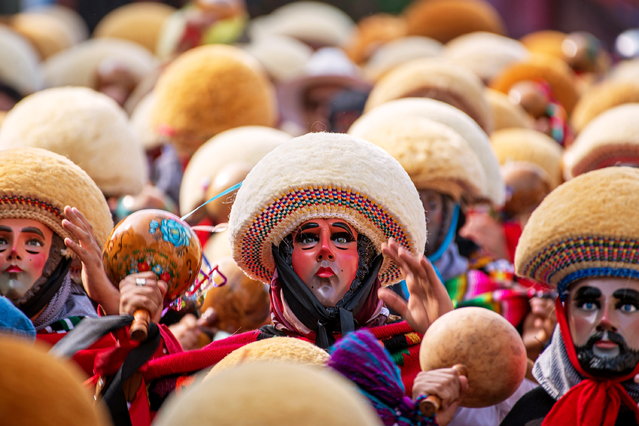
Indigenous men perfom the “Danza del Parachicos” (Parachicos dance) to honor the Lord of Esquipulas during a pilgrimage in the municipality of Chiapa de Corzo, Mexico, 15 January 2024. (Photo by Carlos López/EPA)

Indigenous men perfom the “Danza del Parachicos” (Parachicos dance) to honor the Lord of Esquipulas during a pilgrimage in the municipality of Chiapa de Corzo, Mexico, 15 January 2024. (Photo by Carlos López/EPA)
Details
15 Apr 2025 03:50:00
A couple hugs while standing near a Christmas tree made out of plastic bins and plastic hampers outside the Museum of History in Monterrey, Mexico, December 4, 2015. (Photo by Daniel Becerril/Reuters)

A couple hugs while standing near a Christmas tree made out of plastic bins and plastic hampers outside the Museum of History in Monterrey, Mexico, December 4, 2015. The humble Christmas tree has a rich history, from evergreen trees used to symbolise eternal life in Ancient Egypt to tree worship among pagan Europeans. The modern version has its origins in Germany, where the song “O Tannenbaum” is still a festive favourite. Today the traditional tree with lights and decorations appears in cities including Washington, Moscow and Beirut. Alternative constructions range from recycled rubbish in Mexico City to old window frames in Rakvere, Estonia. Whatever the shape or size, the message is the same: Merry Christmas. (Photo by Neil Hall/Reuters)

Details
23 Dec 2015 08:01:00
People are seen in the crowd as Serbian Emir Kusturica & The No Smoking Orchestra performs during the third day of the Mexican musicial festival Vive Latino, at the Foro Sol in Mexico City, on March 29, 2014. (Photo by Alfredo Estrella/AFP Photo)

People are seen in the crowd as Serbian Emir Kusturica & The No Smoking Orchestra performs during the third day of the Mexican musicial festival Vive Latino, at the Foro Sol in Mexico City, on March 29, 2014. (Photo by Alfredo Estrella/AFP Photo)
Details
05 Apr 2014 13:53:00
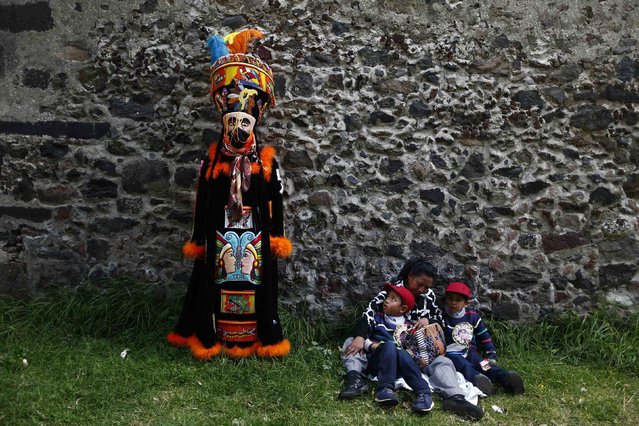
A boy sitting with his family looks up at a traditional Chinelo costumed dancer during a celebration 40 days after the birth of Jesus, in Xochimilco on the outskirts of Mexico City, February 2, 2015. (Photo by Edgard Garrido/Reuters)

A boy sitting with his family looks up at a traditional Chinelo costumed dancer during a celebration 40 days after the birth of Jesus, in Xochimilco on the outskirts of Mexico City, February 2, 2015. The tradition of the Chinelo dates back to colonial times and the outfits and masks, which are supposed to resemble the faces of the Europeans and always sport an uptilted beard, became more elaborate between the 1800s and 1900s to make fun of the upper social classes. (Photo by Edgard Garrido/Reuters)
Details
03 Feb 2015 13:09:00