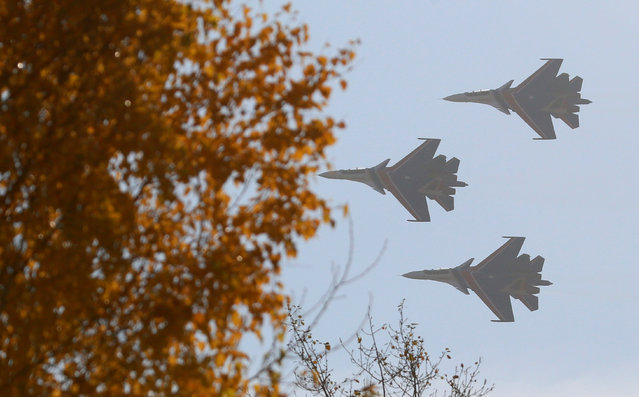
Sukhoi Su-30SM jet fighters of the Russkiye Vityazi (Russian Knights) aerobatic team perform during a demonstration flight in Krasnoyarsk, Russia October 6, 2018. (Photo by Ilya Naymushin/Reuters)
Actor Jackie Chan poses with student performers after participating in a leg of the Beijing 2022 Winter Olympics Torch Relay at the Badaling Great Wall on February 3, 2022 outside Beijing, China. (Photo by Kevin Frayer/Getty Images)
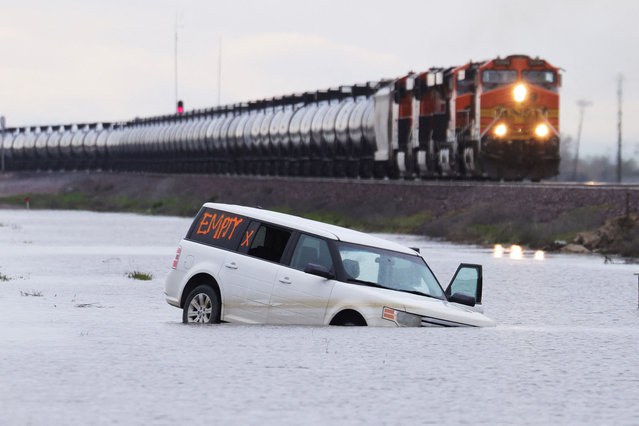
A train passes as floodwaters from the Tule River inundate the area after days of heavy rain in Corcoran, California, U.S., March 22, 2023. (Photo by David Swanson/Reuters)
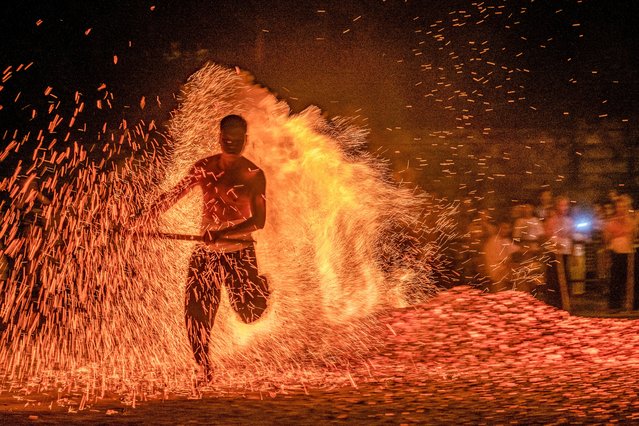
The photo taken on September 17, 2024 shows a villager walking over burning charcoal to perform a traditional fire-walking ritual called “Lianhuo” at Shuangfeng village in Jinhua, in eastern China's Zhejiang province. (Photo by AFP Photo/China Stringer Network)
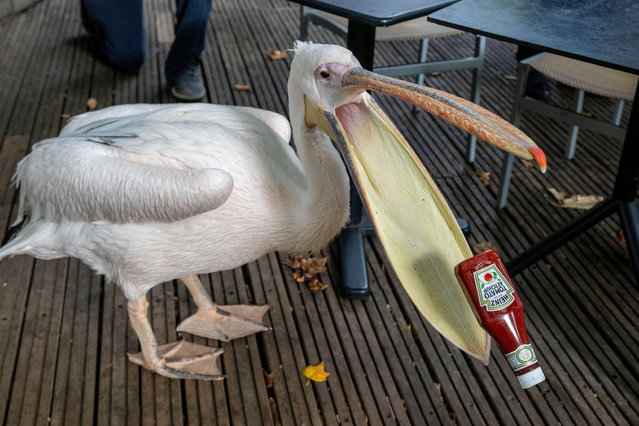
A pelican investigates a fallen ketchup bottle outside a cafe in St James’s Park in London, England on October 9, 2025. The species has lived there for hundreds of years and remain a popular sight for visitors. Introduced in 1664 as a gift from the Russian ambassador, about 40 pelicans have since made the park their home. The bottle was safely retrieved from the pelican. (Photo by Stephen Chung/Alamy Live News)
A trapped car is pushed along a flooded street after typhoon Soudelor hit Fuzhou, Fujian province, China, August 9, 2015. The typhoon battered China's east coast on Sunday, killing eight people and forcing authorities to cancel hundreds of flights and evacuate more than 163,000 people. (Photo by Reuters/Stringer)
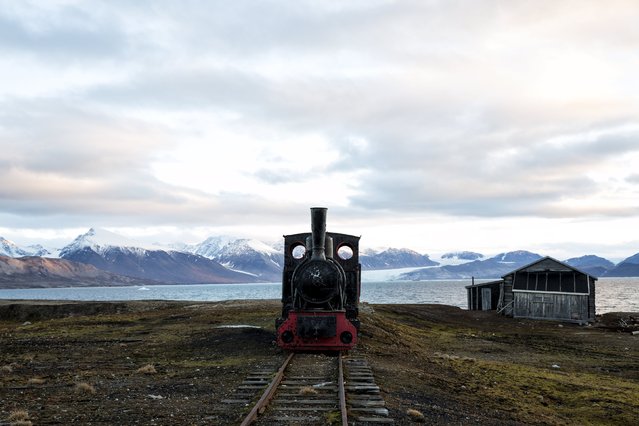
An old locomotive train that was used for transporting coal is preserved as a monument at Ny-Alesund, in Svalbard, Norway, October 11, 2015. A Norwegian chain of islands just 1,200 km (750 miles) from the North Pole is trying to promote new technologies, tourism and scientific research in a shift from high-polluting coal mining that has been a backbone of the remote economy for decades. (Photo by Anna Filipova/Reuters)
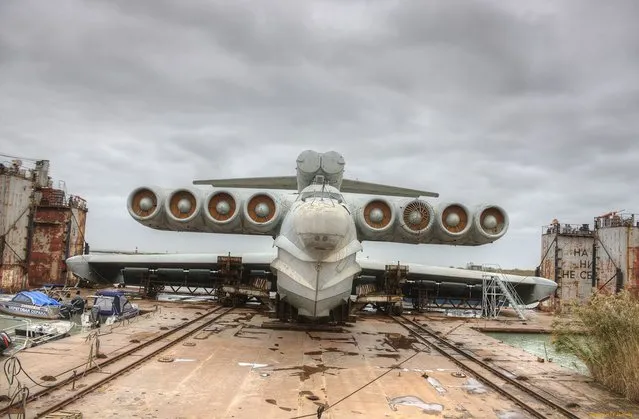
“The Lun-class ekranoplan (NATO reporting name Duck) was a ground effect vehicle (GEV) designed by Rostislav Evgenievich Alexeev and used by the Soviet and Russian navies from 1987 until sometime in the late 1990s. It “flew” using the lift generated by the ground effect of its large wings when close to the surface of the water – about four metres or less. Although they might look similar and/or have related technical characteristics, ekranoplans like the Lun are not aircraft, seaplanes, hovercraft, or hydrofoils – ground effect is a separate technology altogether. The International Maritime Organization classifies these vehicles as maritime ships. The name Lun comes from the Russian for harrier”. – Wikipedia (Photo by Igor113)