The Founders' Award winner, Downey Rose Float Association “Exploring the Everglades” float, moves through 127th Rose Parade in Pasadena, California January 1, 2016. (Photo by David McNew/Reuters)
Teenagers on roller skates hold on to each other as they are pulled by a vintage car to move along a street in Havana, Cuba March 19, 2016. (Photo by Ivan Alvarado/Reuters)
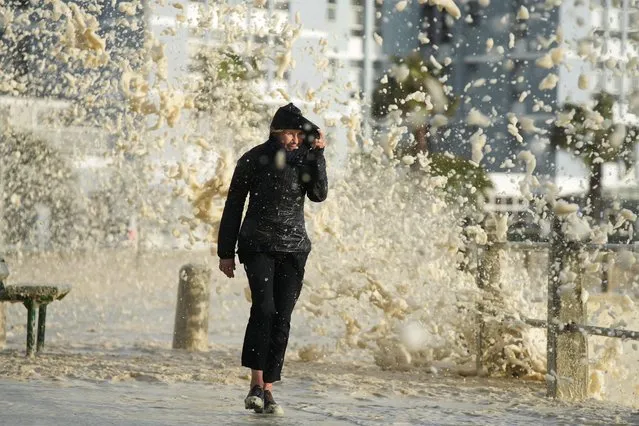
A woman runs through a sea foam, as a seasonal cold front moved over the Cape Peninsula, following a week of severe weather and flooding in Cape Town, South Africa on June 19, 2023. (Photo by Nic Bothma/Reuters)
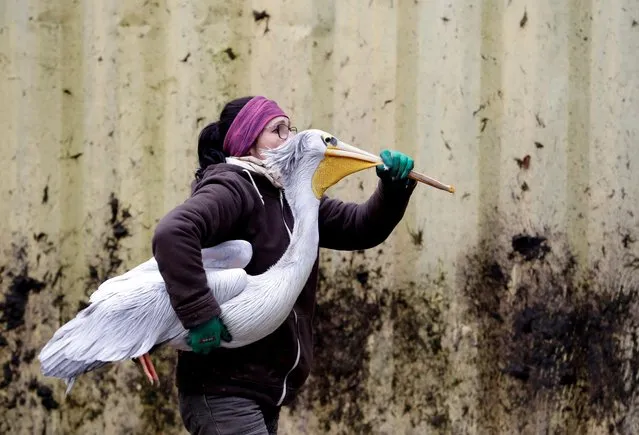
A zoo keeper carries a pelican to move it to its winter enclosure at Dvur Kralove Zoo in Dvur Kralove nad Labem, Czech Republic on November 5, 2019. (Photo by David W. Cerny/Reuters)
Participants hang from ropes as they learn how to use safety gears at an experience centre for construction safety training in Beijing, September 5, 2014. The centre which opened in June 2014 was established to educate workers about construction safety. According to the centre, about 1,000 construction workers undergo 3-hour classes which comprises of 33 modules every month. (Photo by Kim Kyung-Hoon/Reuters)
Model feebee poses as part of art installation “Dazzle room” made by artist Shigeki Matsuyama at Room 32 fashion and design exhibition in Tokyo, Friday, February 19, 2016. Matsuyama's installation features a strong contrast of black and white, which he learned from dazzle camouflage used mainly in World War I, in Tokyo, Friday, Feb. 19, 2016. (Photo by Shuji Kajiyama/AP Photo)
Little owl chicks in Northumberland, UK on August 19, 2018. Strutting up and down and barrelling through the air, these Little Owl chicks will soon be fending for themselves. The intense little birds were snapped by wildlife photographer Bill Doherty in his native Northumberland. The chicks have about seven or eight weeks to learn their survival skills before their parents drive them away to fend for themselves. (Photo by Bill Doherty/South West News Service)
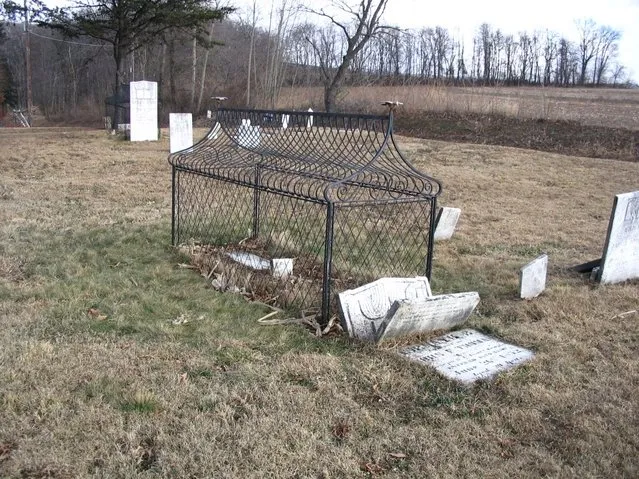
Mortsafes were contraptions designed to protect graves from disturbance. Resurrectionists had supplied the schools of anatomy in Scotland since the early 18th century. This was due to the necessity for medical students to learn anatomy by attending dissections of human subjects, which was frustrated by the very limited allowance of dead bodies – for example the corpses of executed criminals – granted by the government, which controlled the supply.