Loading...
Done
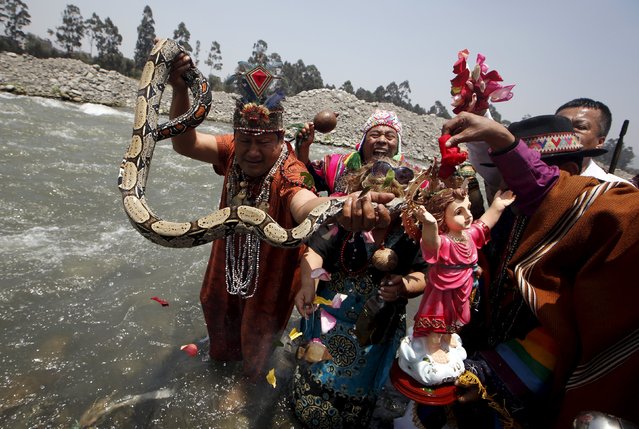
Peruvian shamans holding a figure of a Nino Jesus (Child Jesus) and a snake perform a ritual at the Rimac river to fight the negative effects of the Nino weather phenomena over Nature, in Lima, October 1, 2015. (Photo by Mariana Bazo/Reuters)

Peruvian shamans holding a figure of a Nino Jesus (Child Jesus) and a snake perform a ritual at the Rimac river to fight the negative effects of the Nino weather phenomena over Nature, in Lima, October 1, 2015. (Photo by Mariana Bazo/Reuters)
Details
03 Oct 2015 08:07:00
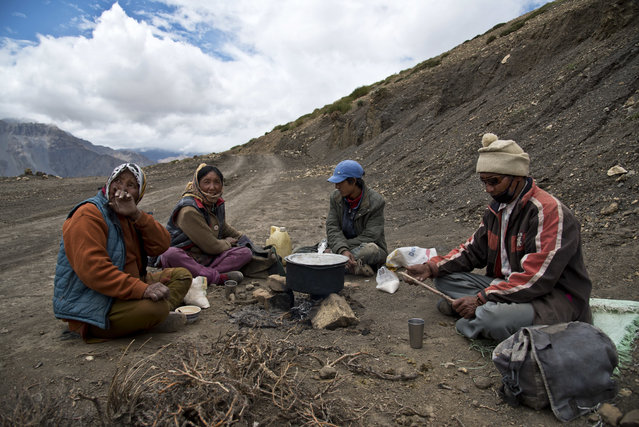
In this August 17, 2016, photo, from left to right, Chhering Chodom, 60, Tashi Yangzom, 50, Lobsang Chhering, 27, and Dorje Tandup, 58, drink milk tea on the side of the road. For centuries, the sleepy valley nestled in the Indian Himalayas remained a hidden Buddhist enclave forbidden to outsiders. Enduring the harsh year-round conditions of the high mountain desert, the people of Spiti Valley lived by a simple communal code – share the Earth's bounty, be hospitable to neighbors, and eschew greed and temptation at all turns. That's all starting to change, for better or worse. Since India began allowing its own citizens as well as outsiders to visit the valley in the early 1990s, tourism and trade have boomed. And the marks of modernization, such as solar panels, asphalt roads and concrete buildings, have begun to appear around some of the villages that dot the remote landscape at altitudes above 4,000 meters (13,000 feet). (Photo by Thomas Cytrynowicz/AP Photo)

In this August 17, 2016, photo, from left to right, Chhering Chodom, 60, Tashi Yangzom, 50, Lobsang Chhering, 27, and Dorje Tandup, 58, drink milk tea on the side of the road. For centuries, the sleepy valley nestled in the Indian Himalayas remained a hidden Buddhist enclave forbidden to outsiders. Enduring the harsh year-round conditions of the high mountain desert, the people of Spiti Valley lived by a simple communal code – share the Earth's bounty, be hospitable to neighbors, and eschew greed and temptation at all turns. That's all starting to change, for better or worse. (Photo by Thomas Cytrynowicz/AP Photo)

Details
15 Sep 2016 09:22:00
The finishing touches are made to a new wax figure of Theresa May at Madame Tussauds in London, England on November 7, 2017. (Photo by Victoria Jones/PA Wire)

The finishing touches are made to a new wax figure of Theresa May at Madame Tussauds in London, England on November 7, 2017. (Photo by Victoria Jones/PA Wire)
Details
09 Nov 2017 05:55:00
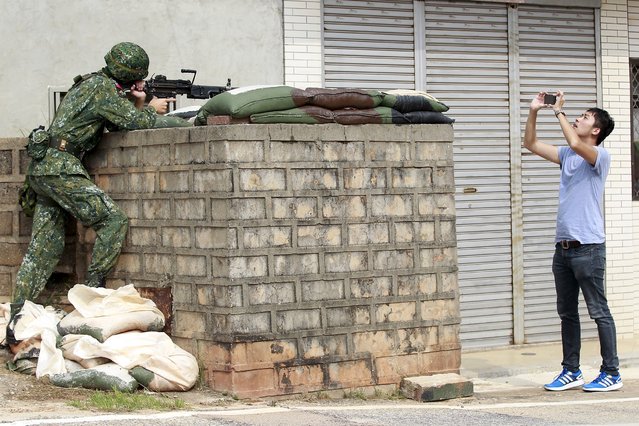
A reporter takes pictures of a soldier during the annual Han Kuang military exercise in Kinmen, Taiwan, September 7, 2015. (Photo by Pichi Chuang/Reuters)

A reporter takes pictures of a soldier during the annual Han Kuang military exercise in Kinmen, Taiwan, September 7, 2015. Rustic Kinmen, with a population of less than 129,000, is a half-hour ferry ride to China, but it takes an hour to fly to major Taiwan cities. Just off its shores, glass-walled high-rises wink seductively from the booming mainland port of Xiamen in one of China's most prosperous provinces. (Photo by Pichi Chuang/Reuters)
Details
10 Oct 2015 08:02:00
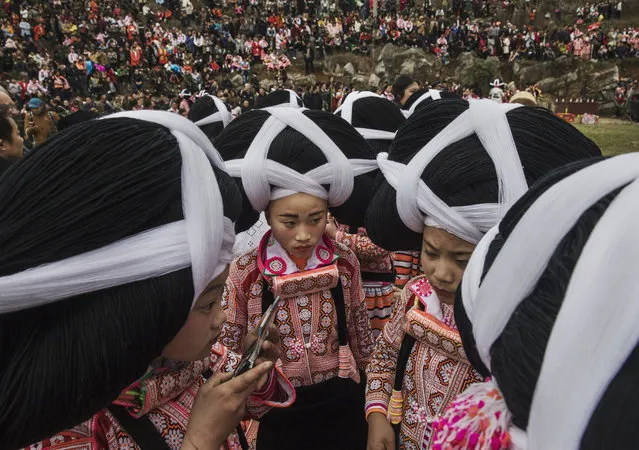
Girls of the Long Horn Miao ethnic minority group wear headdresses as they prepare gather for Tiaohua or Flower Festival as part of the Lunar New Year on February 6, 2017 in Longga village, Guizhou province, southern China. The Long Horn Miao are recognized for their declining practice of wrapping a blend of linen, wool, and the hair of their ancestors around animal horns or a wooden clip to make headdresses. Many young women say they now wear the headdresses only for special occasions and festivals, as the ornaments, which are attached by the horns to their real hair, have proved impractical for modern daily life in a fast changing world. China officially recognizes 56 different ethnic minorities, and statistics show over 7 million Chinese identifying themselves as Miao. But the small Long Horn Miao community counts only around 5000 people living in 12 villages, whose age-old traditions, language, and culture are fading. It is increasingly difficult in a modernizing China, as young people are drawn from remote rural villages to opportunities in bigger cities amongst wide-scale urbanization. Farming and labour remain the mainstays of life for the Long Horn Miao, leaving the area relatively poor in comparison with many parts of China. The government has invested significant amounts into local infrastructure and the tourism industry to try to bolster the local economy. (Photo by Kevin Frayer/Getty Images)

Girls of the Long Horn Miao ethnic minority group wear headdresses as they prepare gather for Tiaohua or Flower Festival as part of the Lunar New Year on February 6, 2017 in Longga village, Guizhou province, southern China. (Photo by Kevin Frayer/Getty Images)
Details
13 Feb 2017 00:01:00
A Hindu holy man looks at a decoration on the ghats of the river Saryu as part of preparations for the groundbreaking ceremony of a temple to the Hindu god Ram in Ayodhya, in the Indian state of Uttar Pradesh, Monday, August 3, 2020. As Hindus prepare to celebrate the groundbreaking of a long-awaited temple at a disputed ground in northern India, Muslims say they have no firm plans yet to build a new mosque at an alternative site they were granted to replace the one torn down by Hindu hard-liners decades ago. (Photo by Rajesh Kumar Singh/AP Photo)

A Hindu holy man looks at a decoration on the ghats of the river Saryu as part of preparations for the groundbreaking ceremony of a temple to the Hindu god Ram in Ayodhya, in the Indian state of Uttar Pradesh, Monday, August 3, 2020. As Hindus prepare to celebrate the groundbreaking of a long-awaited temple at a disputed ground in northern India, Muslims say they have no firm plans yet to build a new mosque at an alternative site they were granted to replace the one torn down by Hindu hard-liners decades ago. (Photo by Rajesh Kumar Singh/AP Photo)
Details
13 Aug 2020 00:01:00
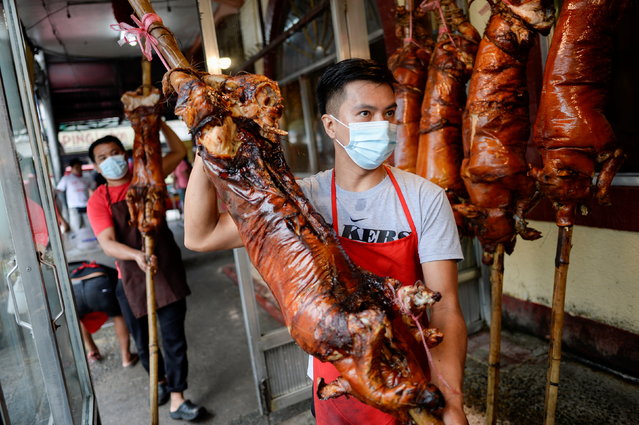
Workers wearing face masks as a protection against the coronavirus disease (COVID-19) carry roasted pigs, locally known as “lechon”, at a restaurant, in Quezon City, Metro Manila, Philippines, December 21, 2020. (Photo by Lisa Marie David/Reuters)

Workers wearing face masks as a protection against the coronavirus disease (COVID-19) carry roasted pigs, locally known as “lechon”, at a restaurant, in Quezon City, Metro Manila, Philippines, December 21, 2020. (Photo by Lisa Marie David/Reuters)
Details
17 Feb 2021 09:41:00
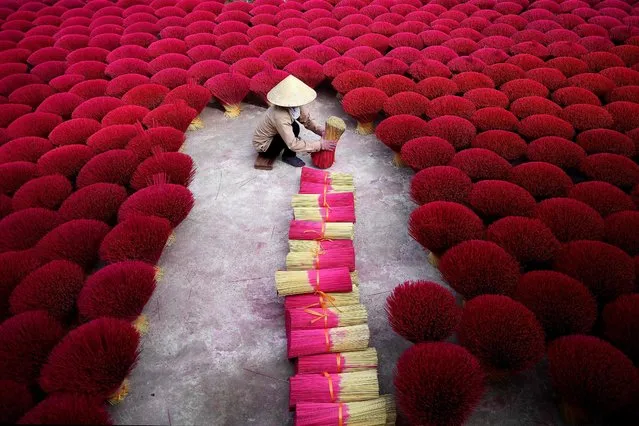
This picture taken on January 3, 2019 shows a Vietnamese woman collecting incense sticks in a courtyard in the village of Quang Phu Cau on the outskirts of Hanoi. In Vietnam's “incense village”, hundreds of workers are hard at work dying, drying and whittling down bamboo bark to make the fragrant sticks ahead of the busy lunar new year holiday. (Photo by Manan Vatsyayana/AFP Photo)

This picture taken on January 3, 2019 shows a Vietnamese woman collecting incense sticks in a courtyard in the village of Quang Phu Cau on the outskirts of Hanoi. In Vietnam's “incense village”, hundreds of workers are hard at work dying, drying and whittling down bamboo bark to make the fragrant sticks ahead of the busy lunar new year holiday. (Photo by Manan Vatsyayana/AFP Photo)
Details
01 Mar 2019 00:05:00