Loading...
Done
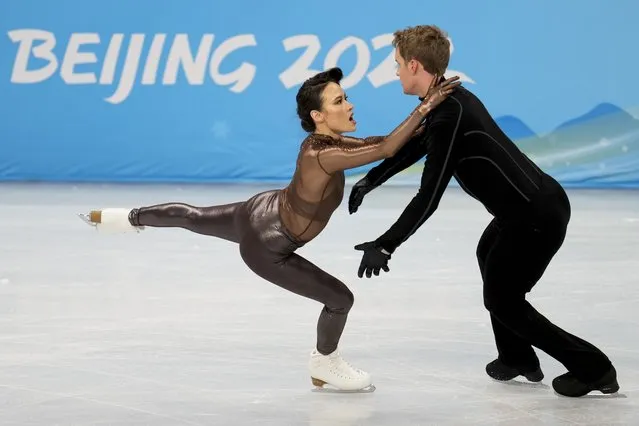
Figure skating couple Madison Chock and Evan Bates, of the USA, practice their dance routine during a training session at the 2022 Winter Olympics, Thursday, February 3, 2022, in Beijing. At the Beijing Winter Games, opening Friday, it’s a homecoming of sorts for one of the world’s most sprawling diasporas – often sweet and sometimes complicated, but always a reflection of where they are, where they come from and the Olympic spirit itself. “Every time I’m on the bus, I’m just looking out and studying the city and just imagining my roots are here, my ancestors are here”, says Chock, whose father is Chinese-Hawaiian, with family ties to rural China. (Photo by Natacha Pisarenko/AP Photo)

Figure skating couple Madison Chock and Evan Bates, of the USA, practice their dance routine during a training session at the 2022 Winter Olympics, Thursday, February 3, 2022, in Beijing. (Photo by Natacha Pisarenko/AP Photo)
Details
06 Feb 2022 06:25:00
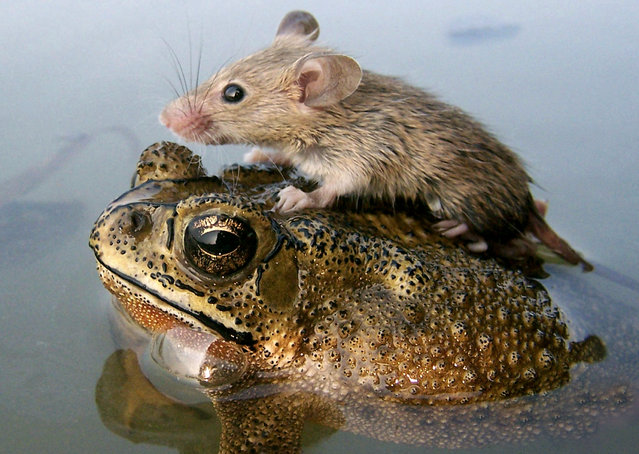
A mouse rides on the back of a frog in floodwaters in the northern Indian city Lucknow June 30, 2006. (Photo by Pawan Kumar/Reuters)

A mouse rides on the back of a frog in floodwaters in the northern Indian city Lucknow June 30, 2006. (Photo by Pawan Kumar/Reuters)
Details
15 Jul 2017 08:23:00
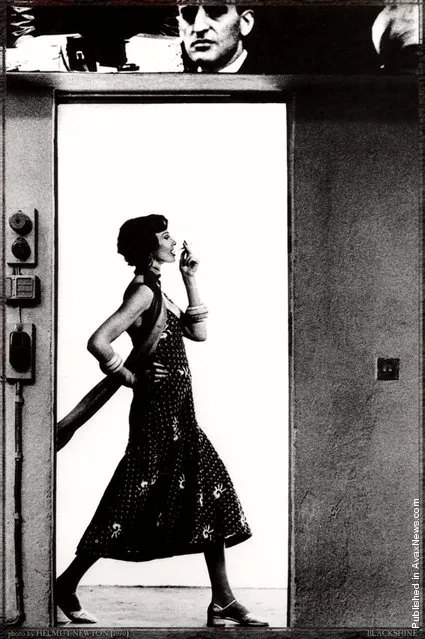
Photographers: Helmut Newton

“Newton was born in Berlin, the son of Klara “Claire” (Marquis) and Max Neustädter, a button factory owner. His family was Jewish. Newton attended the Heinrich-von-Treitschke-Realgymnasium and the American School in Berlin. Interested in photography from the age of 12 when he purchased his first camera, he worked for the German photographer Yva (Elsie Neulander Simon) from 1936. The increasingly oppressive restrictions placed on Jews by the Nuremberg laws meant that his father lost control of the factory in which he manufactured buttons and buckles; he was briefly interned in a concentration camp on “Kristallnacht”, November 9, 1938, which finally compelled the family to leave Germany. Newton's parents fled to South America. He was issued with a passport just after turning 18, and left Germany on December 5, 1938. At Trieste he boarded the “Conte Rosso” (along with about 200 others escaping the Nazis) intending to journey to China. After arriving in Singapore he found he was able to remain there, first and briefly as a photographer for the Straits Times and then as a portrait photographer”. – Wikipedia

Photo: Sigourney Weaver by Helmut Newton, 1995.
Details
08 Apr 2012 13:49:00
Ocean voyage

Do you think that history is a science? Well, not exactly. First, and foremost, history is the state's “legend of wars”, it’s official regalia. Of course, public historians are not interested in scientific truth – quite the opposite. In this respect, any attempt to present a state’s history as altruistic and benevolent as possible is welcomed and encouraged – as opposed to any revisionism attempts that may be more accurate. In this matter, Chinese have surpassed us all – they revised in highly creative manner (but rather shamelessly) the technology already invented by Europeans, a process that resulted in oldest state on the planet. Here is an interesting paradox: ask any sinologist about the Middle Kingdom during second century B.C., and he will describe it to you in such a vivid manner as if he has been living there all his life – but as soon as you will ask him to describe Chinese history in the 19-20th centuries… let's say, his eagerness will be greatly diminished. However, we will discuss China in a different article, and in the meantime we will try to understand how exactly historic “legend of wars” is formed and functions – based on a specific and well-known example. A great example is Ferdinand Magellan's first voyage around the world.

Details
14 Nov 2011 09:11:00
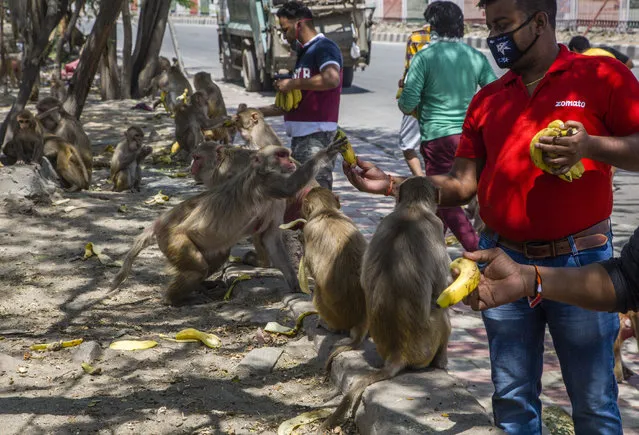
Men give bananas to monkeys gathered on the side of the road as India remains under an unprecedented lockdown over the highly contagious coronavirus (COVID-19) on April 08, 2020 in New Delhi, India. Wild animals, including monkeys, are roaming human settlements in India as people are staying indoors due to the 21-day lockdown. With India's 1.3 billion population and tens of millions of cars off the roads, wildlife is moving towards areas inhabited by humans. Wild animals in many countries have been seen roaming streets. A study says some 60 percent of the new diseases found around the globe every year are zoonotic, meaning they originate in animals and are passed on to humans. COVID-19 is a zoonotic disease that is suspected to have come from the wet markets of Wuhan, China. (Photo by Yawar Nazir/Getty Images)

Men give bananas to monkeys gathered on the side of the road as India remains under an unprecedented lockdown over the highly contagious coronavirus (COVID-19) on April 08, 2020 in New Delhi, India. Wild animals, including monkeys, are roaming human settlements in India as people are staying indoors due to the 21-day lockdown. (Photo by Yawar Nazir/Getty Images)
Details
12 Apr 2020 00:05:00
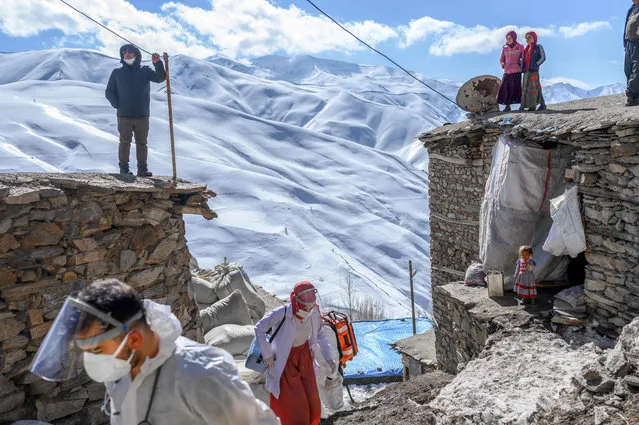
In this photograph taken on February 15, 2021, doctor Sergen Saracoglu (L) and nurse Yilzdiz Ayten (C) from the Bahcesaray public hospital vaccination team, arrive at the village of Guneyyamac in eastern Turkey, as part of an expedition to vaccinate residents of 65 years old or above with Sinovac's CoronaVac Covid-19 vaccine. Turkey's population of more than 83 million is spread out across Europe and Asia and covers some seemingly impregnable terrain. The vaccination effort with China's CoronaVac jab kicked off with a bang in mid-January when Turkey inoculated more than half a million people in the first few days. But it slowed down considerably when doctors left the big cities and tried to reach remote places such as Imamli and Ozbeyli – two ethnically Kurdish hamlets of a few hundred herders and farmers each. (Photo by Bulent Kilic/AFP Photo)

In this photograph taken on February 15, 2021, doctor Sergen Saracoglu (L) and nurse Yilzdiz Ayten (C) from the Bahcesaray public hospital vaccination team, arrive at the village of Guneyyamac in eastern Turkey, as part of an expedition to vaccinate residents of 65 years old or above with Sinovac's CoronaVac Covid-19 vaccine. (Photo by Bulent Kilic/AFP Photo)
Details
18 Mar 2021 09:32:00
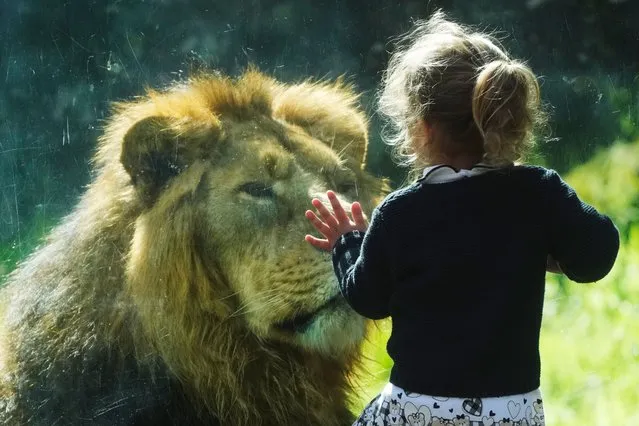
A child and any Asiatic Lion look at each other through a glass at Rome's Zoo, Thursday, March 7, 2024. (Photo by Gregorio Borgia/AP Photo)

A child and any Asiatic Lion look at each other through a glass at Rome's Zoo, Thursday, March 7, 2024. (Photo by Gregorio Borgia/AP Photo)
Details
17 Mar 2024 06:08:00
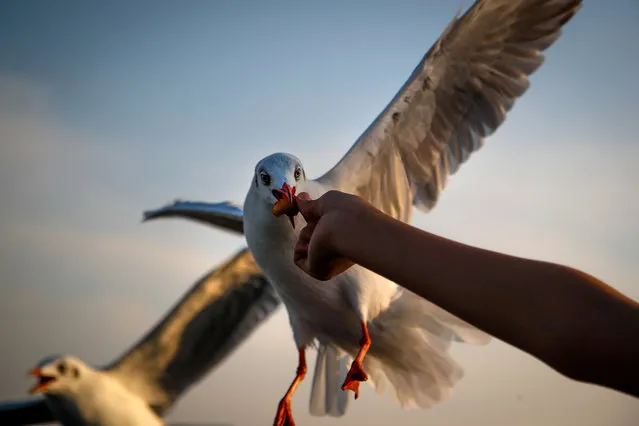
A seagull eats a piece of dried fish of a man's hand during sunset at Bang Pu seaside resort in Samut Prakan province on the outskirts of Bangkok, Thailand, 13 January 2019. Every year during the cold winter months between October to March thousands of seagulls migrate to Bang Pu seaside from Siberia to escape the harsh winter. (Photo by Diego Azubel/EPA/EFE)

A seagull eats a piece of dried fish of a man's hand during sunset at Bang Pu seaside resort in Samut Prakan province on the outskirts of Bangkok, Thailand, 13 January 2019. Every year during the cold winter months between October to March thousands of seagulls migrate to Bang Pu seaside from Siberia to escape the harsh winter. (Photo by Diego Azubel/EPA/EFE)
Details
27 Jan 2019 00:03:00