Loading...
Done


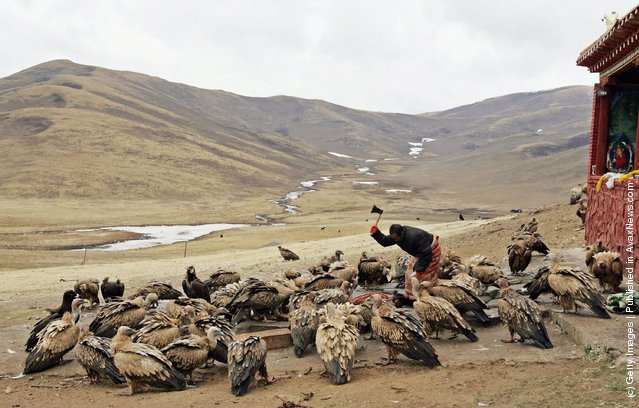
“Sky burial or ritual dissection was once a common funerary practice in Tibet wherein a human corpse is cut in specific locations and placed on a mountaintop, exposing it to the elements or the mahabhuta and animals – especially to birds of prey. The location of the sky burial preparation and place of execution are understood in the Vajrayana traditions as charnel grounds. In Tibet the practice is known as jhator, which literally means, «giving alms to the birds»”. – Wikipedia

Photo: A burial master chops bones of a body to feed vultures during a celestial burial ceremony on April 19, 2006 in Dari County of Guoluo Prefecture, Qinghai Province, northwest China. Celestial burial is a traditional funeral of Tibetan people, which began in the 7th century. (Photo by China Photos/Getty Images)
Details
18 Jun 2011 12:12:00
In this photo taken on Monday, October 27, 2014, a cactus stands at a broken window in a damaged house after shelling not far from Donetsk airport in the town of Donetsk, eastern Ukraine. (Photo by Dmitry Lovetsky/AP Photo)

In this photo taken on Monday, October 27, 2014, a cactus stands at a broken window in a damaged house after shelling not far from Donetsk airport in the town of Donetsk, eastern Ukraine. Donetsk, which has lost about 400,000 of its 1 million pre-war population, is bracing to a winter ahead. In a climate like eastern Ukraine's, where temperatures typically stay below zero all winter, the damage to the critical infrastructure and lack of effort to provide adequate shelter to people whose homes were destroyed could literally mean a death from the cold. (Photo by Dmitry Lovetsky/AP Photo)
Details
06 Nov 2014 09:06:00
A demonstrator wearing a face mask reading “Who gave the order?” looks on during a protest to mark the International Day for the Elimination of Violence against Women, in Bogota, Colombia on November 25, 2020. (Photo by Luisa Gonzalez/Reuters)

A demonstrator wearing a face mask reading “Who gave the order?” looks on during a protest to mark the International Day for the Elimination of Violence against Women, in Bogota, Colombia on November 25, 2020. (Photo by Luisa Gonzalez/Reuters)
Details
20 Feb 2021 09:32:00
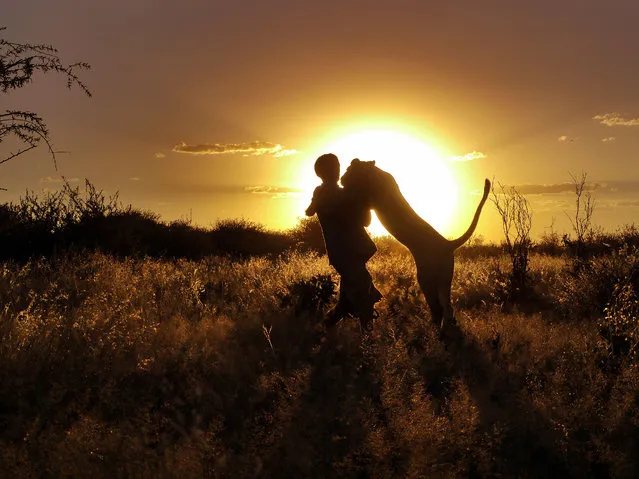
These heart-warming photograph show an incredible bond between a wild lioness and the men fighting to save her species. The picture show Sirga – a 110lb lioness – and her adopted pride Valentin Gruener (not pictured) and Mikkel Legarth. Incredibly she treats the two men just like she would other lions and with their help she can now hunt for prey on her own. (Photo by Caters News)

These heart-warming photograph show an incredible bond between a wild lioness and the men fighting to save her species. The picture show Sirga – a 110lb lioness – and her adopted pride Valentin Gruener (not pictured) and Mikkel Legarth. Incredibly she treats the two men just like she would other lions and with their help she can now hunt for prey on her own. As a cub she was driven out from a pride and rescued by German and Danish duo Valentin and Mikkel who could not stand by and watch her die. She is now a beacon for hoped success of the Modisa Wildlife Project, founded in Botswana, Africa, by Valentin and Mikkel with the hope of saving the lion population. (Photo by Caters News)
Details
27 Apr 2014 09:36:00
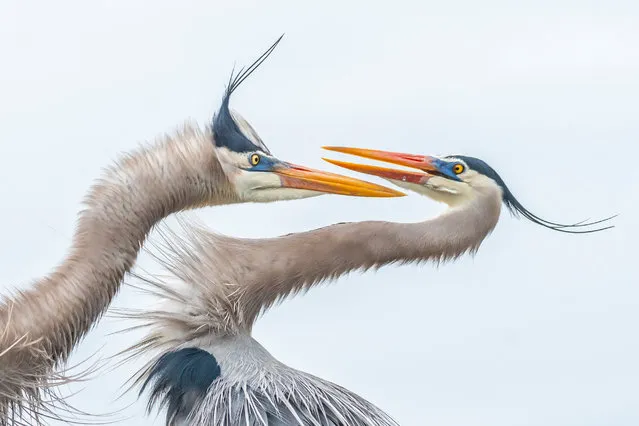
Melissa Rowell, amateur honourable mention. Wakodahatchee wetlands, Delray Beach, Florida, US. Equipped with sinewy necks and spear-like bills, great blue herons can lunge with fearsome speed to strike their aquatic prey. Adults will also employ rapid stabbing motions as one aspect of their complex courtship displays; they’re seemingly dangerous moves, but fitting to the intensity of mating season. (Photo by Melissa Rowell/Audubon photography awards)

Wakodahatchee wetlands, Delray Beach, Florida, US. Equipped with sinewy necks and spear-like bills, great blue herons can lunge with fearsome speed to strike their aquatic prey. Adults will also employ rapid stabbing motions as one aspect of their complex courtship displays; they’re seemingly dangerous moves, but fitting to the intensity of mating season. (Photo by Melissa Rowell/Audubon Photography Awards)
Details
17 Jul 2019 00:03:00
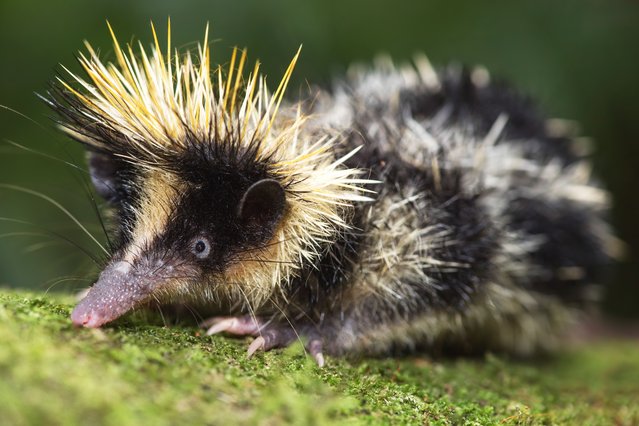
This spiky tenrec was spotted in Madagascar’s Mantadia National Park in the last decade of September 2025. Mostly nocturnal and rarely seen, it puffs out its spines when threatened. Spiky tenrecs are excellent swimmers — unlike most spiny mammals, some species of tenrec can forage in streams and rivers, using their spines for protection while hunting aquatic insects and small prey. (Photo by Dale Morris/Solent News & Photo Agency)

This spiky tenrec was spotted in Madagascar’s Mantadia National Park in the last decade of September 2025. Mostly nocturnal and rarely seen, it puffs out its spines when threatened. Spiky tenrecs are excellent swimmers — unlike most spiny mammals, some species of tenrec can forage in streams and rivers, using their spines for protection while hunting aquatic insects and small prey. (Photo by Dale Morris/Solent News & Photo Agency)
Details
05 Oct 2025 04:02:00
Indigenous dancers participate in a traditional healing ceremony for the mother earth at El Salvador del Mundo Square in San Salvador, December 10, 2014. Salvadorean indigenous organizations participated in a ceremony to ask for solutions to stop climate change and respect planet earth as the U.N. Climate Change Conference COP 20 is bring held in Peru. (Photo by Jose Cabezas/Reuters)

Indigenous dancers participate in a traditional healing ceremony for the mother earth at El Salvador del Mundo Square in San Salvador, December 10, 2014. Salvadorean indigenous organizations participated in a ceremony to ask for solutions to stop climate change and respect planet earth as the U.N. Climate Change Conference COP 20 is bring held in Peru. The two-week long United Nations climate summit opened on December 1 in Lima, with experts and analysts from around the world gathering to discuss melting glaciers and extreme weather patterns. (Photo by Jose Cabezas/Reuters)
Details
12 Dec 2014 12:51:00
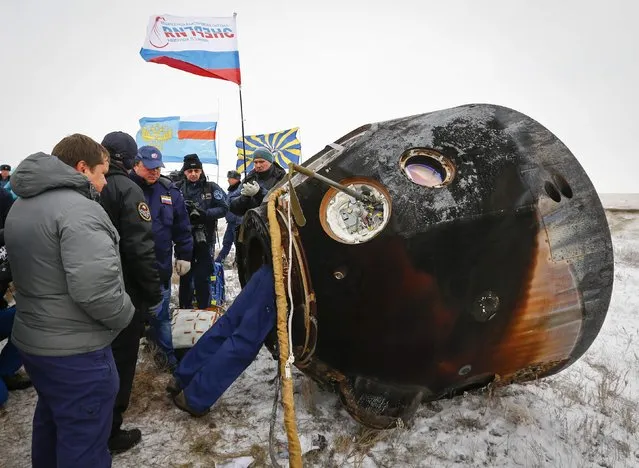
Ground personnel work next to the Soyuz TMA-13M capsule of the International Space Station (ISS) crew of Alexander Gerst of Germany, Maxim Suraev of Russia and Reid Wiseman of the U.S. after its landing near the town of Arkalyk in northern Kazakhstan November 10, 2014. (Photo by Shamil Zhumatov/Reuters)

Ground personnel work next to the Soyuz TMA-13M capsule of the International Space Station (ISS) crew of Alexander Gerst of Germany, Maxim Suraev of Russia and Reid Wiseman of the U.S. after its landing near the town of Arkalyk in northern Kazakhstan November 10, 2014. A veteran Russian cosmonaut and two International Space Station crewmates, one from the United States and one from Germany, returned safely to Earth on Sunday with a parachute landing of their Soyuz capsule in Kazakhstan, ending 5-1/2 months in orbit. (Photo by Shamil Zhumatov/Reuters)
Details
10 Nov 2014 13:58:00