Loading...
Done
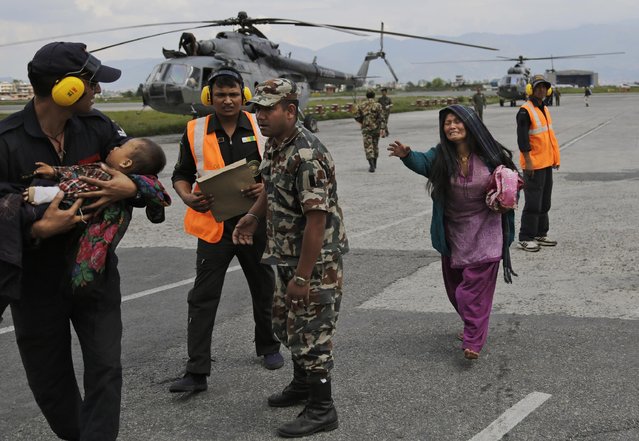
An Indian Air Force person walks carrying a Nepalese child, wounded in Saturday's earthquake, to a waiting ambulance as the mother rushes to join after they were evacuated from a remote area at the airport in Kathmandu, Nepal, Monday, April 27, 2015. (Photo by Altaf Qadri/AP Photo)

An Indian Air Force person walks carrying a Nepalese child, wounded in Saturday's earthquake, to a waiting ambulance as the mother rushes to join after they were evacuated from a remote area at the airport in Kathmandu, Nepal, Monday, April 27, 2015. The death toll from Nepal's earthquake is expected to rise depended largely on the condition of vulnerable mountain villages that rescue workers were still struggling to reach two days after the disaster. (Photo by Altaf Qadri/AP Photo)
Details
28 Apr 2015 13:52:00


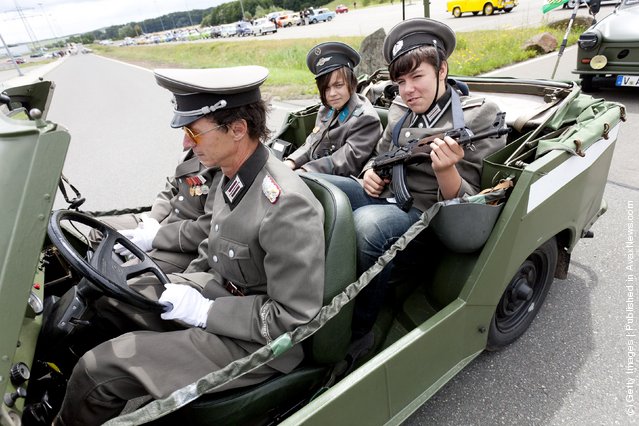
“The Trabant is a car that was produced by former East German auto maker VEB Sachsenring Automobilwerke Zwickau in Zwickau, Sachsen. It was the most common vehicle in East Germany, and was also exported to countries both inside and outside the communist bloc. The main selling points was that it had room for four adults and luggage in a compact, light and durable shell and that it was fast (when introduced) and durable. With its mediocre performance, smoky two-stroke engine, and production shortages, the Trabant is often cited as an example of the disadvantages of centralized planning; on the other hand, it is regarded with derisive affection as a symbol of the failed former East Germany and of the fall of communism (in former West Germany, as many East Germans streamed into West Berlin and West Germany in their Trabants after the opening of the Berlin Wall in 1989). It was in production without any significant changes for nearly 30 years with 3,096,099 Trabants produced in total”. – Wikipedia

Photo: Enthusiasts weared in uniforms of the former eastern german army trive in a military Trabant car as fans and owners of East German-era Trabant cars gather at the 2011 International Trabantfahrer Treffen (International Trabant Drivers Meeting) on June 26, 2011 in Zwickau, Germany. The Trabant, also known as the Trabi, was among the main cars produced in communist East Germany and built by VEB Sachsenring Automobilwerke in Zwickau for 30 years until 1989. Today the car has cult status for many followers and one company, IndiKar, is even seeking to revive the brand in a modern, electric version. (Photo by Carsten Koall/Getty Images)

Details
27 Jun 2011 12:21:00
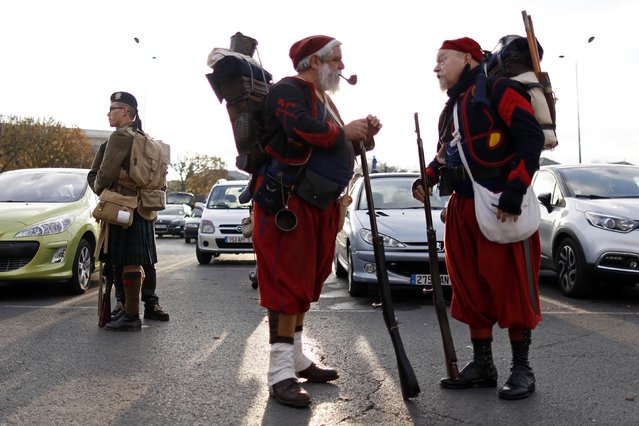
History enthusiasts of French association “Arquebusiers de l'Est”, dressed as soldiers of 3rd regiment of Zouave, attend an Armistice Day ceremony to commemorate the end of World War One at Epernay, eastern France, November 11, 2014. (Photo by Charles Platiau/Reuters)

History enthusiasts of French association “Arquebusiers de l'Est”, dressed as soldiers of 3rd regiment of Zouave, attend an Armistice Day ceremony to commemorate the end of World War One at Epernay, eastern France, November 11, 2014. More than a hundred volunteers from France, Romania, England, Belgium, Russia and Italy took part in the parade. The year 2014 marks the centennial commemoration for the soldiers who fought in the First World War (WWI). (Photo by Charles Platiau/Reuters)
Details
13 Nov 2014 13:41:00
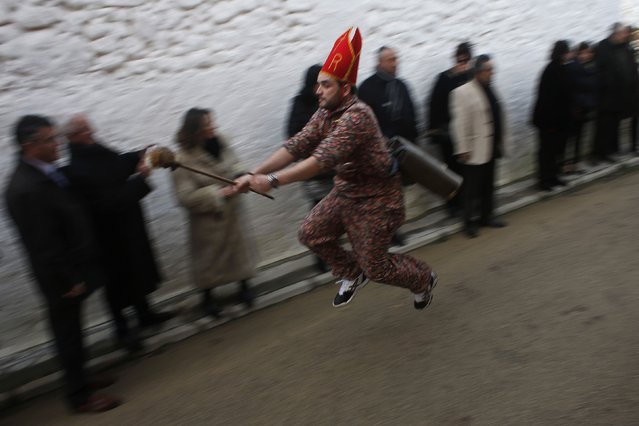
A believer dressed as a “diablo” (devil) jumps at the San Blas' (Saint Blaise) procession during the “Endiablada” festival in Almonacid del Marquesado, in central Spain February 3, 2015. In the “Endiablada”, an undated traditional festival in honour of the Candelaria Virgin and San Blas. (Photo by Susana Vera/Reuters)

A believer dressed as a “diablo” (devil) jumps at the San Blas' (Saint Blaise) procession during the “Endiablada” festival in Almonacid del Marquesado, in central Spain February 3, 2015. In the “Endiablada”, an undated traditional festival in honour of the Candelaria Virgin and San Blas, believers are dressed in colourful costumes, wear a mitre with lead cowbells tied to their waists that ring as they wander around the village and in front of the saints' statues during their processions. (Photo by Susana Vera/Reuters)
Details
05 Feb 2015 12:02:00
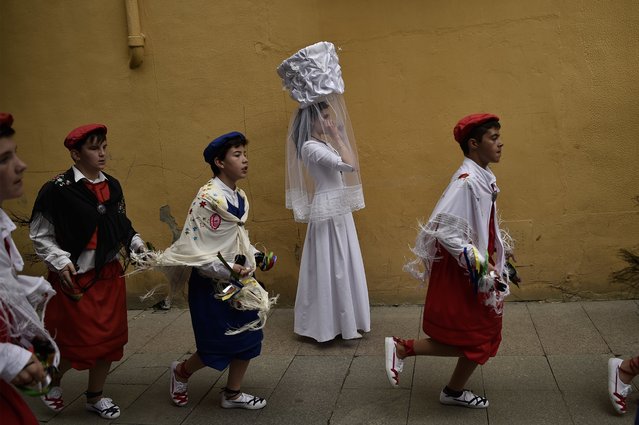
A participant of  “Bread Procession of the Saint”, takes part in the ceremony in honor of Domingo de La Calzada Saint (1019-1109) who helped poor people and pilgrimage, in Santo Domingo de La Calzada, northern Spain, Wednesday, May 11, 2016. (Photo by Alvaro Barrientos/AP Photo)

A participant of “Bread Procession of the Saint”, takes part in the ceremony in honor of Domingo de La Calzada Saint (1019-1109) who helped poor people and pilgrimage, in Santo Domingo de La Calzada, northern Spain, Wednesday, May 11, 2016. Every year during spring season, “Las Doncellas” (White Virgins), hold on their head a basket cover with white cloth while they walk past along of this old village in honor of the saint. (Photo by Alvaro Barrientos/AP Photo)
Details
12 May 2016 14:59:00
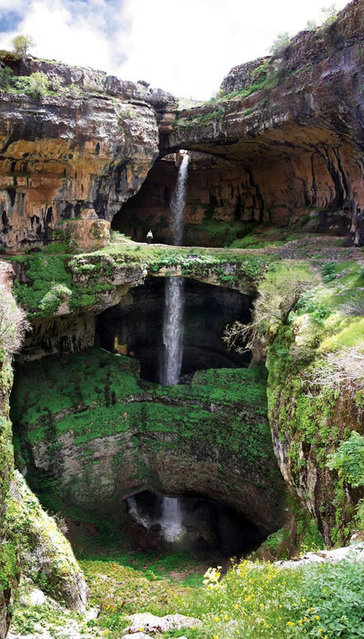
Baatara Gorge Waterfall

Discovered in 1952 by French bio-speleologist Henri Coiffait, the waterfall and accompanying sinkhole were fully mapped in the 1980s by the Spéléo club du Liban. The cave is also known as the "Cave of the Three Bridges." Traveling from Laklouk to Tannourine one passes the village of Balaa, and the "Three Bridges Chasm" (in French "Gouffre des Trois Ponts") is a five-minute journey into the valley below where one sees three natural bridges, rising one above the other and overhanging a chasm descending into Mount Lebanon. During the spring melt, a 90–100-metre (300–330 ft) cascade falls behind the three bridges and then down into the 250-metre (820 ft) chasm. A 1988 fluorescent dye test demonstrated that the water emerged at the spring of Dalleh in Mgharet al-Ghaouaghir.
Details
31 Aug 2013 11:27:00
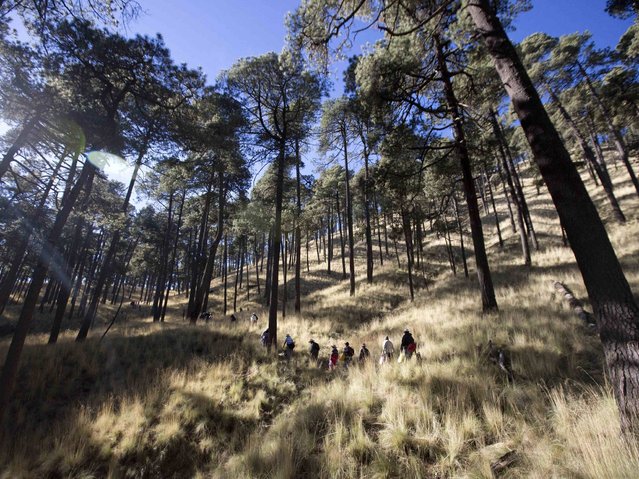
People celebrate the day of Don Gregorio Chino Popocatepetl, as the volcano is known to them, with food, music, dance and fireworks. (Photo by Eduardo Verdugo/AP Photo)

People who live in nearby villages make their yearly pilgrimage as they walk up the slopes of the Popocatepetl volcano in Mexico, Wednesday, March 12, 2014. Every year on March 12, residents make their way up the volcano celebrate the day of Don Gregorio Chino Popocatepetl, as the volcano is known to them, with food, music, dance and fireworks. When the sun rises, hundreds of pilgrims head out from the towns of Santiago Xalintzintla, Tlamacas and San Nicolas de Los Ranchos in van and trucks to drive, then walk up the 17,886-foot (5,450-meter) volcano for their daylong celebration. (Photo by Eduardo Verdugo/AP Photo)
Details
16 Mar 2014 09:09:00
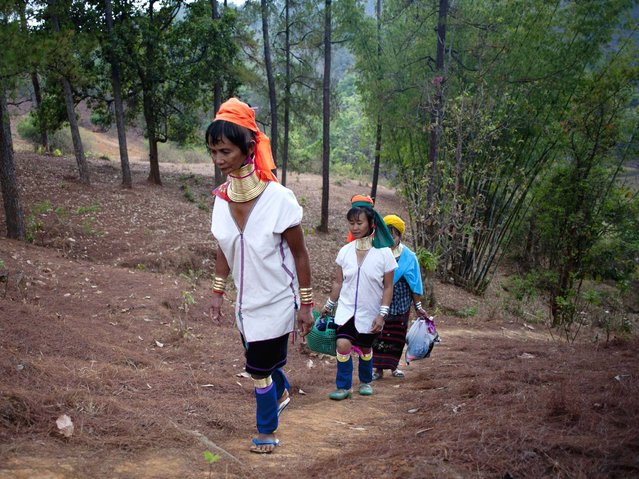
One of the theories says that the coils originate from the desire to look more attractive by exaggerating sexual dimorphism, as women have more slender necks than men. (Photo by Ye Aung Thu/AFP Photo)

This photo taken on April 16, 2014 shows ethnic Kayan women wearing traditional clothes and bronze rings around tbeir neck in Panpet village, Demoso township in Kayah state, eastern Myanmar. Some ethnic Kayan women, also known as Padaung, begin wearing the bronze rings on their neck and legs from a young age. Usually they start wearing six to ten rings when they are five to ten-years-old and then they put on one more ring a year for years after then. (Photo by Ye Aung Thu/AFP Photo)
Details
23 Apr 2014 08:56:00