Loading...
Done
People appear dangling as a large-scale installation art piece by Leandro Erlich, named “Dalston House”, is displayed on June 24, 2013 in London, England. Part of the “Beyond Barbican” summer series of events, the interactive installation is a full facade of a late nineteenth-century Victorian terraced house built on the ground with a large mirror above it to reflect people as to appear dangling from the structure.  (Photo by Dan Dennison/Getty Images)

People appear dangling as a large-scale installation art piece by Leandro Erlich, named “Dalston House”, in London, England. Part of the “Beyond Barbican” summer series of events, the interactive installation is a full facade of a late nineteenth-century Victorian terraced house built on the ground with a large mirror above it to reflect people as to appear dangling from the structure. (Photo by Dan Dennison)
Details
02 Jun 2015 10:07:00
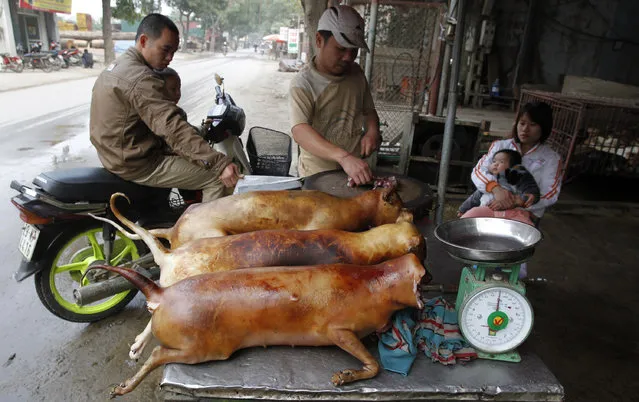
A vendor (C) cuts slaughtered dogs for sale at his roadside stall in Duong Noi village, outside Hanoi December 16, 2011. While animal rights activists have condemned eating dog meat as cruel treatment of the animals, it is still an accepted popular delicacy for some Vietnamese, as well in some other Asian countries. (Photo by Reuters/Kham)

A vendor (C) cuts slaughtered dogs for sale at his roadside stall in Duong Noi village, outside Hanoi December 16, 2011. While animal rights activists have condemned eating dog meat as cruel treatment of the animals, it is still an accepted popular delicacy for some Vietnamese, as well in some other Asian countries. Duong Noi is well-known as a dog-meat village, where hundreds of dogs are killed each day for sale as popular traditional food. Dog-eating as a custom is rooted in Vietnam and was developed as a result of poverty. One kilogram of dog meat costs about 130,000 dongs ($6.2). (Photo by Reuters/Kham)
Details
16 Jul 2013 11:40:00
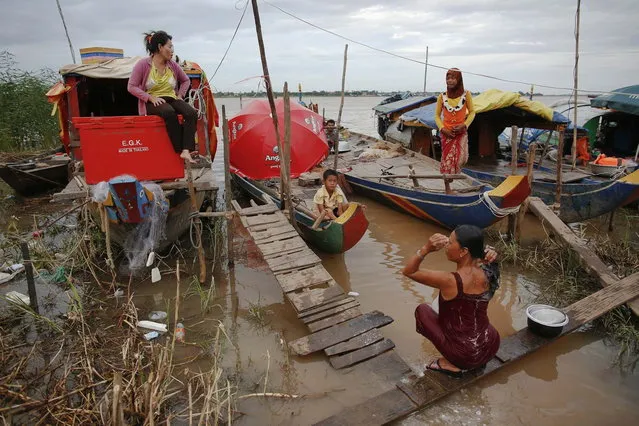
Ethnic Cham Muslim people pass the time near their boats on banks of Mekong river in Phnom Penh July 29, 2013. (Photo by Damir Sagolj/Reuters)

Ethnic Cham Muslim people pass the time near their boats on banks of Mekong river in Phnom Penh July 29, 2013. About 100 ethnic Cham families, made up of nomads and fishermen without houses or land who arrived at the Cambodian capital in search of better lives, live on their small boats on a peninsula where the Mekong and Tonle Sap rivers meet, just opposite the city's centre. The community has been forced to move several times from their locations in Phnom Penh as the land becomes more valuable. They fear that their current home, just behind a new luxurious hotel under construction at the Chroy Changva district is only temporary and that they would have to move again soon. (Photo by Damir Sagolj/Reuters)
Details
31 Jul 2013 06:34:00
Isabel Schmalenbach, an environmental scientist with the Helgoland Biological Institute (Biologische Anstalt Helgoland), part of the Alfred Wegener Institute for Polar and Marine Research, holds a one-year old baby European lobster (Homarus gammarus) raised at the institute on August 3, 2013 on Helgoland Island, Germany. (Photo by Sean Gallup/Getty Images)

Isabel Schmalenbach, an environmental scientist with the Helgoland Biological Institute (Biologische Anstalt Helgoland), part of the Alfred Wegener Institute for Polar and Marine Research, holds a one-year old baby European lobster (Homarus gammarus) raised at the institute on August 3, 2013 on Helgoland Island, Germany. Later in the day Schmalenbach and her colleagues released a total of 415 one-year old lobsters into the North Sea as part of an effort to repopulate the lobster population around Helgoland (also called Heligoland). In the 19th century local fishermen caught up to 80,000 lobsters a year in the surrounding waters, combined with the heavy allied bombing of the island during and after World War II, as well as other environmental factors, decimated the lobster population. (Photo by Sean Gallup)
Details
05 Aug 2013 08:39:00
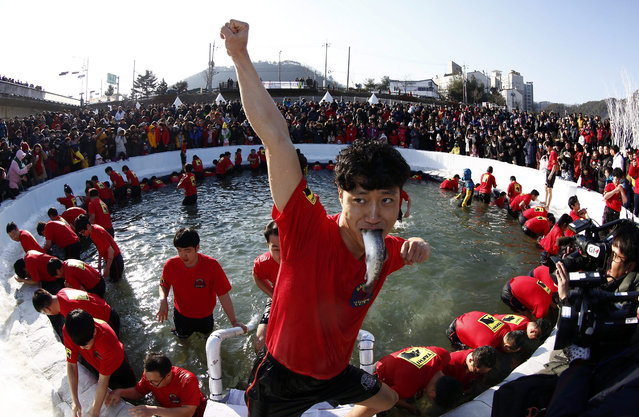
A visitor celebrates after attending a bare hand fishing event in a frozen river during the Hwacheon Sancheoneo Ice Festival at Hwacheon-gun, Gangwon province, South Korea, 09 January 2016. The festival runs under the theme 'Unfrozen Hearts, Unforgettable Memories' from 09 January to 31 January 2016. (Photo by Jeon Heon-Kyun/EPA)

A visitor celebrates after attending a bare hand fishing event in a frozen river during the Hwacheon Sancheoneo Ice Festival at Hwacheon-gun, Gangwon province, South Korea, 09 January 2016. The festival runs under the theme “Unfrozen Hearts, Unforgettable Memories” from 09 January to 31 January 2016. (Photo by Jeon Heon-Kyun/EPA)
Details
11 Jan 2016 08:04:00
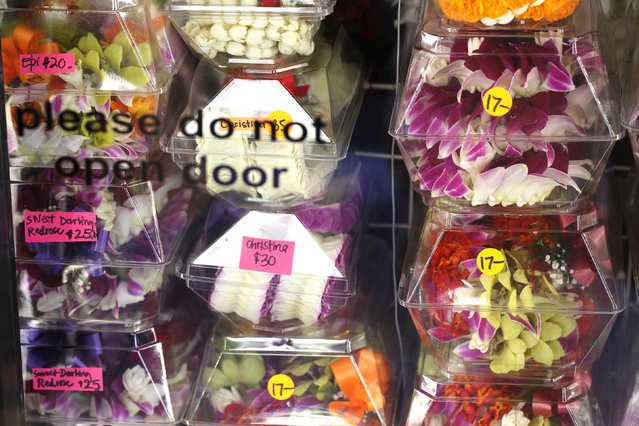
A selection of hand-made leis, traditional Hawaiian necklaces made of flowers and worn mostly on special occasions, fill a cooler at Lin's Lei Shop in the Chinatown district of Honolulu, Hawaii December 22, 2015. Hawaii, whose economy depends heavily on tourism, sees a brief lull in visitors each year in January and February. But in addition to the usual tourist destinations, the state shows a unique overlay of mainland U.S. culture atop tropical beauty year-round. (Photo by Jonathan Ernst/Reuters)

A selection of hand-made leis, traditional Hawaiian necklaces made of flowers and worn mostly on special occasions, fill a cooler at Lin's Lei Shop in the Chinatown district of Honolulu, Hawaii December 22, 2015. Hawaii, whose economy depends heavily on tourism, sees a brief lull in visitors each year in January and February. But in addition to the usual tourist destinations, the state shows a unique overlay of mainland U.S. culture atop tropical beauty year-round. (Photo by Jonathan Ernst/Reuters)
Details
16 Jan 2016 08:00:00
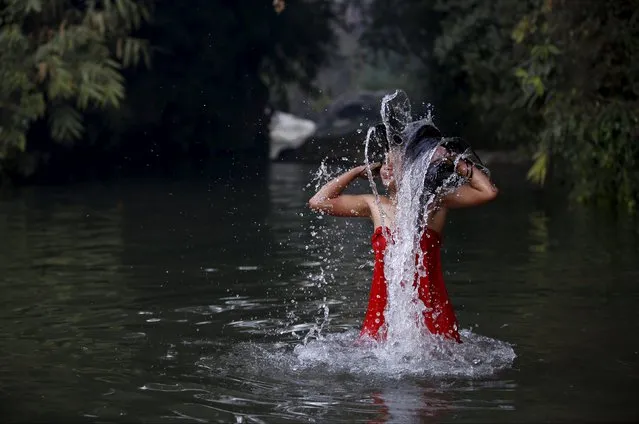
A devotee takes a holy bath in River Saali in Sankhu during the Swasthani Brata Katha festival in Kathmandu, Nepal, January 24, 2016. (Photo by Navesh Chitrakar/Reuters)

A devotee takes a holy bath in River Saali in Sankhu during the Swasthani Brata Katha festival in Kathmandu, Nepal, January 24, 2016. During the month long festival, devotees recite one chapter of a Hindu tale daily from the 31-chapter sacred Swasthani Brata Katha book that is dedicated to God Madhavnarayan and Goddess Swasthani, alongside various other gods and goddess and the miraculous feats performed by them. The devotees also go on pilgrimages to various temples, perform religious rituals, take a holy bath in the rivers and fast for a month, especially among women who believe fasting helps in their family's well-being or in getting them a good husband. (Photo by Navesh Chitrakar/Reuters)
Details
25 Jan 2016 12:05:00
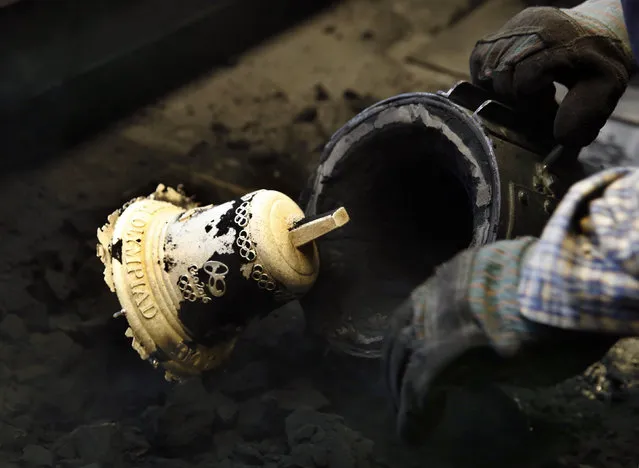
Serge Huguenin of the Blondeau foundry takes the newly melted bell out of the mould in La Chaux-de-Fonds, Switzerland January 21, 2016. At this year's Summer Olympics in Rio de Janeiro, no matter how elaborate the opening ceremony or how sophisticated the live broadcasts, the final lap of athletics races will be announced the traditional way by ringing an old-fashioned bell. (Photo by Denis Balibouse/Reuters)

Serge Huguenin of the Blondeau foundry takes the newly melted bell out of the mould in La Chaux-de-Fonds, Switzerland January 21, 2016. At this year's Summer Olympics in Rio de Janeiro, no matter how elaborate the opening ceremony or how sophisticated the live broadcasts, the final lap of athletics races will be announced the traditional way by ringing an old-fashioned bell. Omega, the official timekeeper of the event, has ordered 21 bells, forged almost entirely by hand by Blondeau's Bell Foundry in the Jura Mountains in Switzerland. Each last-lap bell is branded with the RIO 2016 logo and circled with the words “2016 GAMES OF THE XXXI OLYMPIAD”. (Photo by Denis Balibouse/Reuters)
Details
02 Feb 2016 13:51:00