Loading...
Done
A man walks into a room in the Ice hotel in Jukkasjarvi, Sweden, December 16, 2015. (Photo by Ints Kalnins/Reuters)

In Jukkasjärvi, a village a few miles east of Kiruna, the proprietors of one hotel begin planning for a winter ice festival in March. That’s when they begin collecting some 5,000 tons of ice from the River Torne in order to prepare the Icehotel, the world’s coolest place to stay. Options for overnight stay include snow rooms, ice rooms, art suites, and the Northern Lights room, all of which range from about $300 to $900 per night. But the deluxe suite’s the only way to go. These rooms come with a critical amenity: heated ensuite bathrooms and saunas. Here: A man walks into a room in the Ice hotel in Jukkasjarvi, Sweden, December 16, 2015. (Photo by Ints Kalnins/Reuters)
Details
18 Dec 2015 08:02:00
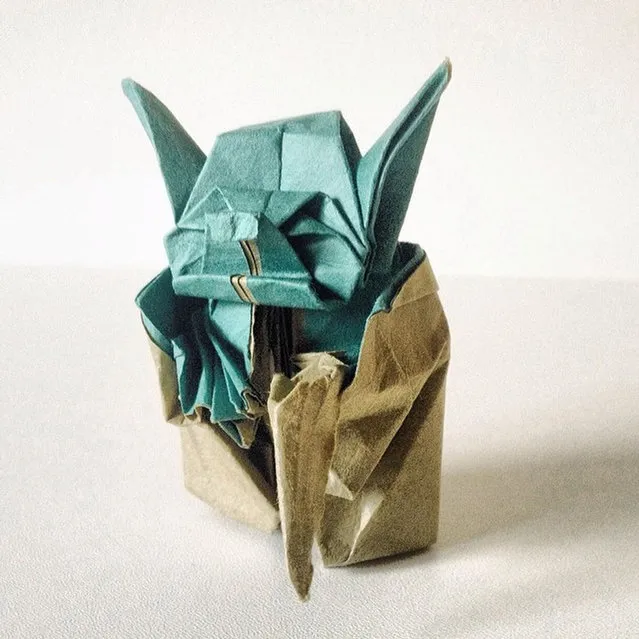
Origami By Ross Symons

As kids we have the natural desire to explore and to create. Whenever our parents would make for us a paper plane, we would become overjoyed seeing it fly across the room. However, planes are not the only thing that can be made from paper, and not only kids are fascinated by it. Some people master the art of origami and are able to create pretty much anything. You never know what’s going to come out when the artist twists and turns a piece of paper in meticulous ways. Finally, the figurine is complete, and you immediately see the striking resemblance of this piece of paper with an animal or some other creature. Ross Symons is one of those artists. He creates his figurines simply for the joy it brings him. Maybe, he uses this as a medium to enter his childhood, or maybe he has other motifs – we will never know. (Photo by Ross Symons)
Details
31 Oct 2014 12:12:00
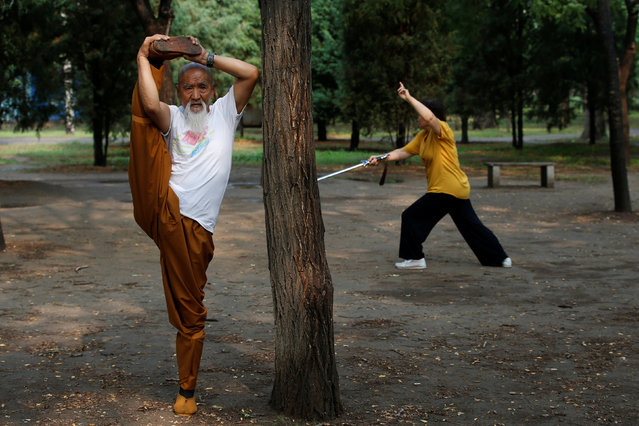
Kung Fu master Li Liangui practices 'Suogugong' Kung Fu and his wife Liang Xiaoyan (R) practices Qigong at a park in Beijing, China, June 30, 2016. (Photo by Kim Kyung-Hoon/Reuters)

Kung Fu master Li Liangui practices “Suogugong” Kung Fu and his wife Liang Xiaoyan (R) practices Qigong at a park in Beijing, China, June 30, 2016. For 50 years, kung fu master Li Liangui has been contorting his body into eye-watering positions while practising one of the more unusual and less popular Chinese martial art forms. The 70-year-old is an expert in suogugong, or body shrinking kung fu, where practitioners dislocate their bones to help them achieve unlikely positions and feats. (Photo by Kim Kyung-Hoon/Reuters)
Details
17 Sep 2016 10:27:00
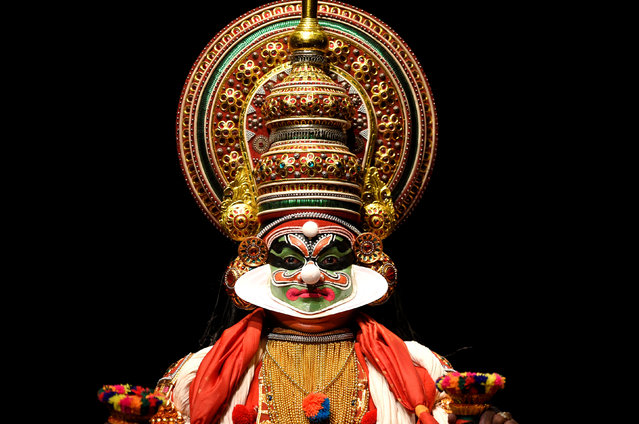
A member of the Indian company Margi Kathakali theatre performs during “Kijote Kathakali”, a Kathakali recital based on the Spanish classic “Don Quixote”, at the Niemeyer Center in Aviles, northern Spain, July 29, 2016. The performance and text captured the essence of the novel while sticking to the format of Kathakali. Kathakali is one of the major forms of classical Indian dance. It is another “story play” genre of art, but one distinguished by its elaborately colorful make-up, costumes and face masks wearing actor-dancers, who have traditionally been all males. (Photo by Eloy Alonso/Reuters)

A member of the Indian company Margi Kathakali theatre performs during “Kijote Kathakali”, a Kathakali recital based on the Spanish classic “Don Quixote”, at the Niemeyer Center in Aviles, northern Spain, July 29, 2016. The performance and text captured the essence of the novel while sticking to the format of Kathakali. Kathakali is one of the major forms of classical Indian dance. (Photo by Eloy Alonso/Reuters)
Details
31 Jul 2016 11:02:00
Brtukan. “Being a girl of colour in a society where the majority of the people are white, I have had to get used to all the different ways people approach me. From being asked what kind of rap music you listen to and how you wash your hair, to getting told, “you don’t sound black”, “you’re pretty for a black girl” or “you’re not that black so it’s OK”, as if being black is such a bad thing”. (Photo by Lisa Minogue/The Guardian)

As part of FLAIR Melbourne – a Flinders Lane art festival – Melbourne’s Lisa Minogue presents stylised photographic portraits of Australian women of colour, their faces painted vibrantly to accentuate their individuality and encourage the viewer to study each face more closely. Minogue asked each woman the same question: “What do the words “coloured girl” mean to you?”. (Photo by Lisa Minogue/The Guardian)
Details
17 Aug 2016 11:16:00


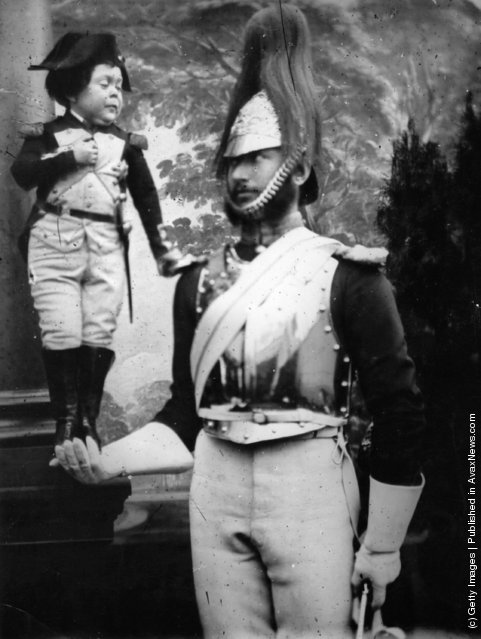
“Tom Thumb is a character of English folklore. The History of Tom Thumb was published in 1621, and has the distinction of being the first fairy tale printed in English. Tom is no bigger than his father's thumb, and his adventures include being swallowed by a cow, tangling with giants, and becoming a favourite of King Arthur. The earliest allusions to Tom occur in various 16th century works such as Reginald Scot's Discovery of Witchcraft (1584) where Tom is cited as one of the supernatural folk employed by servant maids to frighten children”. – Wikipedia

Photo: Portrait of the dwarf, Tom Thumb standing on the hand of a Guardsman. Charles Sherwood Stratton (1838 – 1883) was nicknamed General Tom Thumb by P T Barnum, the circus owner. (Photo by London Stereoscopic Company/Getty Images). Circa 1875
Details
24 Mar 2011 10:16:00
Hillcoat Riding Fu Tu. China, An Xian, 1917-1919. (Photo by Sidney David Gamble)

“Sidney D. Gamble (July 12, 1890 – 1968) was born in Cincinnati, Ohio, to David Berry and Mary Huggins Gamble; grandson of James Gamble, who, with William Procter, founded Procter & Gamble in 1837. in 1912 he graduated magna cum laude from Princeton University with a Bachelor of Literature degree and was elected to Phi Beta Kappa. He visited China for four extended periods, 1908, 1917–1919, 1924–27, and 1931–1932, doing Christian social work for the Y.M.C.A and conducting social surveys. He is now best known for his remarkable and extensive photographs of Peking and North China.” – Wikipedia. (Photo by Sidney David Gamble via Duke University Libraries)

Photo: Hillcoat Riding Fu Tu. China, An Xian, 1917-1919. P.S. All photos are available in high resolution.
Details
16 Aug 2012 11:24:00
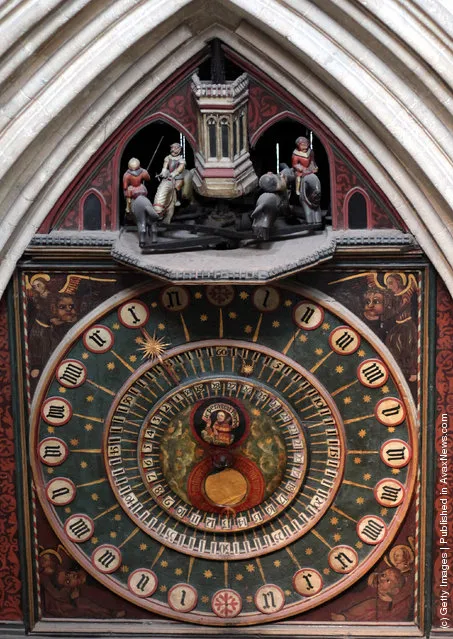
Wells Clock – World's Oldest Mechanical Clock

“Wells Cathedral is a Church of England cathedral in Wells, Somerset, England. Built between 1175 and 1490, Wells Cathedral has been described as “the most poetic of the English Cathedrals”. The Wells clock, an astronomical clock, is located in the north transept. The surviving mechanism, dated to between 1386 and 1392, was replaced in the 19th century, and was eventually moved to the Science Museum in London, where it continues to operate. It is the second-oldest surviving clock in England”. – Wikipedia

Photo: The clock face of world's oldest continually-working mechanical clock is seen as it is hand wound for the very last time on August 21, 2010 in Wells, England. (Photo by Matt Cardy/Getty Images)
Details
10 Aug 2011 11:23:00