Loading...
Done
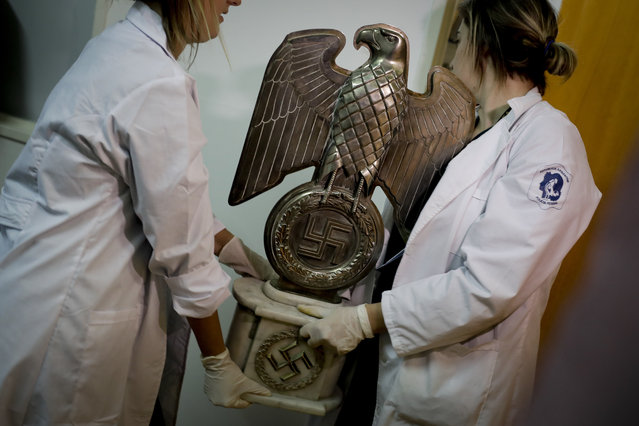
Members of the federal police carry a Nazi statue at the Interpol headquarters in Buenos Aires, Argentina, Friday, June 16, 2017. In a hidden room in a house near Argentina's capital, police discovered on June 8th the biggest collection of Nazi artifacts in the country's history. Authorities say they suspect they are originals that belonged to high-ranking Nazis in Germany during World War II. (Photo by Natacha Pisarenko/AP Photo)

Members of the federal police carry a Nazi statue at the Interpol headquarters in Buenos Aires, Argentina, Friday, June 16, 2017. In a hidden room in a house near Argentina's capital, police discovered on June 8th the biggest collection of Nazi artifacts in the country's history. Authorities say they suspect they are originals that belonged to high-ranking Nazis in Germany during World War II. (Photo by Natacha Pisarenko/AP Photo)
Details
20 Jun 2017 07:21:00
Girls dressed in Soviet WWII uniforms of traffic control officers as Russian President Vladiimir Putin lays a wreath in the Hall of Military Glory of the Mamayev Kurgan memorial complex commemorating the Battle of Stalingrad to mark the 75th anniversary of the victory in the battle in Volgograd, Russia on February 2, 2018. The battle between Nazi troops and the Soviet Army was a major pivotal moment in the Great Patriotic War and World War II. (Photo by Mikhail Metzel/TASS via Getty Images)

Girls dressed in Soviet WWII uniforms of traffic control officers as Russian President Vladiimir Putin lays a wreath in the Hall of Military Glory of the Mamayev Kurgan memorial complex commemorating the Battle of Stalingrad to mark the 75th anniversary of the victory in the battle in Volgograd, Russia on February 2, 2018. The battle between Nazi troops and the Soviet Army was a major pivotal moment in the Great Patriotic War and World War II. (Photo by Mikhail Metzel/TASS via Getty Images)
Details
04 Feb 2018 07:08:00
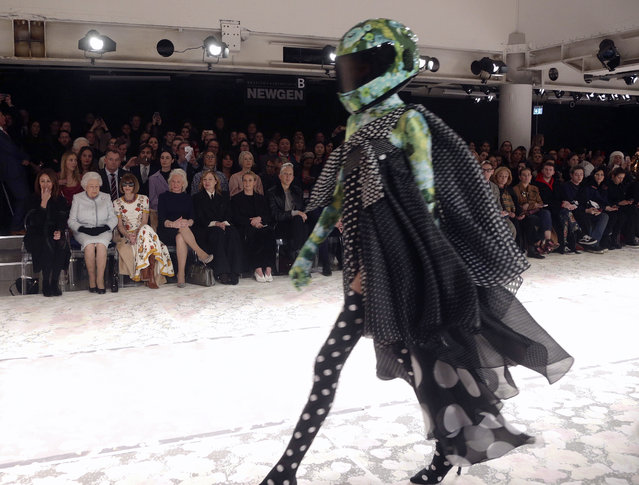
Britain's Queen Elizabeth, second left, sits next to fashion editor Anna Wintour, third left, and Caroline Rush, chief executive of the British Fashion Council (BFC) as they view Richard Quinn's runway show before presenting him with the inaugural Queen Elizabeth II Award for British Design, as she visits London Fashion Week's BFC Show Space in central London, Tuesday, February 20, 2018. (Photo by Yui Mok/Pool photo via AP Photo)

Britain's Queen Elizabeth, second left, sits next to fashion editor Anna Wintour, third left, and Caroline Rush, chief executive of the British Fashion Council (BFC) as they view Richard Quinn's runway show before presenting him with the inaugural Queen Elizabeth II Award for British Design, as she visits London Fashion Week's BFC Show Space in central London, Tuesday, February 20, 2018. (Photo by Yui Mok/Pool photo via AP Photo)
Details
22 Feb 2018 08:32:00
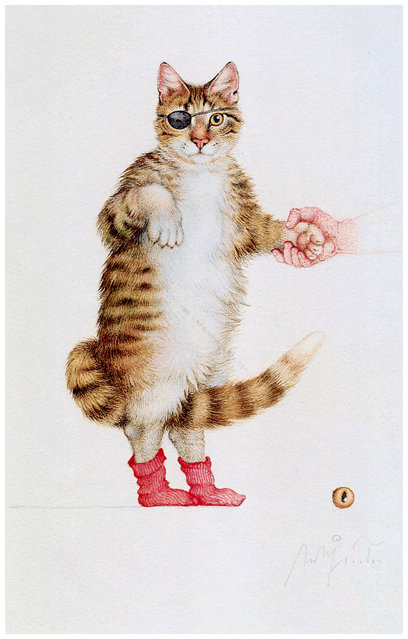
Katerfruehstueck. Artwork by Michael Mathias Prechtl

“Michael Mathias Prechtl (April 26, 1926, Amberg – March 19, 2003, Nuremberg) was a German artist, illustrator and cartoonist. He served as a soldier on the Eastern Front during World War II and spent 1945-49 as a prisoner of war in the Soviet Union”. – Wikipedia

Photo: “Der Gestiefelte Kater (Puss in Boots)”, 1997. Artwork by Michael Mathias Prechtl
Details
09 Sep 2012 10:45:00
Rabbit Island in Japan

Only after World War II did the secret spill: Ōkunoshima, located in the Inland Sea of Japan between Hiroshima and Shikoku, was the top-secret site for manufacturing chemical warfare. When the factories were closed down, a number of exotic wild rabbits were seen freely roaming the island. They were assumed to have been the test subjects for the chemical weapons, which the military failed to eradicate when the factory was demolished.
Details
17 Feb 2014 12:23:00
D-Day memory lane

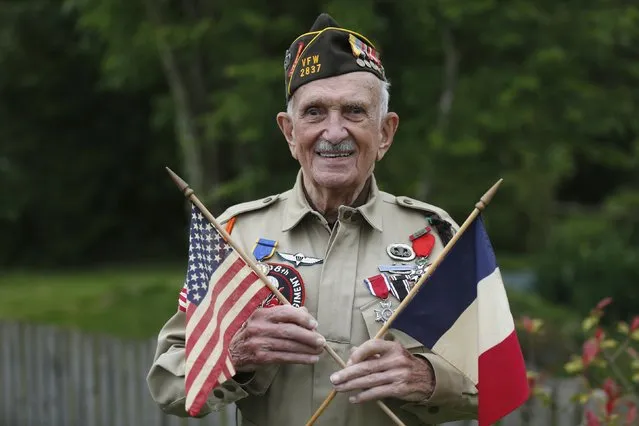
World War II veteran Jack W. Schlegel, 91 years-old, from Mount Tremper, New York, of the 508th Parachute Infantry Division of the 82nd Airborne who parachuted near Sainte-Mere-Eglise on June 6,1944, poses with American and French flags as he visits the American War cemetery in Colleville-sur-Mer, on the Normandy coast June 2, 2014. REUTERS/Pascal Rossignol
Details
04 Jun 2014 19:12:00


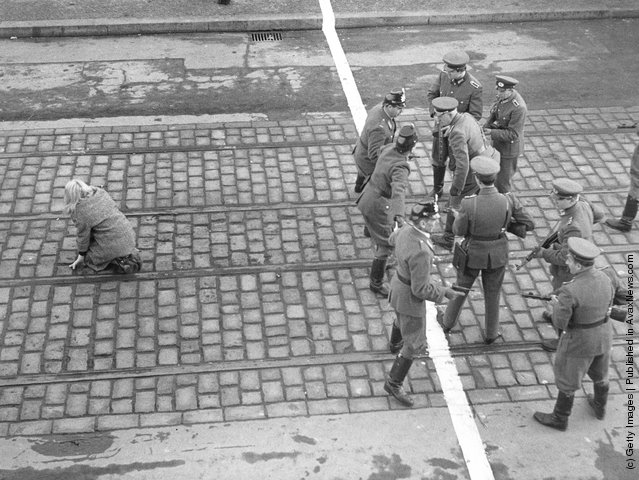
“The Berlin Wall (German: Berliner Mauer) was a barrier constructed by the German Democratic Republic (GDR, East Germany) starting on 13 August 1961, that completely cut off West Berlin from surrounding East Germany and from East Berlin. The barrier included guard towers placed along large concrete walls, which circumscribed a wide area (later known as the “death strip”) that contained anti-vehicle trenches, “fakir beds” and other defenses. The Soviet-dominated Eastern Bloc officially claimed that the wall was erected to protect its population from fascist elements conspiring to prevent the “will of the people” in building a socialist state in East Germany. However, in practice, the Wall served to prevent the massive emigration and defection that marked Germany and the communist Eastern Bloc during the post-World War II period”. – Wikipedia

Photo: West Berlin policemen and East German Volkspolizei face each other across the border in Berlin, circa 1955. (Photo by Three Lions/Hulton Archive/Getty Images)
Details
22 May 2011 10:49:00
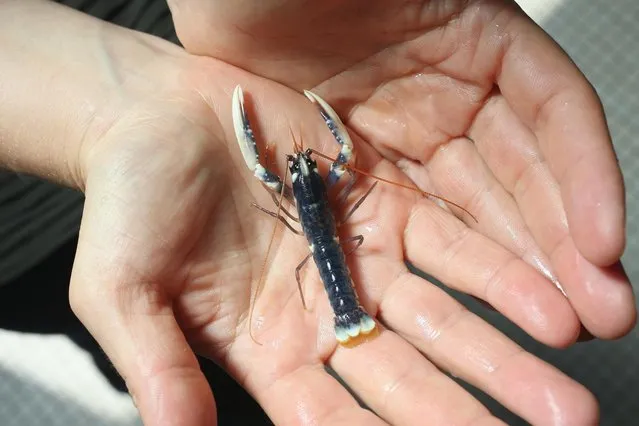
Isabel Schmalenbach, an environmental scientist with the Helgoland Biological Institute (Biologische Anstalt Helgoland), part of the Alfred Wegener Institute for Polar and Marine Research, holds a one-year old baby European lobster (Homarus gammarus) raised at the institute on August 3, 2013 on Helgoland Island, Germany. (Photo by Sean Gallup/Getty Images)

Isabel Schmalenbach, an environmental scientist with the Helgoland Biological Institute (Biologische Anstalt Helgoland), part of the Alfred Wegener Institute for Polar and Marine Research, holds a one-year old baby European lobster (Homarus gammarus) raised at the institute on August 3, 2013 on Helgoland Island, Germany. Later in the day Schmalenbach and her colleagues released a total of 415 one-year old lobsters into the North Sea as part of an effort to repopulate the lobster population around Helgoland (also called Heligoland). In the 19th century local fishermen caught up to 80,000 lobsters a year in the surrounding waters, combined with the heavy allied bombing of the island during and after World War II, as well as other environmental factors, decimated the lobster population. (Photo by Sean Gallup)
Details
05 Aug 2013 08:39:00