Loading...
Done
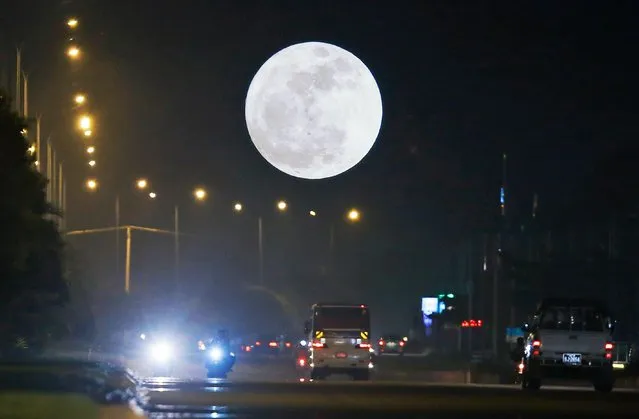
A so-called “Supermoon” dominates the sky while traffic rolls in the streets in Naypyitaw, Myanmar, 03 December 2017. According to the National Aeronautics and Space Administration (NASA) a series of three “Supermoons” – dubbed the “Supermoon trilogy” – will appear in the sky on 03 December 2017, on 01 January 2018 and and 31 January 2018. A 'Supermoon' commonly is a full moon at its closest distance to the earth with the moon appearing larger than usual. (Photo by Hein Htet/EPA/EFE)

A so-called “Supermoon” dominates the sky while traffic rolls in the streets in Naypyitaw, Myanmar, 03 December 2017. According to the National Aeronautics and Space Administration (NASA) a series of three “Supermoons” – dubbed the “Supermoon trilogy” – will appear in the sky on 03 December 2017, on 01 January 2018 and and 31 January 2018. A “Supermoon” commonly is a full moon at its closest distance to the earth with the moon appearing larger than usual. (Photo by Hein Htet/EPA/EFE)
Details
05 Dec 2017 07:45:00
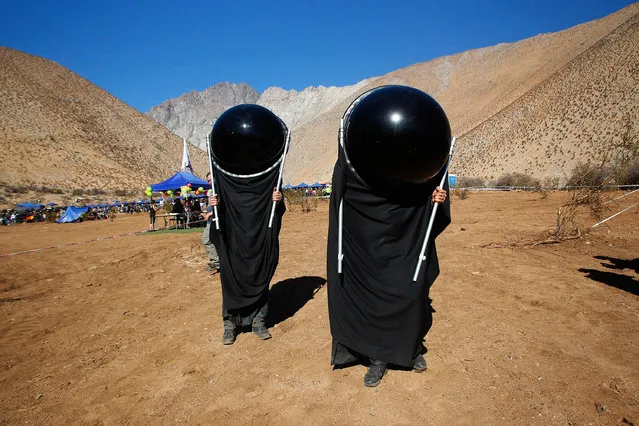
Chileans watch the sky with special suits prior to a total solar eclipse on July 2, 2019 in Paiguano, Chile. Around 25,0000 tourists arrived to Paiguano, a small town of around 1,000 inhabitants in the Elqui Valley, 650 km away Santiago. This is the only Earth's total solar eclipse of 2019 and the first one since 2017. From this point, the sun will fully disappear for around two minutes. It is best visible from a stripe in the South Pacific, Chile and Argentina. (Photo by Marcelo Hernandez/Getty Images)

Chileans watch the sky with special suits prior to a total solar eclipse on July 2, 2019 in Paiguano, Chile. Around 25,0000 tourists arrived to Paiguano, a small town of around 1,000 inhabitants in the Elqui Valley, 650 km away Santiago. This is the only Earth's total solar eclipse of 2019 and the first one since 2017. From this point, the sun will fully disappear for around two minutes. It is best visible from a stripe in the South Pacific, Chile and Argentina. (Photo by Marcelo Hernandez/Getty Images)
Details
04 Jul 2019 00:05:00
An offering of a dried baby llama and fake U.S. burn in honor of Pachamama, or Mother Earth, during a New Year ritual on Turriturrini Mountain on the outskirts of Huarina, Bolivia, Friday, June 21, 2024. Aymara Indigenous communities are celebrating the Andean New Year 5,532 or “Willka Kuti” which translates to “Return of the sun” in Aymara. (Photo by Juan Karita/AP Photo)

An offering of a dried baby llama and fake U.S. burn in honor of Pachamama, or Mother Earth, during a New Year ritual on Turriturrini Mountain on the outskirts of Huarina, Bolivia, Friday, June 21, 2024. Aymara Indigenous communities are celebrating the Andean New Year 5,532 or “Willka Kuti” which translates to “Return of the sun” in Aymara. (Photo by Juan Karita/AP Photo)
Details
31 Jul 2024 06:29:00
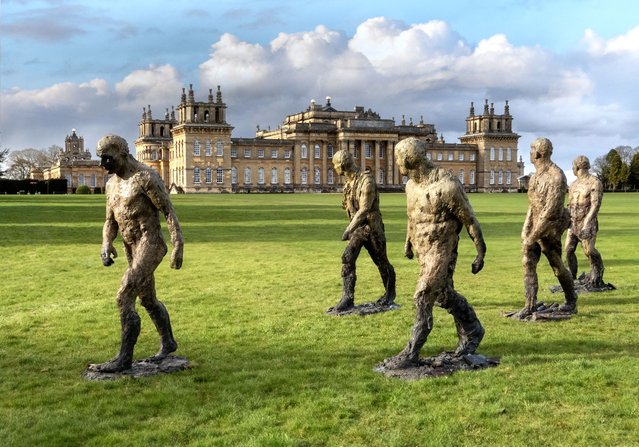
British sculptor Laurence Edwards' striking bronze figures, Walking Men, at Blenheim Palace in Oxfordshire, UK on April 9, 2024. The 8ft tall figures are seen to be anti-heroic and seem to have come from the earth itself. Branches, leaves and clods of clay are woven through them, making it unclear where human and ground begin and end. (Photo by Pete Seaward/South West News Service)

British sculptor Laurence Edwards' striking bronze figures, Walking Men, at Blenheim Palace in Oxfordshire, UK on April 9, 2024. The 8ft tall figures are seen to be anti-heroic and seem to have come from the earth itself. Branches, leaves and clods of clay are woven through them, making it unclear where human and ground begin and end. (Photo by Pete Seaward/South West News Service)
Details
21 May 2024 13:56:00
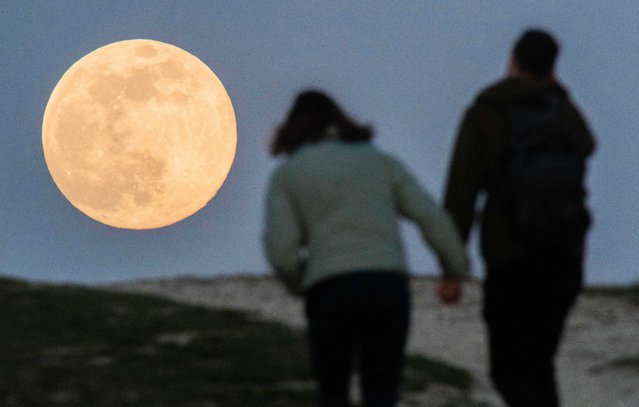
A couple is walking hand-held up Kronsberg, just outside Hanover, Germany on April 7, 2020, when the moon rises on the horizon as the so-called supermoon. The moon reaches its perigee, i.e. the point closest to the Earth's orbit, on the night of 7-8 April as a full moon and therefore appears particularly large to the human observer. (Photo by Julian Stratenschulte/dpa via ZUMA Press)

A couple is walking hand-held up Kronsberg, just outside Hanover, Germany on April 7, 2020, when the moon rises on the horizon as the so-called supermoon. The moon reaches its perigee, i.e. the point closest to the Earth's orbit, on the night of 7-8 April as a full moon and therefore appears particularly large to the human observer. (Photo by Julian Stratenschulte/dpa via ZUMA Press)
Details
09 Apr 2020 00:07:00
An employee of the National Park Service takes a selfie with President Barack Obama, left, in the background meeting with the crowd after a tour of Everglades National Park on Earth Day, Wednesday, April 22, 2015, in Florida. Obama used the visit  to warn of the damage that climate change is already inflicting on the nation's environmental treasures. (Photo by Lynne Sladky/AP Photo)

An employee of the National Park Service takes a selfie with President Barack Obama, left, in the background meeting with the crowd after a tour of Everglades National Park on Earth Day, Wednesday, April 22, 2015, in Florida. Obama used the visit to warn of the damage that climate change is already inflicting on the nation's environmental treasures. (Photo by Lynne Sladky/AP Photo)
Details
29 Apr 2015 06:52:00
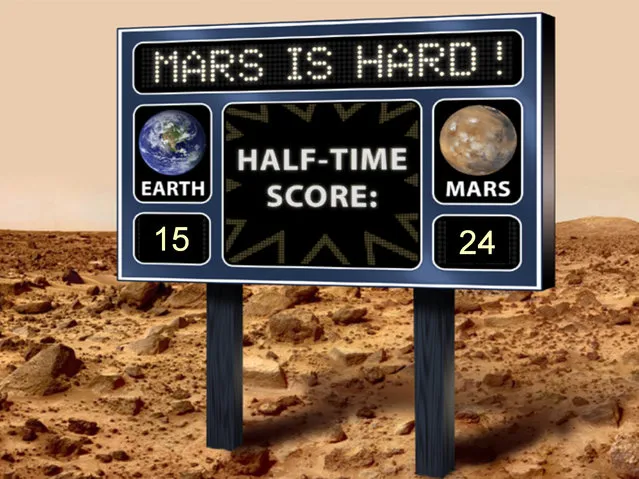
This artist's scoreboard displays a fictional game between Mars and Earth, with Mars in the lead. (Image by NASA/JPL-Caltech)

This artist's scoreboard displays a fictional game between Mars and Earth, with Mars in the lead. It refers to the success rate of sending missions to Mars, both as orbiters and landers. Of the previous 39 missions targeted for Mars from around the world, 15 have been successes and 24 failures. For baseball fans, that's a batting average of .385. The United States has had 13 successes out of 18 attempts, or a “batting average” of .722. NASA's Curiosity rover, set to land on the Red Planet the evening of Aug. 5, 2012 PDT (morning of Aug. 6 EDT), will mark the United States' 19th attempt to tackle the challenge of Mars, and the world's 40th attempt. (Image by NASA/JPL-Caltech)
Details
06 Aug 2012 09:47:00
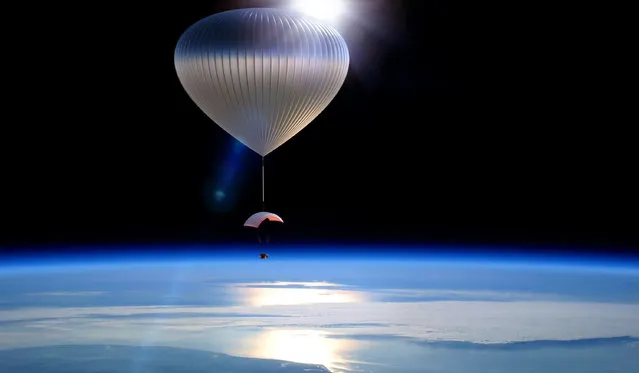
This undated image provided by World View shows World View capsule and balloon spacecraft that will rise to 100,000 feet above Earth for passengers to see the curvature of the planet and the blackness of space. (Photo by World View via AP Photo)

This undated image provided by World View shows World View capsule and balloon spacecraft that will rise to 100,000 feet above Earth for passengers to see the curvature of the planet and the blackness of space. Space tourism companies are employing designs including winged vehicles, vertical rockets with capsules and high-altitude balloons. While developers envision ultimately taking people to orbiting habitats, the moon or beyond, the immediate future involves short flights into or near the lowest reaches of space without going into orbit. (Photo by World View via AP Photo)
Details
15 Feb 2016 10:28:00