Loading...
Done
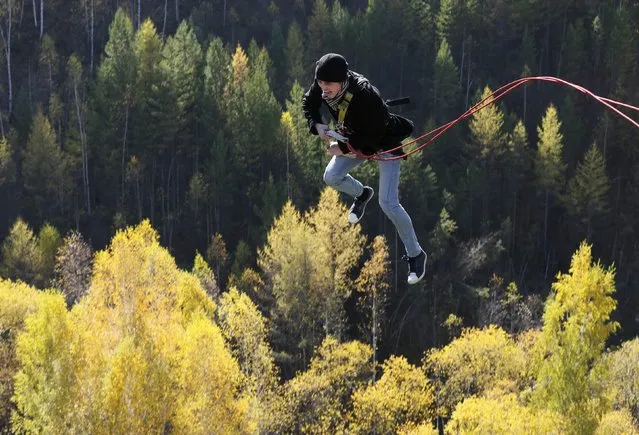
A member of the “Exit Point” amateur rope-jumping group jumps from a 44-metre high (144-feet high) waterpipe bridge in the Siberian Taiga area outside Krasnoyarsk, September 28, 2014. (Photo by Ilya Naymushin/Reuters)

A member of the “Exit Point” amateur rope-jumping group jumps from a 44-metre high (144-feet high) waterpipe bridge in the Siberian Taiga area outside Krasnoyarsk, September 28, 2014. Fans of rope-jumping, a kind of extreme sport involving a jump from a high point using an advanced system of amortization including mountaineering and rope safety equipment, attended the Golden Autumn group's jumping season. (Photo by Ilya Naymushin/Reuters)
Details
04 Oct 2014 11:12:00
A sculptural artwork depicting former Chilean dictator Augusto Pinochet and headless presidents shot by a hooded high school student (not pictured) is seen at the Contemporary Art Museum in Santiago, December 2, 2014. (Photo by Ivan Alvarado/Reuters)

A sculptural artwork depicting former Chilean dictator Augusto Pinochet and headless presidents shot by a hooded high school student (not pictured) is seen at the Contemporary Art Museum in Santiago, December 2, 2014. The artwork, part of the “El ladrillo angular” (The angular brick) exhibition, portrays a student fighting against the ongoing continuity of dictatorship because of a political and economic system which has been impossible to destroy, according to “Papas Fritas” the artwork's creator. (Photo by Ivan Alvarado/Reuters)
Details
03 Dec 2014 14:45:00
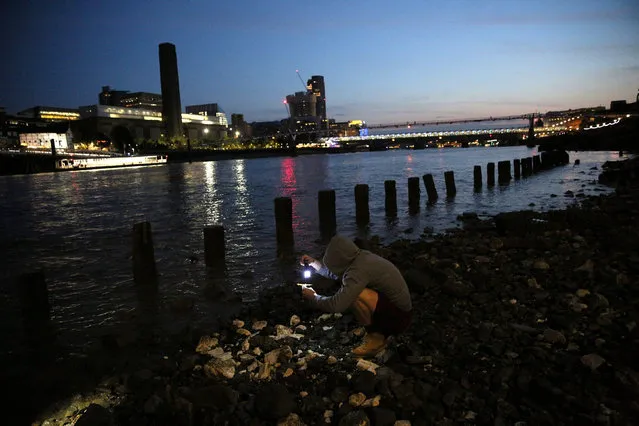
A mudlark uses a torch to look for items on the bank of the River Thames in London, Britain June 06, 2016. Mudlarking is believed to trace its origins to the 18th and 19th century, when scavengers searched the Thames' shores for items to sell. These days, history and archaeology fans are the ones hoping to find old relics such as coins, ceramics, artifacts or everyday items from across centuries. They wait for the low tide and then scour specific areas of exposed shores. "If you're in a field you could be out all day long, with the river you're restricted to about two or three hours," mudlark Nick Stevens said. While many just use the naked eye for their searches, others rely on metal detectors for which a permit from the Port of London Authority is needed. Digging also requires consent. (Photo by Neil Hall/Reuters)

A mudlark uses a torch to look for items on the bank of the River Thames in London, Britain June 06, 2016. Mudlarking is believed to trace its origins to the 18th and 19th century, when scavengers searched the Thames' shores for items to sell. These days, history and archaeology fans are the ones hoping to find old relics such as coins, ceramics, artifacts or everyday items from across centuries. their finds with the Portable Antiquities Scheme. Any item over 300 years old must be recorded. (Photo by Neil Hall/Reuters)
Details
27 Aug 2016 10:43:00
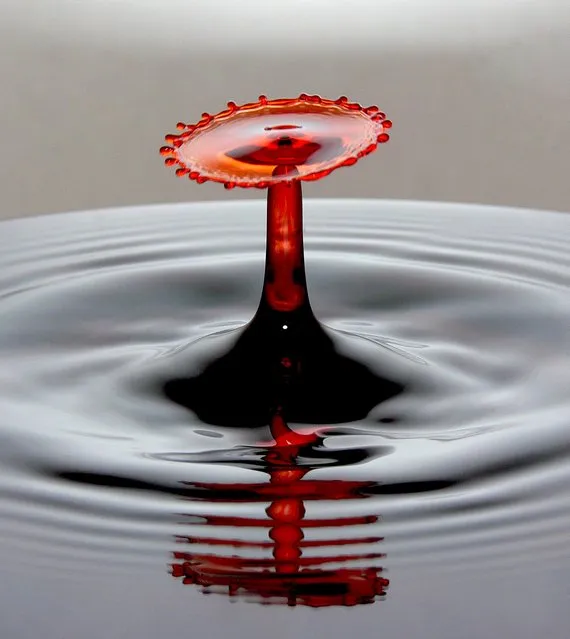
Waterdrop Sculptures by Josh Fancher

“I'm Josh Fancher, a 21 year old with an avid interest in photography, including macro, nature and wildlife, night photography, landscapes, cityscapes and architectural photography. Inspired by the beautiful and amazing water drop photography of Martin Waugh, I started doing water drop collisions in December of 2007. I use a 105mm Micro Nikkor lens for water drops, along with a pair of Nikon SB 600 flashes. I recently got a StopShot system (Nov 2009), which makes timing a lot easier. Before then, timing was manual, with an eye dropper, eye-hand coordination, and a lot of patience” – Josh Fancher. (Photo by Josh Fancher)
Details
19 Aug 2012 10:30:00


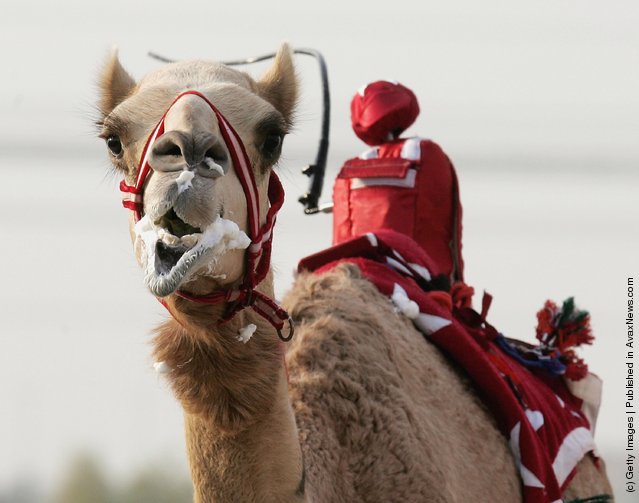
A camel foams at the mouth as he is whipped by a robot jockey during a race at Nad al-Sheba on December 6, 2006 in Dubai, United Arab Emirates. This is the first season that robotic jockeys have been used to race camels in Dubai. Controversially children from India were used to ride the camels in past seasons. These robot jockeys costing 15000GBP and up, were designed in Geneva and include shock absorbers and GPS tracking systems. The camel's owners control them from their speeding four wheel drives at the side of the track. (Photo by Chris Jackson/Getty Images)
Details
01 May 2011 09:01:00
RT-2PM2 Topol-M TEL with presumably Yars system transport-launch container

“March 19, 2012 was the first rehearsal for the Victory Day Parade at the training ground in Alabino (near Moscow, Moscow Military District). Since the end of February troops and vehicles from various units and formations of the Armed Forces began arriving to Alabino training ground. The first rehearsal included only military vehicles. During the ride the average speed of vehicles is 12 km/h, the distance depending on the type of vehicle from 12 to 15 meters”. – Vitaly Kuzmin
Details
15 Apr 2012 12:50:00
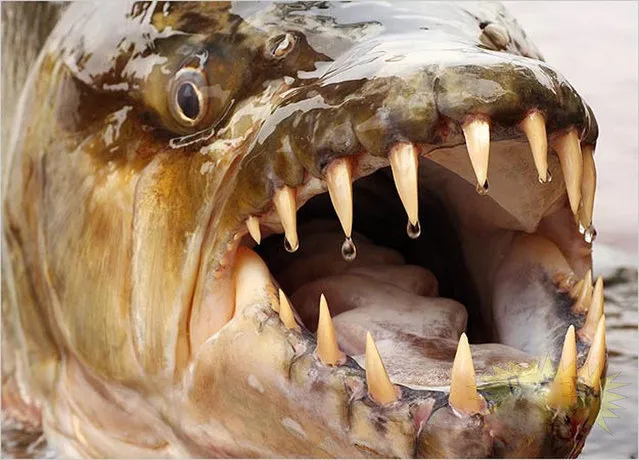
Hydrocynus goliath, also known as the goliath tigerfish, giant tigerfish or mbenga

“Hydrocynus goliath, also known as the goliath tigerfish, giant tigerfish or mbenga, is a very large African predatory freshwater fish. The giant tigerfish is restricted to the Zaire River system, Lualaba River, Lake Upemba and Lake Tanganyika”. (Photo by Tigerfishcamp / Tourettefishing / Bigfishesoftheworld)
Details
15 May 2012 12:04:00
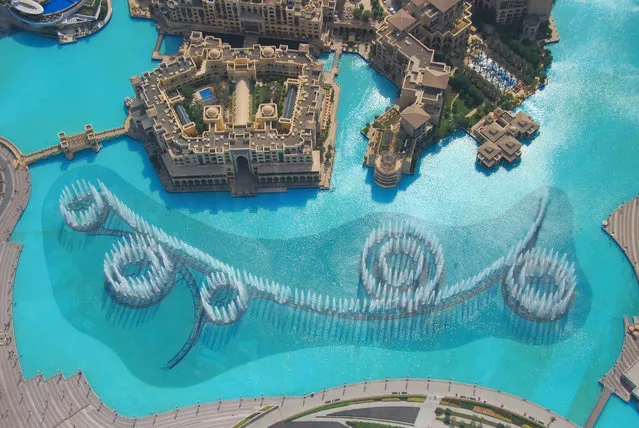
The Dubai Fountain

The Dubai Fountain is a record-setting choreographed fountain system set on the 30-acre manmade Burj Khalifa Lake, at the center of the Downtown Dubai development in Dubai, United Arab Emirates. It was designed by WET Design, the California-based company responsible for the fountains at the Bellagio Hotel Lake in Las Vegas. Illuminated by 6,600 lights and 25 colored projectors, it is 275 m (902 ft) long and shoots water 240 feet into the air accompanied by a range of classical to contemporary Arabic and world music. It was built at a cost of AED 800 million (USD 218 million).
Details
08 Jun 2015 10:55:00