Loading...
Done
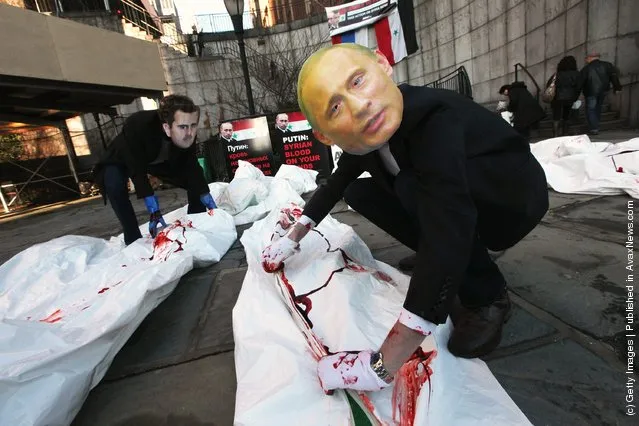
Actors wearing masks of Syrian President Bashar al-Assad and Russian Prime Minister Vladimir Putin perform with body bags during a demonstration outside United Nations headquarters

Actors wearing masks of Syrian President Bashar al-Assad and Russian Prime Minister Vladimir Putin perform with body bags during a demonstration outside United Nations headquarters on January 24, 2011 in New York City. Protesters called on the U.N. Security Council to pass a resolution to attempt to halt al-Assad's crackdown on the Syrian uprising. (Photo by Mario Tama/Getty Images)
Details
25 Jan 2012 11:43:00
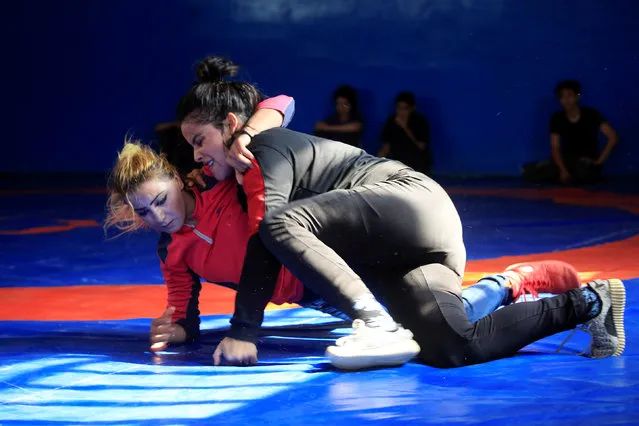
Iraqi women practice at the sports club in Diwaniya, Iraq on November 10, 2018. (Photo by Alaa Al-Marjani/Reuters)

Iraqi women practice at the sports club in Diwaniya, Iraq on November 10, 2018. On the blue mats of the al-Rafideen Club in the conservative city of Diwaniya, some 180 km (110 miles) south of Baghdad, some 30 female wrestlers, some still wearing headscarves, train three times a week. When a big competition comes up, they train every day. (Photo by Alaa Al-Marjani/Reuters)
Details
19 Nov 2018 00:03:00
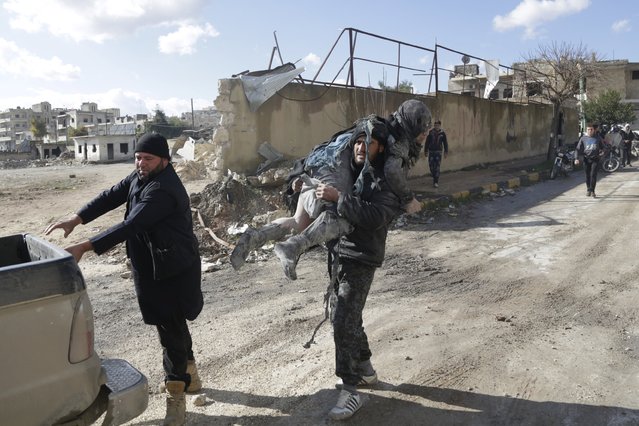
A man carries an injured woman in a site hit by what activists said were airstrikes carried out by the Russian air force in the rebel-controlled area of Maaret al-Numan town in Idlib province, Syria January 9, 2016. (Photo by Khalil Ashawi/Reuters)

A man carries an injured woman in a site hit by what activists said were airstrikes carried out by the Russian air force in the rebel-controlled area of Maaret al-Numan town in Idlib province, Syria January 9, 2016. At least 70 people died in what activists said where four vacuum bombs dropped by the Russian air force in the town of Maaret al-Numan; other air strikes where also carried out in the towns of Saraqib, Khan Sheikhoun and Maar Dabseh, in Idlib. (Photo by Khalil Ashawi/Reuters)
Details
10 Jan 2016 12:08:00
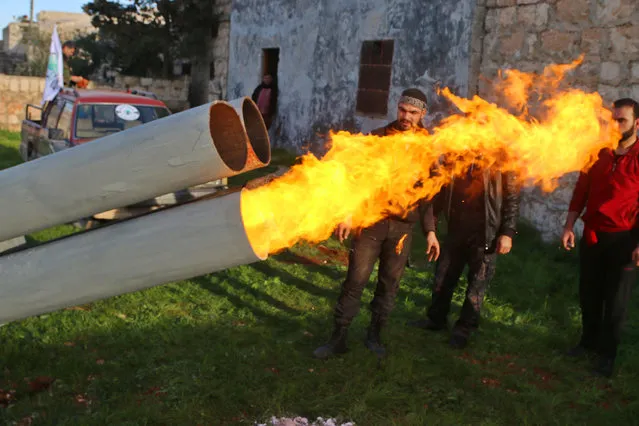
Al-Shamiyah Front fighters inspect a new locally-made cannon named “Borkan” (Volcano) as it was being launched towards forces loyal to Syria's president Bashar Al-Assad located in Aleppo artillery school, March 7, 2015. The “Borkan” is made out of four tubes attached to a loader, which can fire four shells at a time, and have a range of three kilometers (1.86 miles). (Photo by Abdalrhman Ismail/Reuters)

Al-Shamiyah Front fighters inspect a new locally-made cannon named “Borkan” (Volcano) as it was being launched towards forces loyal to Syria's president Bashar Al-Assad located in Aleppo artillery school, March 7, 2015. The “Borkan” is made out of four tubes attached to a loader, which can fire four shells at a time, and have a range of three kilometers (1.86 miles). (Photo by Abdalrhman Ismail/Reuters)
Details
24 Mar 2015 10:11:00
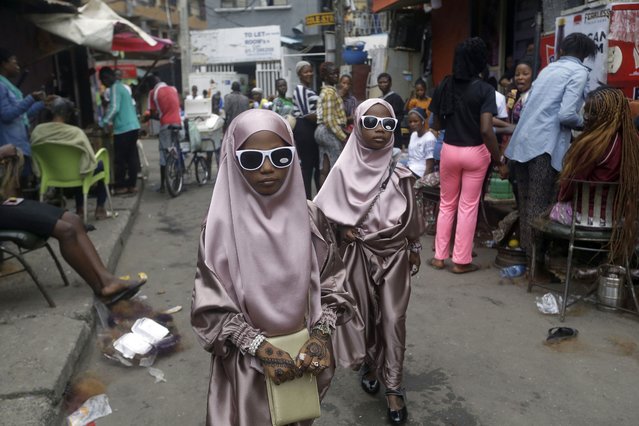
Muslim girls are seen after prayers, in Lagos, Nigeria, Friday, July 31, 2020. Small groups of pilgrims performed one of the final rites of the Islamic hajj on Friday as Muslims worldwide marked the start of the Eid al-Adha holiday amid a global pandemic that has impacted nearly every aspect of this year's pilgrimage and celebrations. The last days of hajj coincide with the four-day Eid al-Adha, or “Feast of Sacrifice”, in which Muslims slaughter livestock and distribute the meat to the poor. (Photo by Sunday Alamba/AP Photo)

Muslim girls are seen after prayers, in Lagos, Nigeria, Friday, July 31, 2020. Small groups of pilgrims performed one of the final rites of the Islamic hajj on Friday as Muslims worldwide marked the start of the Eid al-Adha holiday amid a global pandemic that has impacted nearly every aspect of this year's pilgrimage and celebrations. The last days of hajj coincide with the four-day Eid al-Adha, or “Feast of Sacrifice”, in which Muslims slaughter livestock and distribute the meat to the poor. (Photo by Sunday Alamba/AP Photo)
Details
14 Aug 2020 00:01:00
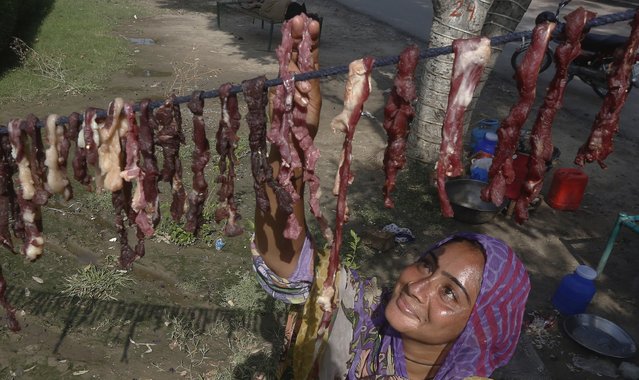
A woman hangs strips of salted meat she collected from different places during the Muslim's Eid al-Adha or Festival of Sacrifice, in Lahore, Pakistan, Sunday, August 2, 2020. Pakistanis are celebrating the Eid al-Adha, or the Feast of the Sacrifice, to mark the willingness of the Prophet Ibrahim – Abraham to Christians and Jews – to sacrifice his son. During the holiday Muslims slaughter sheep and cattle, distribute part of the meat to the poor. (Photo by K.M. Chaudary/AP Photo)

A woman hangs strips of salted meat she collected from different places during the Muslim's Eid al-Adha or Festival of Sacrifice, in Lahore, Pakistan, Sunday, August 2, 2020. Pakistanis are celebrating the Eid al-Adha, or the Feast of the Sacrifice, to mark the willingness of the Prophet Ibrahim – Abraham to Christians and Jews – to sacrifice his son. During the holiday Muslims slaughter sheep and cattle, distribute part of the meat to the poor. (Photo by K.M. Chaudary/AP Photo)
Details
28 Aug 2020 00:05:00
Iraqis run for cover as they flee Mosul's Al-Tayaran neighbourhood on February 28, 2017, during an offensive by Iraqi forces to retake the area from Islamic State (IS) group fighters. Hundreds of civilians fled through the desert to escape fighting and privation in Mosul, joining thousands of others who left their homes as conditions worsen in the city's west. (Photo by Ahmad Al-Rubaye/AFP Photo)

Iraqis run for cover as they flee Mosul's Al-Tayaran neighbourhood on February 28, 2017, during an offensive by Iraqi forces to retake the area from Islamic State (IS) group fighters. Hundreds of civilians fled through the desert to escape fighting and privation in Mosul, joining thousands of others who left their homes as conditions worsen in the city's west. (Photo by Ahmad Al-Rubaye/AFP Photo)
Details
02 Mar 2017 00:01:00
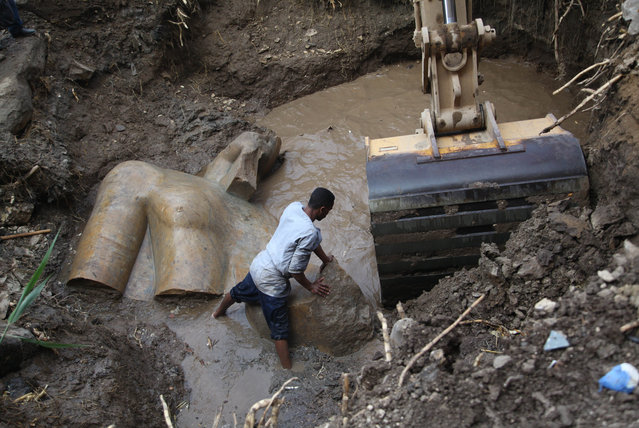
An Egyptian worker prepares to lift parts of a statue at the site of a new archeological discovery at Souq Al-Khamis district in Al-Matareya area, Cairo, Egypt on March 9 2017. According to the Ministry of Antiquities, two 19th dynasty royal statues were found in parts in the vicinity of King Ramses II temple in ancient Heliopolis (Oun) Sun Temples by a German-Egyptian archeological mission. (Photo by Xinhua News Agency/Rex Features/Shutterstock)

An Egyptian worker prepares to lift parts of a statue at the site of a new archeological discovery at Souq Al-Khamis district in Al-Matareya area, Cairo, Egypt on March 9 2017. According to the Ministry of Antiquities, two 19th dynasty royal statues were found in parts in the vicinity of King Ramses II temple in ancient Heliopolis (Oun) Sun Temples by a German-Egyptian archeological mission. (Photo by Xinhua News Agency/Rex Features/Shutterstock)
Details
15 Mar 2017 00:06:00