Loading...
Done
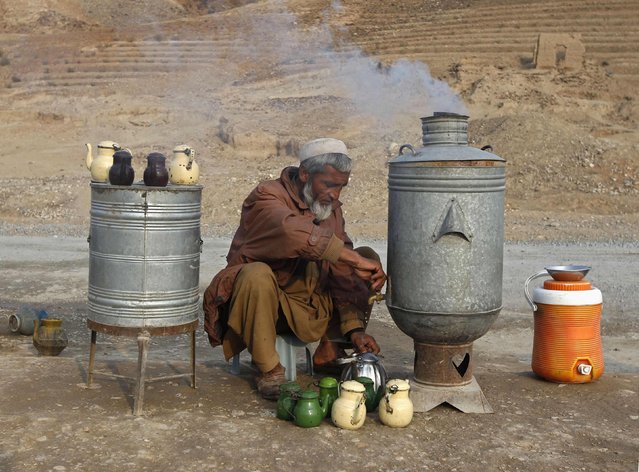
An Afghan man prepares tea for customers at a roadside tea shop on the outskirts of Jalalabad February 2, 2015. (Photo by Reuters/Parwiz)

An Afghan man prepares tea for customers at a roadside tea shop on the outskirts of Jalalabad February 2, 2015. (Photo by Reuters/Parwiz)
Details
25 Feb 2015 08:44:00
Visitors look at tropical fish transported from Japan's southern island of Okinawa displayed in a giant 14-ton fish tank at the Sony Square event space in Tokyo on July 17, 2016. The 45-day-long summer exhibition will be held through August 28 to display sea creatures common to the waters around Okinawa. (Photo by Kazuhiro Nogi/AFP Photo)

Visitors look at tropical fish transported from Japan's southern island of Okinawa displayed in a giant 14-ton fish tank at the Sony Square event space in Tokyo on July 17, 2016. The 45-day-long summer exhibition will be held through August 28 to display sea creatures common to the waters around Okinawa. (Photo by Kazuhiro Nogi/AFP Photo)
Details
18 Jul 2016 13:05:00
Young woman, 20+, with goose bumps, standing on the beach, Niendorf at the Baltic Sea, Schleswig-Holstein, Germany, Europe on September 1, 2016. (Photo by Alamy Stock Photo)

Young woman, 20+, with goose bumps, standing on the beach, Niendorf at the Baltic Sea, Schleswig-Holstein, Germany, Europe on September 1, 2016. (Photo by Alamy Stock Photo)
Details
06 Sep 2016 10:37:00
A view of traditional bolinhos de bacalhau (fried codfish balls) in Rio de Janeiro, Brazil, May 7, 2016. (Photo by Sergio Moraes/Reuters)

If the most popular foods of Rio de Janeiro have one thing in common, it is their informality. You can find fine restaurants in the city, but they do not set Rio apart from other places. What does set it apart, and what invariably brings its residents, known as "Cariocas," together is the unpretentious food they eat in bright, loud, crowded bars and restaurants, on busy street corners, or after a day at the beach. Here: A view of traditional bolinhos de bacalhau (fried codfish balls) in Rio de Janeiro, Brazil, May 7, 2016. (Photo by Sergio Moraes/Reuters)

Details
05 Aug 2016 13:20:00
A visitor looks at a creation by Russian artist Irina Nakhova presented at the Russia's pavilion during the 56th International Art Exhibition (Biennale d'Arte) titled “All the Worlds Futures” on May 5, 2015 in Venice. (Photo by Gabriel Bouys/AFP Photo)

A visitor looks at a creation by Russian artist Irina Nakhova presented at the Russia's pavilion during the 56th International Art Exhibition (Biennale d'Arte) titled “All the Worlds Futures” on May 5, 2015 in Venice. (Photo by Gabriel Bouys/AFP Photo)
Details
09 May 2015 11:25:00
A girl paddles on her stand-up board on the waters of Guanabara bay at Bica beach in Rio de Janeiro Brazil, January 10, 2016. (Photo by Ricardo Moraes/Reuters)

A girl paddles on her stand-up board on the waters of Guanabara bay at Bica beach in Rio de Janeiro Brazil, January 10, 2016. Few features capture the beauty, or the problems, of one of the world's most dramatic urban landscapes like Guanabara Bay - the finger-like inlet that forms the shoreline and harbor for Rio de Janeiro. The bay, which carves into southeast Brazil from the Atlantic Ocean, literally gave Rio its name when Portuguese mariners mistook it for a “rio”, or “river”. Four centuries later, the bay is preparing to welcome another sort of seafarer – Olympic sailors, who will navigate the bay when the 2016 Rio Olympics kick off in August. (Photo by Ricardo Moraes/Reuters)
Details
28 Apr 2016 12:13:00
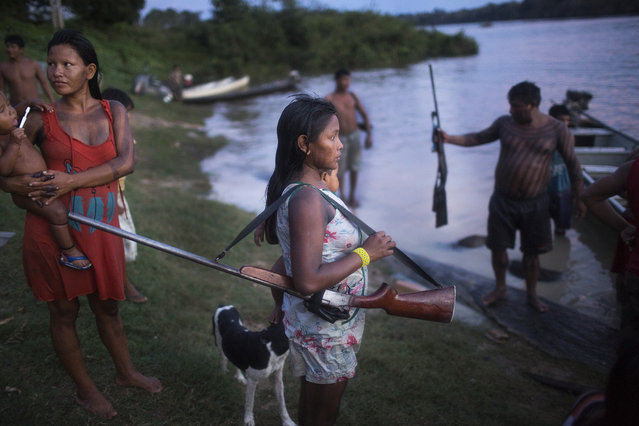
A Xikrin woman holds her husband's shotgun while he cleans freshly hunted peccary in the river. According to tradition, Xikrin women are not allowed to leave the village while their husbands are out hunting a wife must patiently wait for his return. (Taylor Weidman)

A Xikrin woman holds her husband's shotgun while he cleans freshly hunted peccary in the river. According to tradition, Xikrin women are not allowed to leave the village while their husbands are out hunting a wife must patiently wait for his return. (Photo and caption by Taylor Weidman)
Details
13 Dec 2013 09:32:00
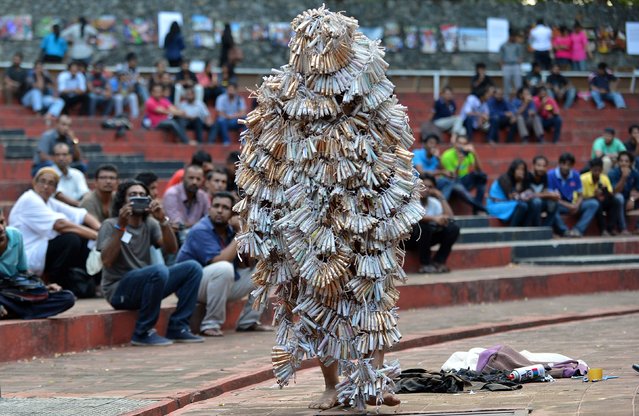
A Sri Lankan activist, who wrapped himself with fire crackers, walks in Colombo on July 23, 2014 to symbolically demonstrate against people burned during Anti-Tamil riots on the island thirty-one years ago. Official accounts placed the death toll at 400 while human rights activists put the toll at thousands. (Photo by Ishara S.Kodikara/AFP Photo)

A Sri Lankan activist, who wrapped himself with fire crackers, walks in Colombo on July 23, 2014 to symbolically demonstrate against people burned during Anti-Tamil riots on the island thirty-one years ago. Official accounts placed the death toll at 400 while human rights activists put the toll at thousands. (Photo by Ishara S.Kodikara/AFP Photo)
Details
26 Jul 2014 12:00:00