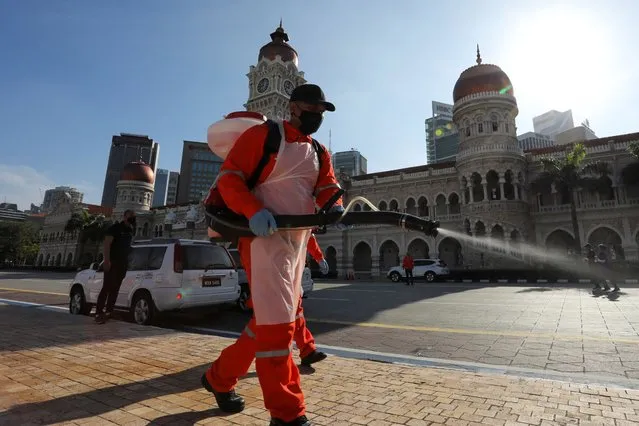
A worker sprays disinfectant at Independence Square during a disinfection operation, amid the coronavirus disease (COVID-19) outbreak in Kuala Lumpur on October 17, 2020. (Photo by Lim Huey Teng/Reuters)
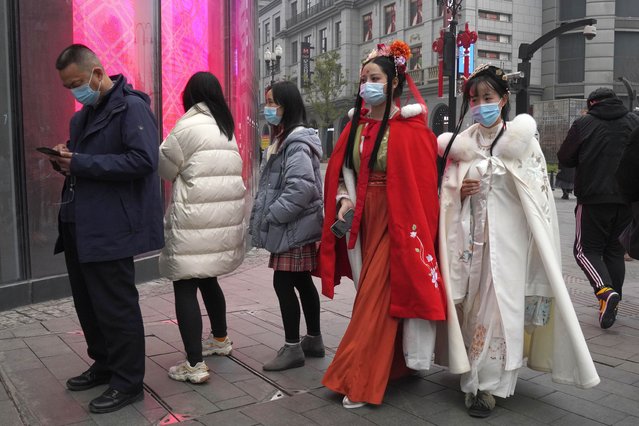
Chinese women dressed in traditional costumes and wearing masks visit a popular shopping street in Wuhan in central China's Hubei province, Saturday, January 23, 2021. A year after it was locked down to contain the spread of coronavirus, the central Chinese city of Wuhan has largely returned to normal, even as China continues to battle outbreaks elsewhere in the country. (Photo by Ng Han Guan/AP Photo)
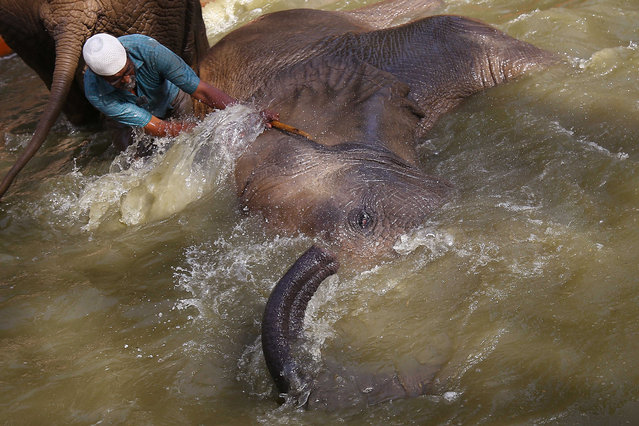
Elephants cool off at a zoo in Karachi, Pakistan, 31 March 2021. Caretakers at Karachi's zoo were working to keep animals cool during a heatwave affecting southern Pakistan. (Photo by Shahzaib Akber/EPA/EFE)
Visitors take photos of the fluorescent sea in the waters of Paishi Village, Dalian City, Liaoning Province, China, May 24, 2020, from the night of May 24 to the early morning of May 25, 2020. The fluorescent sea in dalian is caused by noctilucent algae in the sea water. (Photo by Costfoto/Barcroft Media via Getty Images)
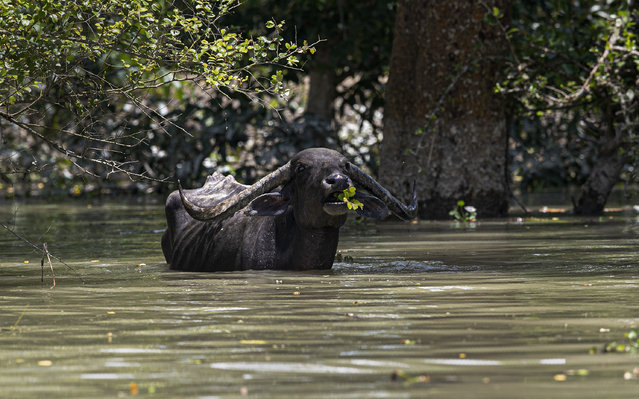
A wild water buffalo eats tree branches standing in flood water at the Pobitora wildlife sanctuary in Pobitora, Morigaon district, Assam, India, Thursday, July 16, 2020. Floods and landslides triggered by heavy monsoon rains have killed dozens of people in this northeastern region. The floods also inundated most of Kaziranga National Park, home to an estimated 2,500 rare one-horned rhinos. (Photo by Anupam Nath/AP Photo)
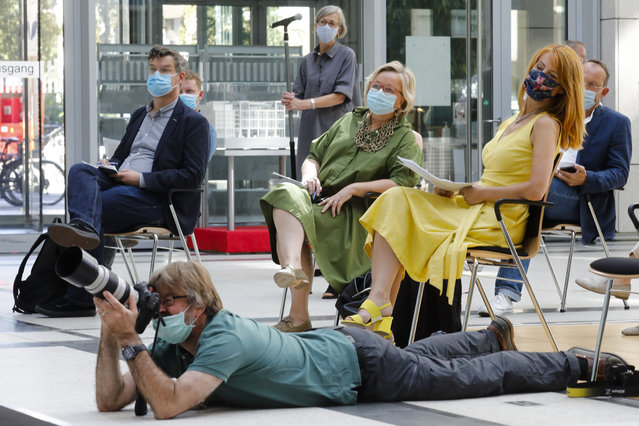
Journalists wear face mask and keep distance as they attend news conference by German Health Minister Jens Spahn about the developing of the coronavirus crisis test strategy in Berlin, Germany, Thursday, August 6, 2020. (Photo by Markus Schreiber/AP Photo)
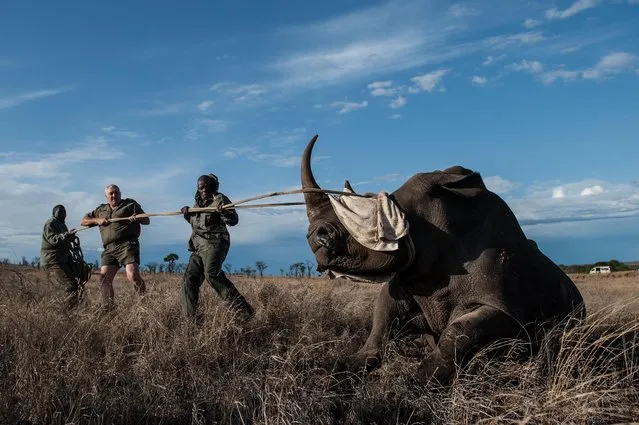
Dr. Marius Kruger (C) and memeber of the Kruger National Park keeps the head of a rhino up during a white rhino relocation capture on October 17, 2014. The Kruger National Park relocated four rhinoceros from a high risk poaching area to a safer area as part of ongoing strategic rhinoceros management plan. (Photo by Stefan Heunis/AFP Photo)
On August 31, 2012, a long filament of solar material that had been hovering in the sun's atmosphere, the corona, erupted out into space at 4:36 p.m. EDT. The coronal mass ejection, or CME, traveled at over 900 miles per second. The CME did not travel directly toward Earth, but did connect with Earth's magnetic environment, or magnetosphere, causing aurora to appear on the night of Monday, September 3. (Photo by NASA/GSFC/SDO via The Atlantic)