Loading...
Done
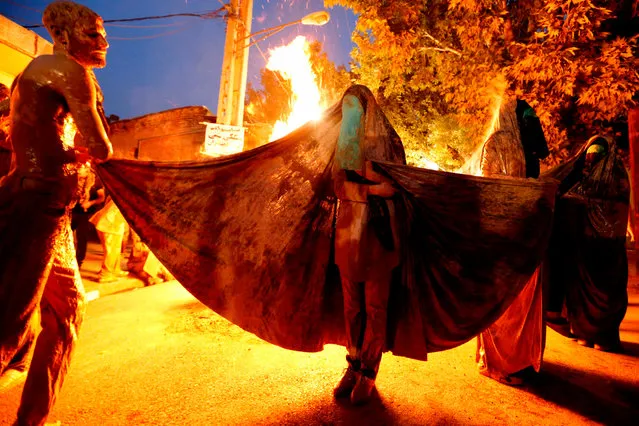
Iranian Shiite Muslim women gather around a bonfire after rubbing mud on their body during the “Kharrah Mali” (Mud Rubbing) ritual to mark the Ashura religious ceremony in the city of Khorramabad, some 470 kms southwest of Tehran, early in the morning on October 1, 2017. “Khrreh Mali” or “Mud Rubbing” is a ritual that is held in the city of Khorramabad every year to commemorate the seventh century slaying of Prophet Mohammed' s grandson Imam Hussein, in which Iranian men roll over in mud and dry themselves by gathering around the bonfires before flagellating themselves. (Photo by Atta Kenare/AFP Photo)

Iranian Shiite Muslim women gather around a bonfire after rubbing mud on their body during the “Kharrah Mali” (Mud Rubbing) ritual to mark the Ashura religious ceremony in the city of Khorramabad, some 470 kms southwest of Tehran, early in the morning on October 1, 2017. “Khrreh Mali” or “Mud Rubbing” is a ritual that is held in the city of Khorramabad every year to commemorate the seventh century slaying of Prophet Mohammed' s grandson Imam Hussein, in which Iranian men roll over in mud and dry themselves by gathering around the bonfires before flagellating themselves. (Photo by Atta Kenare/AFP Photo)
Details
02 Oct 2017 08:38:00
A Nymph or female devotee of the Vale do Amanhecer religious community, prays at their temple complex in Vale do Amanhecer (Sunrise Valley), a community on the outskirts of Planaltina, 50 km from the Brazilian capital, Brasilia, on April 29, 2023. This eclectic community holds its most important ritual of the year on Labour Day to honour the mediums who communicate with good and bad spirits. The group combines a range of religious practices, including Christian and Hindu, with symbols borrowed from the Incas and Mayans, as well as a belief in extraterrestrial life and intergalactic travel. The religion claims hundred temples throughout Brazil, Portugal and other countries. (Photo by Carl de Souza/AFP Photo)

A Nymph or female devotee of the Vale do Amanhecer religious community, prays at their temple complex in Vale do Amanhecer (Sunrise Valley), a community on the outskirts of Planaltina, 50 km from the Brazilian capital, Brasilia, on April 29, 2023. This eclectic community holds its most important ritual of the year on Labour Day to honour the mediums who communicate with good and bad spirits. The group combines a range of religious practices, including Christian and Hindu, with symbols borrowed from the Incas and Mayans, as well as a belief in extraterrestrial life and intergalactic travel. The religion claims hundred temples throughout Brazil, Portugal and other countries. (Photo by Carl de Souza/AFP Photo)
Details
08 Aug 2024 05:51:00
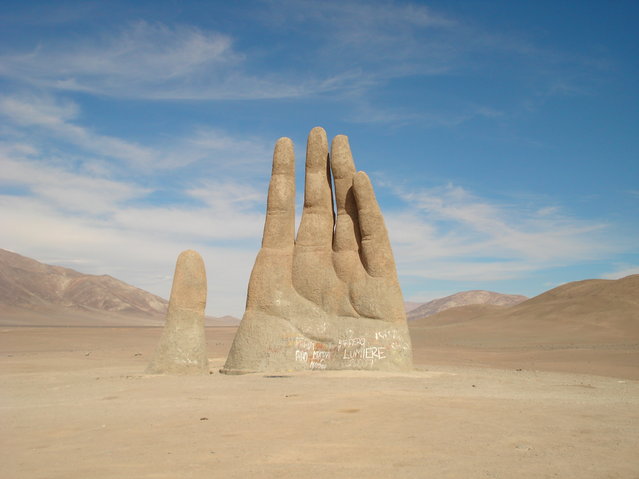
The Giant Hand of Atacama

The Mano de Desierto is a large-scale sculpture of a hand located in the Atacama Desert in Chile, 75 km to the south of the city of Antofagasta, on the Panamerican Highway. The nearest point of reference is the “Ciudad Empresarial La Negra” (La Negra Business City). The sculpture was constructed by the Chilean sculptor Mario Irarrázabal at an altitude of 1,100 meters above sea level. Irarrázabal used the human figure to express emotions like injustice, loneliness, sorrow and torture. Its exaggerated size is said to emphasize human vulnerability and helplessness. The work has a base of iron and cement, and stands 11 metres (36 ft) tall. Funded by Corporación Pro Antofagasta, a local booster organization, the sculpture was inaugurated on March 28, 1992.
Details
21 Dec 2013 10:18:00
RT-2PM2 Topol-M TEL with presumably Yars system transport-launch container

“March 19, 2012 was the first rehearsal for the Victory Day Parade at the training ground in Alabino (near Moscow, Moscow Military District). Since the end of February troops and vehicles from various units and formations of the Armed Forces began arriving to Alabino training ground. The first rehearsal included only military vehicles. During the ride the average speed of vehicles is 12 km/h, the distance depending on the type of vehicle from 12 to 15 meters”. – Vitaly Kuzmin
Details
15 Apr 2012 12:50:00
Festival goers plays in mud during the 15th Annual Boryeong Mud Festival at Daecheon beach in Boryeong, southwest of Seoul

Festival goers plays in mud during the 15th Annual Boryeong Mud Festival at Daecheon beach in Boryeong, about 190 km (118 miles) southwest of Seoul, July 15, 2012. About 2 to 3 million domestic and international tourists visit the beach during the annual mud festival, according to the festival organisation. (Photo by Chung Sung-Jun)
Details
16 Jul 2012 08:45:00
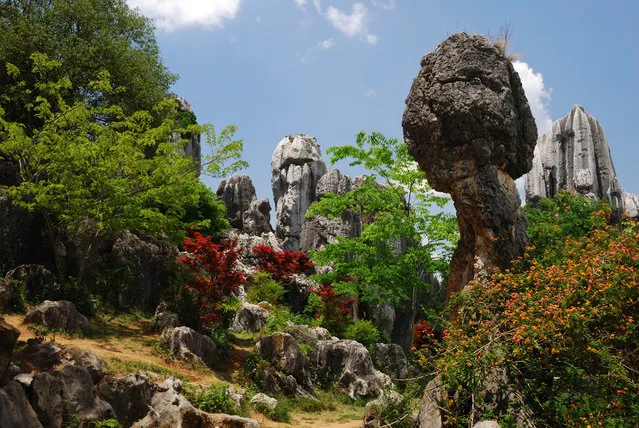
Shilin Stone Forest

The Stone Forest or Shilin is a notable set of limestone formations located in Shilin Yi Autonomous County, Yunnan Province, People's Republic of China, near Shilin approximately 120 km (75 mi) from the provincial capital Kunming. The tall rocks seem to emanate from the ground in the manner of stalagmites, with many looking like petrified trees thereby creating the illusion of a forest made of stone. Since 2007, two parts of the site, the Naigu Stone Forest (乃古石林) and Suogeyi Village (所各邑村), have been UNESCO World Heritage Sites as part of the South China Karst.
Details
27 Sep 2013 10:03:00
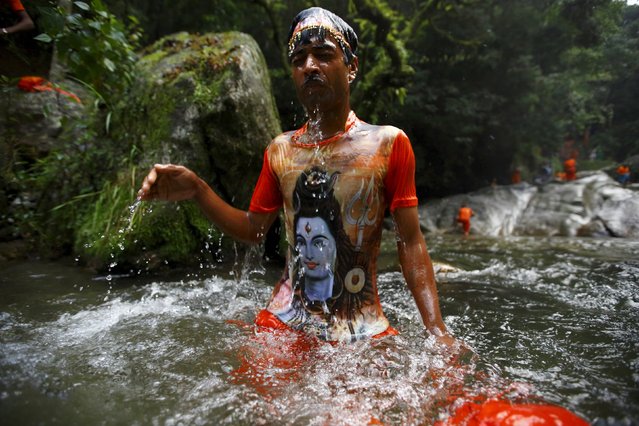
A Hindu devotee wearing a t-shirt printed with a portrait of Lord Shiva takes a holy dip while participating in the “Bol Bom” pilgrimage in Kathmandu August 10, 2015. (Photo by Navesh Chitrakar/Reuters)

A Hindu devotee wearing a t-shirt printed with a portrait of Lord Shiva takes a holy dip while participating in the “Bol Bom” pilgrimage in Kathmandu August 10, 2015. The faithful, chanting the name of Lord Shiva, run about 15 km (9 miles) barefooted toward Pashupatinath temple seeking good health, wealth and happiness. (Photo by Navesh Chitrakar/Reuters)
Details
11 Aug 2015 13:34:00
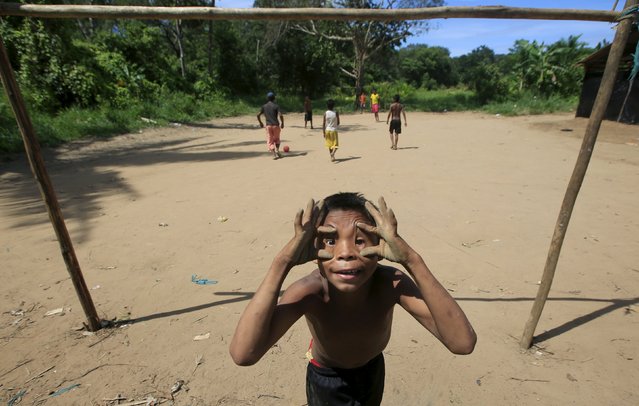
A Colombian Nukak Maku Indian boy gestures in a refugee camp at Agua Bonita near San Jose del Guaviare of Guaviare province September 3, 2015. (Photo by John Vizcaino/Reuters)

A Colombian Nukak Maku Indian boy gestures in a refugee camp at Agua Bonita near San Jose del Guaviare of Guaviare province September 3, 2015. Since emerging from the jungle in 2005, half naked and carrying blowpipes, the Nukak have lived in settlements near the frontier town of San Jose del Guaviare, a humid outpost in the Amazon 400 km (250 miles) southeast of the capital Bogota. (Photo by John Vizcaino/Reuters)
Details
03 Oct 2015 08:01:00