Loading...
Done
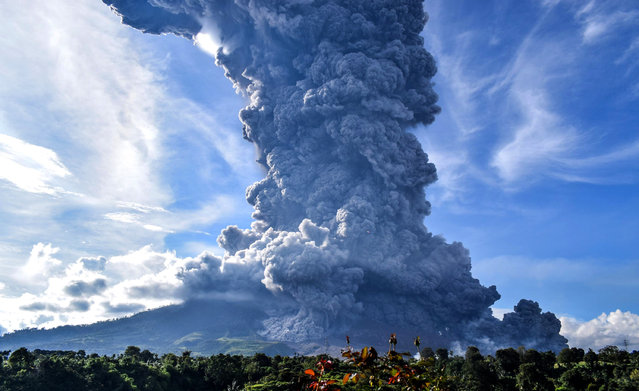
Sinabung mountain spews volcanic smoke in Tiga Pancur Village, Karo, North Sumatra, Indonesia, 09 June 2019. According to BNPB, Mount Sinabung erupted, blowing volcanic ash more than 7,000 meters high. Sinabung is one of the most active volcanos in Indonesia. It erupted in 2010 and since then killed 17 people in eruptions in 2014 and another nine people in 2016. (Photo by Sarianto Sembiring/EPA/EFE)

Sinabung mountain spews volcanic smoke in Tiga Pancur Village, Karo, North Sumatra, Indonesia, 09 June 2019. According to BNPB, Mount Sinabung erupted, blowing volcanic ash more than 7,000 meters high. Sinabung is one of the most active volcanos in Indonesia. It erupted in 2010 and since then killed 17 people in eruptions in 2014 and another nine people in 2016. (Photo by Sarianto Sembiring/EPA/EFE)
Details
12 Jun 2019 00:01:00
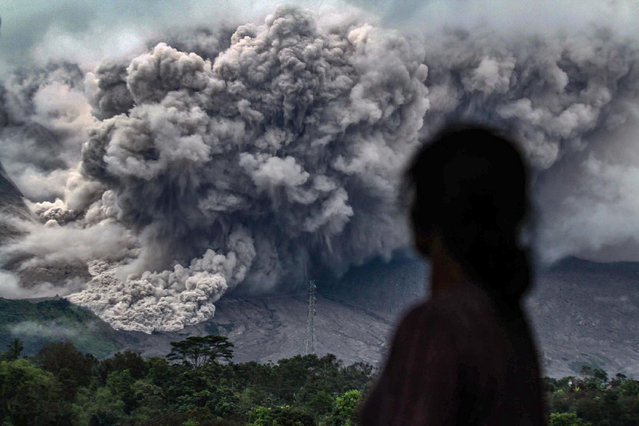
An Indonesian woman watches an eruption from the Mount Sinabung volcano from Tiga Pancur village, in Karo in North Sumatra on November 3, 2017. Sinabung roared back to life in 2010 for the first time in 400 years. After another period of inactivity it erupted once more in 2013, and has remained highly active since. (Photo by Ivan Damanik/AFP Photo)

An Indonesian woman watches an eruption from the Mount Sinabung volcano from Tiga Pancur village, in Karo in North Sumatra on November 3, 2017. Sinabung roared back to life in 2010 for the first time in 400 years. After another period of inactivity it erupted once more in 2013, and has remained highly active since. (Photo by Ivan Damanik/AFP Photo)
Details
13 Nov 2017 07:31:00
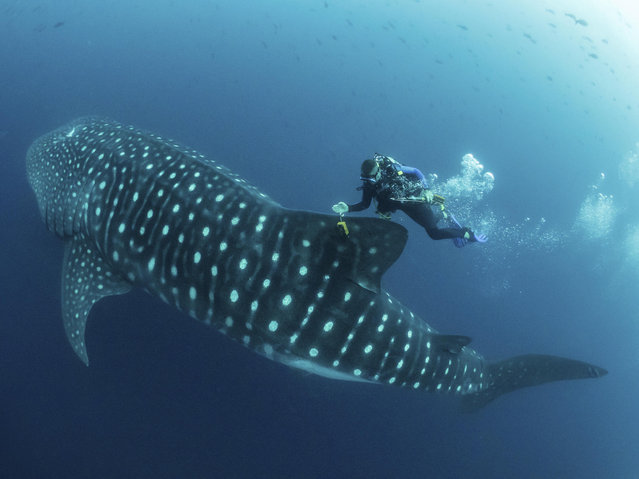
In this 2017 photo provided by Simon Pierce, Jonathan Green checks on a fin-mounted satellite tag on a whale shark in the Galapagos Islands area of Ecuador.  Despite typically being bigger than a double-decker bus, the elusive whale shark has only tiny, almost useless teeth. It's also one of the least understood animals in the ocean. (Photo by Simonjpierce.com via AP Photo)

In this 2017 photo provided by Simon Pierce, Jonathan Green checks on a fin-mounted satellite tag on a whale shark in the Galapagos Islands area of Ecuador. Despite typically being bigger than a double-decker bus, the elusive whale shark has only tiny, almost useless teeth. It's also one of the least understood animals in the ocean. (Photo by Simonjpierce.com via AP Photo)
Details
02 Mar 2018 00:03:00
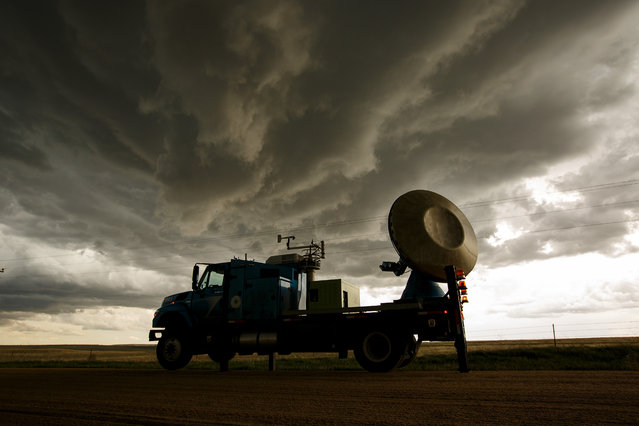
The Doppler on Wheels (DOW) vehicle scans a supercell thunderstorm during a tornado research mission, May 8, 2017 in Elbert County near Agate, Colorado. Doppler on Wheels (DOW) is a mobile doppler radar mounted on a truck that brings instruments directly into storms, allowing scientists to scan storms and tornadoes and make 3-D maps of wind and debris. (Photo by Drew Angerer/Getty Images)

The Doppler on Wheels (DOW) vehicle scans a supercell thunderstorm during a tornado research mission, May 8, 2017 in Elbert County near Agate, Colorado. Doppler on Wheels (DOW) is a mobile doppler radar mounted on a truck that brings instruments directly into storms, allowing scientists to scan storms and tornadoes and make 3-D maps of wind and debris. (Photo by Drew Angerer/Getty Images)
Details
18 May 2017 08:54:00
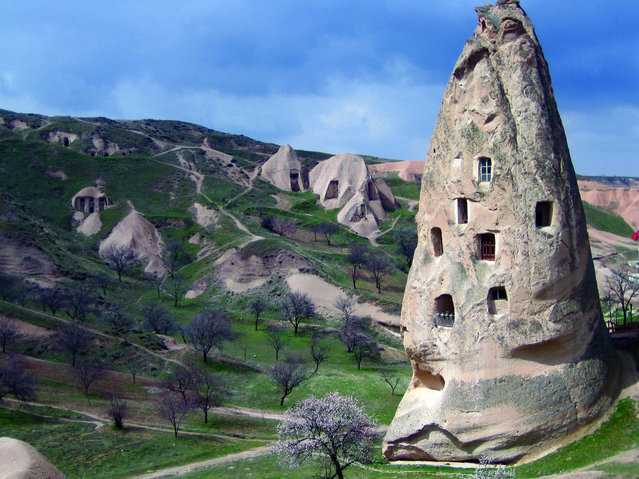
Multi-Level Underground City, Cappadocia, Turkey

Cappadocia is a historical region in Central Anatolia, largely in Nevşehir Province, in Turkey.
In the time of Herodotus, the Cappadocians were reported as occupying the whole region from Mount Taurus to the vicinity of the Euxine (Black Sea). Cappadocia, in this sense, was bounded in the south by the chain of the Taurus Mountains that separate it from Cilicia, to the east by the upper Euphrates and the Armenian Highland, to the north by Pontus, and to the west by Lycaonia and eastern Galatia.
Details
05 Apr 2013 09:50:00
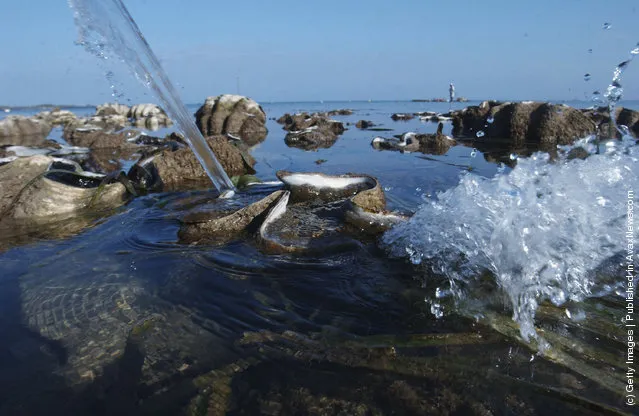
Tridacna Gigas, or Giant Clams

“The giant clam, Tridacna gigas (known as pā’ua in Cook Islands Māori), is the largest living bivalve mollusc. T. gigas is one of the most endangered clam species. It was mentioned as early as 1825 in scientific reports. One of a number of large clam species native to the shallow coral reefs of the South Pacific and Indian oceans, they can weigh more than 200 kilograms (440 lb) measure as much as 120 cm (47 in) across, and have an average lifespan in the wild of 100 years or more”. – Wikipedia

Photo: Tridacna Gigas, or Giant Clams spew water as a traditional fisherman passes by a small sanctuary on January 23, 2004 near Bolinao in the Northern Philippines. The clams, prime builders for coral reefs and providing shelter for spawning fish and other marine life, are exposed by low tides in the sanctuary. Overfishing and pollution throughout the country are not only threatening food security, but are also starting to choke one of the few working clam sanctuaries in the world. (Photo by David Greedy/Getty Images)

Details
01 Oct 2011 13:10:00
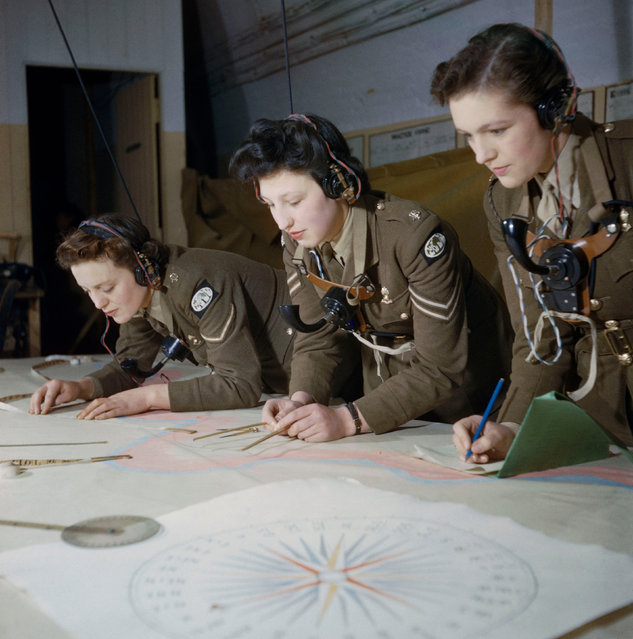
Auxiliary Territorial Service (ATS) plotters at work at Coastal Artillery Headquarters in Dover, December 1942. (Photo by Ted Dearberg/IWM/PA Wire)

Auxiliary Territorial Service (ATS) plotters at work at Coastal Artillery Headquarters in Dover, December 1942. The Auxiliary Territorial Service was the women's branch of the British Army during the Second World War. It was formed on 9 September 1938, initially as a women's voluntary service, and existed until 1 February 1949, when it was merged into the Women's Royal Army Corps. The ATS had its roots in the Women's Auxiliary Army Corps (WAAC), which was formed in 1917 as a voluntary service. During the First World War its members served in a number of jobs including clerks, cooks, telephonists and waitresses. The WAAC was disbanded after four years in 1921. (Photo by Ted Dearberg/IWM/PA Wire)
Details
13 Jul 2017 07:52:00
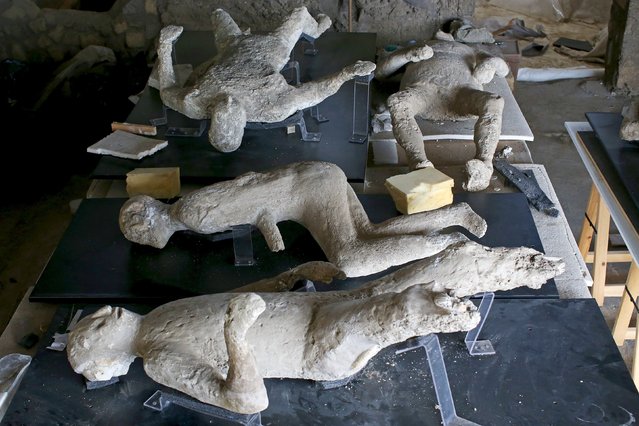
Plaster cast moulds of victims of the Mount Vesuvius eruption lie on a display table in a laboratory at Pompeii October 13, 2015. An expert team made up of archaeologists, radiologists, orthodontists and anthropologists began on September 2015 to use CAT scan technology (computerised axial tomography) to peer inside the plaster cast moulds of Pompeii's victims, in a study that has added more detail to previous findings. (Photo by Alessandro Bianchi/Reuters)

Plaster cast moulds of victims of the Mount Vesuvius eruption lie on a display table in a laboratory at Pompeii October 13, 2015. An expert team made up of archaeologists, radiologists, orthodontists and anthropologists began on September 2015 to use CAT scan technology (computerised axial tomography) to peer inside the plaster cast moulds of Pompeii's victims, in a study that has added more detail to previous findings. A 16-layer scan had to be used in order to penetrate the hardened plaster but the results showed up impressive skeletal remains and near perfect teeth. (Photo by Alessandro Bianchi/Reuters)
Details
22 Oct 2015 08:02:00