Loading...
Done
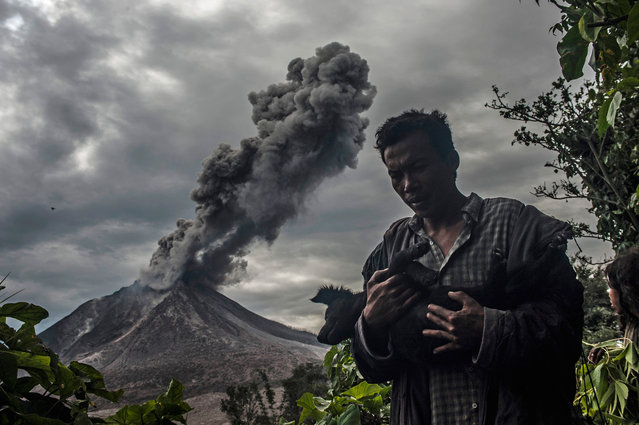
Mount Sinabung, a highly active volcano on Sumatra island, erupted several times this week. A volcanology agency has declared a danger zone of about four miles from the crater after seven farmers were killed and two others seriously injured. Here: A man carries his dog as a giant ash cloud rises from the Sinabung volcano in Karo, Indonesia on May 26, 2016. (Photo by Sutanta Aditya/Barcroft Images)

Mount Sinabung, a highly active volcano on Sumatra island, erupted several times this week. A volcanology agency has declared a danger zone of about four miles from the crater after seven farmers were killed and two others seriously injured. Here: A man carries his dog as a giant ash cloud rises from the Sinabung volcano in Karo, Indonesia on May 26, 2016. (Photo by Sutanta Aditya/Barcroft Images)
Details
28 May 2016 12:09:00
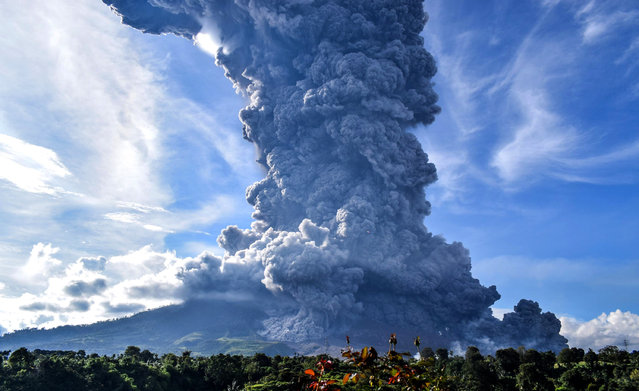
Sinabung mountain spews volcanic smoke in Tiga Pancur Village, Karo, North Sumatra, Indonesia, 09 June 2019. According to BNPB, Mount Sinabung erupted, blowing volcanic ash more than 7,000 meters high. Sinabung is one of the most active volcanos in Indonesia. It erupted in 2010 and since then killed 17 people in eruptions in 2014 and another nine people in 2016. (Photo by Sarianto Sembiring/EPA/EFE)

Sinabung mountain spews volcanic smoke in Tiga Pancur Village, Karo, North Sumatra, Indonesia, 09 June 2019. According to BNPB, Mount Sinabung erupted, blowing volcanic ash more than 7,000 meters high. Sinabung is one of the most active volcanos in Indonesia. It erupted in 2010 and since then killed 17 people in eruptions in 2014 and another nine people in 2016. (Photo by Sarianto Sembiring/EPA/EFE)
Details
12 Jun 2019 00:01:00
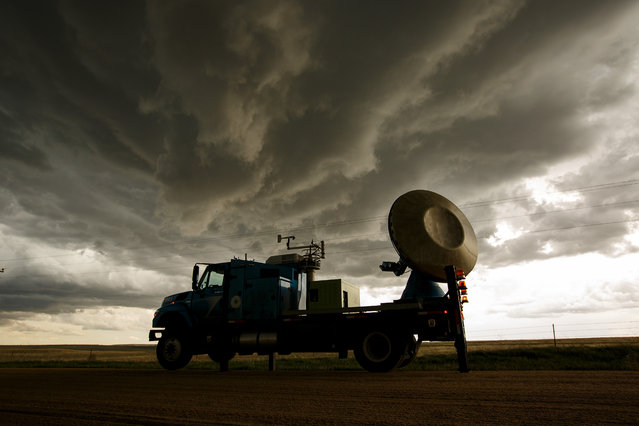
The Doppler on Wheels (DOW) vehicle scans a supercell thunderstorm during a tornado research mission, May 8, 2017 in Elbert County near Agate, Colorado. Doppler on Wheels (DOW) is a mobile doppler radar mounted on a truck that brings instruments directly into storms, allowing scientists to scan storms and tornadoes and make 3-D maps of wind and debris. (Photo by Drew Angerer/Getty Images)

The Doppler on Wheels (DOW) vehicle scans a supercell thunderstorm during a tornado research mission, May 8, 2017 in Elbert County near Agate, Colorado. Doppler on Wheels (DOW) is a mobile doppler radar mounted on a truck that brings instruments directly into storms, allowing scientists to scan storms and tornadoes and make 3-D maps of wind and debris. (Photo by Drew Angerer/Getty Images)
Details
18 May 2017 08:54:00
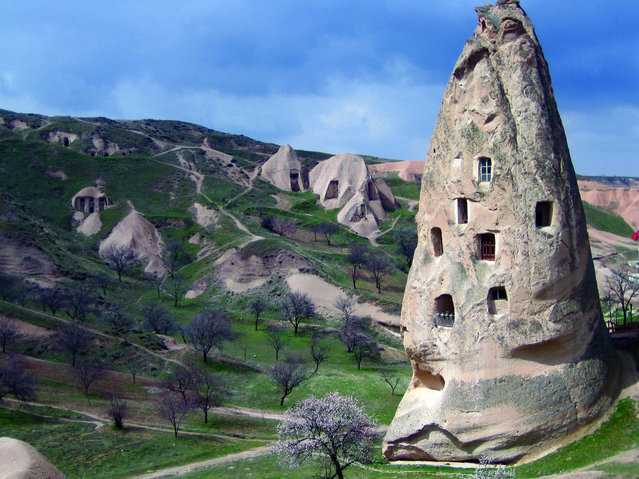
Multi-Level Underground City, Cappadocia, Turkey

Cappadocia is a historical region in Central Anatolia, largely in Nevşehir Province, in Turkey.
In the time of Herodotus, the Cappadocians were reported as occupying the whole region from Mount Taurus to the vicinity of the Euxine (Black Sea). Cappadocia, in this sense, was bounded in the south by the chain of the Taurus Mountains that separate it from Cilicia, to the east by the upper Euphrates and the Armenian Highland, to the north by Pontus, and to the west by Lycaonia and eastern Galatia.
Details
05 Apr 2013 09:50:00
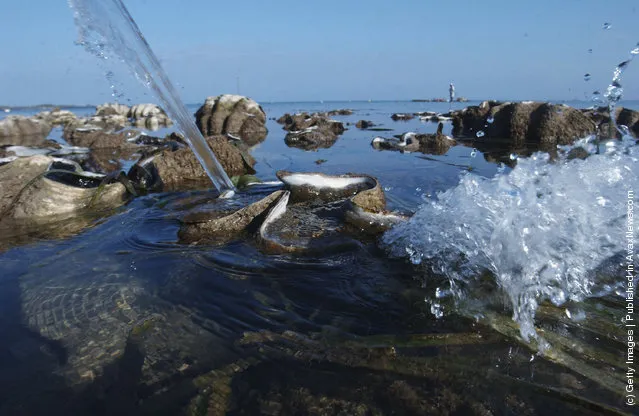
Tridacna Gigas, or Giant Clams

“The giant clam, Tridacna gigas (known as pā’ua in Cook Islands Māori), is the largest living bivalve mollusc. T. gigas is one of the most endangered clam species. It was mentioned as early as 1825 in scientific reports. One of a number of large clam species native to the shallow coral reefs of the South Pacific and Indian oceans, they can weigh more than 200 kilograms (440 lb) measure as much as 120 cm (47 in) across, and have an average lifespan in the wild of 100 years or more”. – Wikipedia

Photo: Tridacna Gigas, or Giant Clams spew water as a traditional fisherman passes by a small sanctuary on January 23, 2004 near Bolinao in the Northern Philippines. The clams, prime builders for coral reefs and providing shelter for spawning fish and other marine life, are exposed by low tides in the sanctuary. Overfishing and pollution throughout the country are not only threatening food security, but are also starting to choke one of the few working clam sanctuaries in the world. (Photo by David Greedy/Getty Images)

Details
01 Oct 2011 13:10:00
Auxiliary Territorial Service (ATS) plotters at work at Coastal Artillery Headquarters in Dover, December 1942. (Photo by Ted Dearberg/IWM/PA Wire)

Auxiliary Territorial Service (ATS) plotters at work at Coastal Artillery Headquarters in Dover, December 1942. The Auxiliary Territorial Service was the women's branch of the British Army during the Second World War. It was formed on 9 September 1938, initially as a women's voluntary service, and existed until 1 February 1949, when it was merged into the Women's Royal Army Corps. The ATS had its roots in the Women's Auxiliary Army Corps (WAAC), which was formed in 1917 as a voluntary service. During the First World War its members served in a number of jobs including clerks, cooks, telephonists and waitresses. The WAAC was disbanded after four years in 1921. (Photo by Ted Dearberg/IWM/PA Wire)
Details
13 Jul 2017 07:52:00
Part Time Job By Chow Hon Lam

What would superheroes do if they had a part time job? Well… besides fighting crime, the powers of most superheroes aren’t exactly very useful. Sure, Flash would make a great delivery boy, delivering the freshest pizza in the world, while Thor might turn out to be a great smith (though judging by the way he handles his mallet, it is very unlikely), but in the end of the day, all these things are pretty useless. It sure is hard being a superhero when you have no villains to catch; especially if the only superpower that you have is lighting yourself on fire. Reducing you to a mere job of being used as fuel for cooking grilled chicken. Besides, it’s not exactly useful for catching villains either, if you don't plan on burning them alive… (Photo by Chow Hon Lam)
Details
08 Dec 2014 11:44:00


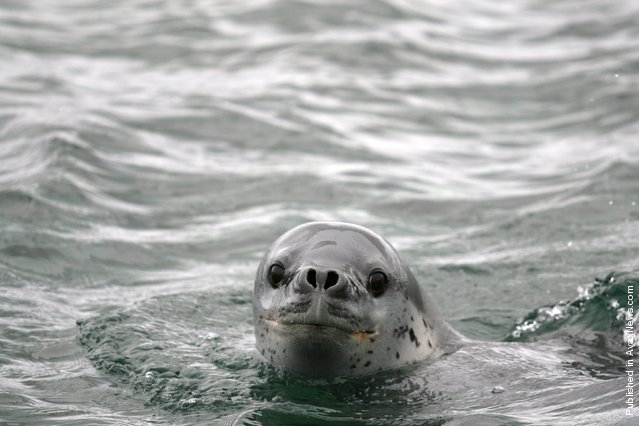
“The leopard seal (Hydrurga leptonyx), also referred to as the sea leopard, is the second largest species of seal in the Antarctic (after the southern elephant seal). It is most common in the southern hemisphere along the coast of Antarctica and on most sub-Antarctic islands, but can also be found on the coasts of southern Australia, Tasmania, South Africa, New Zealand, Lord Howe Island, Tierra del Fuego, the Cook Islands, and the Atlantic coast of South America. It can live twenty-six years, possibly more. Orcas and large sharks are the only natural predators of leopard seals”. – Wikipedia

Photo by: Gilad Rom; Source: Flickr
Details
13 Nov 2011 11:24:00