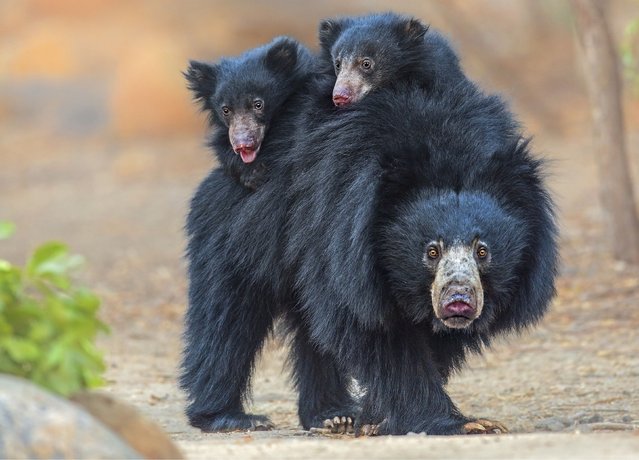
Two sloth bear cubs save their paws from the hot ground during a search for food in the Daroji Bear Sanctuary in Karnataka, India in the second decade of January 2025. (Photo by Baiju Patil/Solent News)
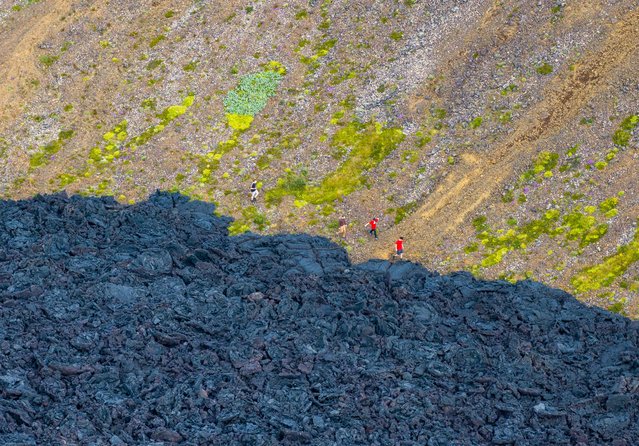
An aerial view taken with a drone shows people walking past dried lava (L) from a previous volcanic eruption as they make their way to a location closer to watch the fresh volcano eruption near Grindavik, Reykjanes, Iceland, 17 July 2025. According to the Icelandic Meteorological Office, a magma flow has begun at the Sundhnuk crater range on 16 July. (Photo by Jakob Vegerfors/EPA)
People rollerblade along the beach a day before renewed restrictions due to a surge of coronavirus disease (COVID-19) cases in Los Angeles, California, U.S. November 29, 2020. (Photo by Brandon Bell/Reuters)
Alejandro Zelayaran, 43, dressed as Santa Claus, wears a protective face shield as he poses for a photograph on a street in Mexico City, Mexico, December 3, 2020. “Faith and hope must move the heart of the humanity”, said Zelayaran, who will don a face shield when he distributes dolls and other gifts at an orphanage in Mexico City. “I want to see families taking care of each other and knowing that even from afar, love and hope always survive”. (Photo by Edgard Garrido/Reuters)
A man wearing a mouth-nose protection to protect against the coronavirus walks past a department store window with the words “BACK TO LIFE” in Schwerin, Germany, Thursday, April 15, 2021. (Photo by Jens Buettner/dpa via AP Photo)
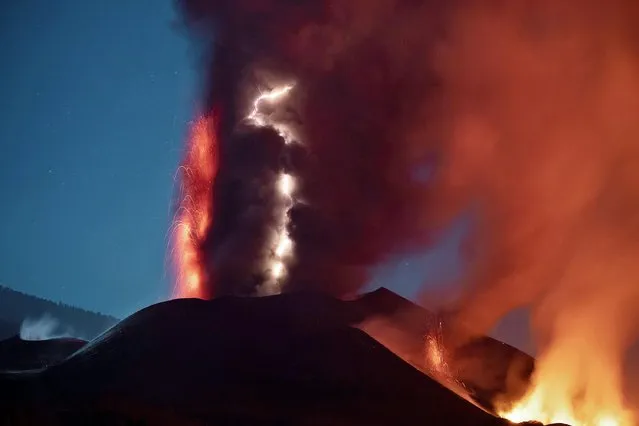
A handout photo made available by Jose Juan Rodriguez Rocha, on 17 November 2021 shows lightning over Cumbre vieja Volcano as seen from El Paso, La Palma, Canary Islands Spain, 14 November 2021. The lightning over a volcano is sometimes seen due to the charge of electricity caused by the friction of the expelled particles within the column of ashes and pyroclastic rocks. (Photo by Jose Juan Rodríguez Rocha/EPA/EFE)
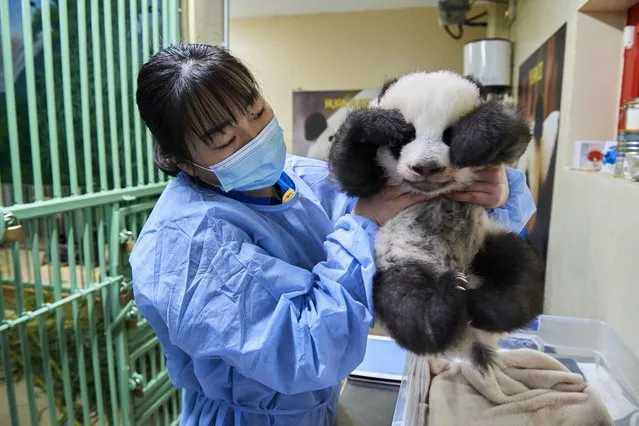
Yuandudu, a camera-shy panda cub, covers her eyes in Beauval ZooParc in France in November 2021. The three-month-old and her twin are fed once each by their mother every day, taking 150-200g of milk per feed. In between they have one bottle feed per day from the specially trained keepers who were sent from China to supervise their birth and early care. (Photo by Eric Baccega/Naturepl.com/LDY Agency)