Loading...
Done
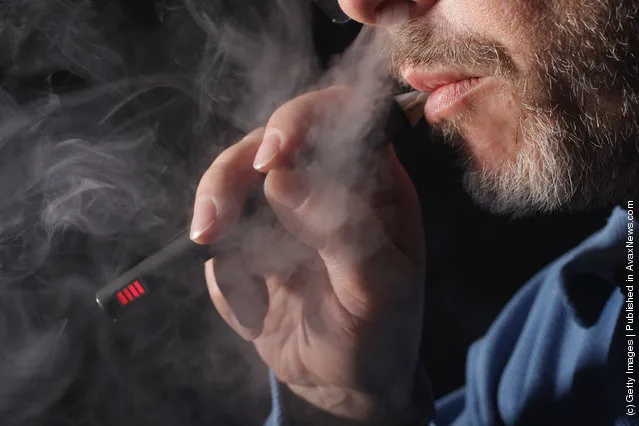
Owner of a shop that sells electronic cigarettes demonstrates how to use one

“An electronic cigarette, or e-cigarette, is an electrical device that simulates the act of tobacco smoking by producing an inhaled mist bearing the physical sensation, appearance, and often the flavor and nicotine content of inhaled tobacco smoke; though without its odor, and intended to omit its health risks. The device uses heat (or in some cases, ultrasonics) to vaporize a propylene glycol- or glycerin-based liquid solution into an aerosol mist, similar to the way a nebulizer or humidifier vaporizes solutions for inhalation”. – Wikipedia

Photo: Owner of a shop that sells electronic cigarettes demonstrates how to use one on March 1, 2012 in Berlin, Germany. The German government has announced that it classifies the liquids used in electronic cigarettes as pharmaceuticals because the liquids contain nicotine, and that sale of the liquids requires certification. (Photo Illustration by Sean Gallup/Getty Images)
Details
03 Mar 2012 10:01:00
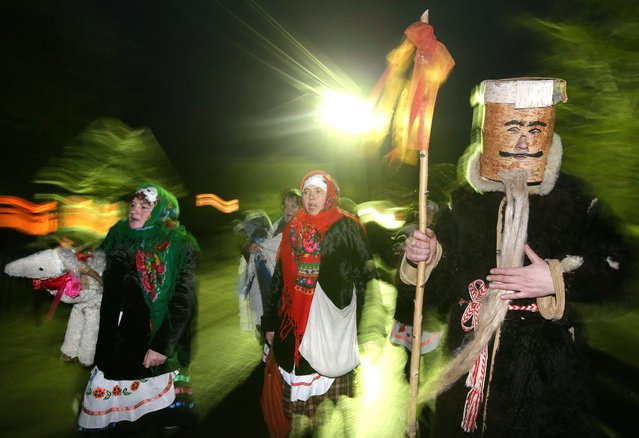
Belarussians in costumes sing songs during the traditional rite of Shchadrets (Schedry vecher or Generous Eve) in the village of Osovo, some 190 km from Minsk, Belarus, 13 January 2015. Shchadrets is a Belarusian folk holiday celebrated on the New Year's Eve in accordance with the Julian calendar (Old New Year). (Photo by Tatyana Zenkovich/EPA)

Belarussians in costumes sing songs during the traditional rite of Shchadrets (Schedry vecher or Generous Eve) in the village of Osovo, some 190 km from Minsk, Belarus, 13 January 2015. Shchadrets is a Belarusian folk holiday celebrated on the New Year's Eve in accordance with the Julian calendar (Old New Year). The holiday is similar to Koliady, when youth in costumes walk from house to house singing holiday songs, performing, and asking for a reward afterwards. (Photo by Tatyana Zenkovich/EPA)
Details
17 Jan 2015 12:21:00
A woman looks at traditional Ukrainian Easter eggs “Pysanka”, installed as part of the upcoming celebrations of Easter, in central Kiev, Ukraine, April 29, 2016. A pysanka is a Ukrainian Easter egg, decorated with traditional Ukrainian folk designs using a wax-resist (batik) method. The word pysanka comes from the verb pysaty, “to write”, as the designs are not painted on, but written with beeswax. Many other eastern European ethnic groups decorate eggs using wax resist for Easter. These include the Belarusians, Bulgarians, Croats, Czechs, Hungarians, Lithuanians, Poles, Romanians, Serbs, Slovaks, Slovenes and Sorbs. (Photo by Valentyn Ogirenko/Reuters)

A woman looks at traditional Ukrainian Easter eggs “Pysanka”, installed as part of the upcoming celebrations of Easter, in central Kiev, Ukraine, April 29, 2016. A pysanka is a Ukrainian Easter egg, decorated with traditional Ukrainian folk designs using a wax-resist (batik) method. The word pysanka comes from the verb pysaty, “to write”, as the designs are not painted on, but written with beeswax. Many other eastern European ethnic groups decorate eggs using wax resist for Easter. These include the Belarusians, Bulgarians, Croats, Czechs, Hungarians, Lithuanians, Poles, Romanians, Serbs, Slovaks, Slovenes and Sorbs. (Photo by Valentyn Ogirenko/Reuters)
Details
30 Apr 2016 09:00:00
Chris “Birdman” Andersen poses for Getty Images photographer Mike Ehrmann during the Miami Heat's Media Day at AmericanAirlines Arena, on September 30, 2013. (Photo by Gary Coronado/The Palm Beach Post)

Chris “Birdman” Andersen poses for Getty Images photographer Mike Ehrmann during the Miami Heat's Media Day at AmericanAirlines Arena, on September 30, 2013. (Photo by Gary Coronado/The Palm Beach Post)

P.S. All pictures are presented in high resolution. To see Hi-Res images – just TWICE click on any picture. In other words, click small picture – opens the BIG picture. Click BIG picture – opens VERY BIG picture (if available; this principle works anywhere on the site AvaxNews)
Details
05 Oct 2013 12:25:00
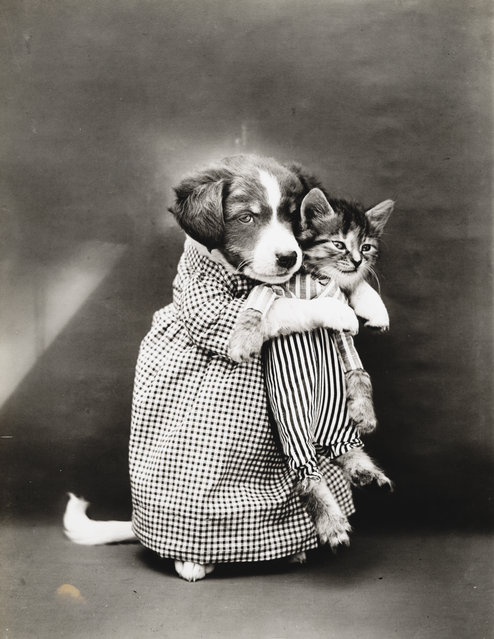
Photograph shows a puppy holding a kitten, 1914. (Photo by Harry Whittier Frees/Library of Congress)

“Harry Whittier Frees (1879–1953) was an American photographer who created novelty postcards and children's books based on his photographs of animals. He dressed the animals and posed them in human situations with props, often with captions; these can be seen as progenitors of modern lolcats”. – Wikipedia. Photo: “The nurse”. Photograph shows a puppy holding a kitten, 1914. (Photo by Harry Whittier Frees/Library of Congress)

P.S. All pictures are presented in high resolution. To see Hi-Res images – just TWICE click on any picture. In other words, click small picture – opens the BIG picture. Click BIG picture – opens VERY BIG picture (if available; this principle works anywhere on the site AvaxNews).
Details
28 Mar 2014 11:20:00
Serge Huguenin of the Blondeau foundry takes the newly melted bell out of the mould in La Chaux-de-Fonds, Switzerland January 21, 2016. At this year's Summer Olympics in Rio de Janeiro, no matter how elaborate the opening ceremony or how sophisticated the live broadcasts, the final lap of athletics races will be announced the traditional way by ringing an old-fashioned bell. (Photo by Denis Balibouse/Reuters)

Serge Huguenin of the Blondeau foundry takes the newly melted bell out of the mould in La Chaux-de-Fonds, Switzerland January 21, 2016. At this year's Summer Olympics in Rio de Janeiro, no matter how elaborate the opening ceremony or how sophisticated the live broadcasts, the final lap of athletics races will be announced the traditional way by ringing an old-fashioned bell. Omega, the official timekeeper of the event, has ordered 21 bells, forged almost entirely by hand by Blondeau's Bell Foundry in the Jura Mountains in Switzerland. Each last-lap bell is branded with the RIO 2016 logo and circled with the words “2016 GAMES OF THE XXXI OLYMPIAD”. (Photo by Denis Balibouse/Reuters)
Details
02 Feb 2016 13:51:00
Brtukan. “Being a girl of colour in a society where the majority of the people are white, I have had to get used to all the different ways people approach me. From being asked what kind of rap music you listen to and how you wash your hair, to getting told, “you don’t sound black”, “you’re pretty for a black girl” or “you’re not that black so it’s OK”, as if being black is such a bad thing”. (Photo by Lisa Minogue/The Guardian)

As part of FLAIR Melbourne – a Flinders Lane art festival – Melbourne’s Lisa Minogue presents stylised photographic portraits of Australian women of colour, their faces painted vibrantly to accentuate their individuality and encourage the viewer to study each face more closely. Minogue asked each woman the same question: “What do the words “coloured girl” mean to you?”. (Photo by Lisa Minogue/The Guardian)
Details
17 Aug 2016 11:16:00
A man dressed as “El Chapulin Colorado”, a character by screenwriter Roberto Gomez Bolanos, performs for fans and media as they wait for the arrival of the funeral van carrying the body of Bolanos, at Mexican media company Televisa in Mexico City November 29, 2014. (Photo by Carlos Jasso/Reuters)

A man dressed as “El Chapulin Colorado”, a character by screenwriter Roberto Gomez Bolanos, performs for fans and media as they wait for the arrival of the funeral van carrying the body of Bolanos, at Mexican media company Televisa in Mexico City November 29, 2014. Mexican actor and screenwriter Roberto Gomez Bolanos, one of Latin America's most beloved comedians, whose slapstick acts charmed fans from Spain to Argentina for over four decades, died on Friday at the age 85. Known as “Chespirito”, a word play on “Little Shakespeare” for his diminutive stature and his prolific scripts, Gomez Bolanos created some of the region's most enduring comic characters. (Photo by Carlos Jasso/Reuters)
Details
01 Dec 2014 13:50:00