Loading...
Done
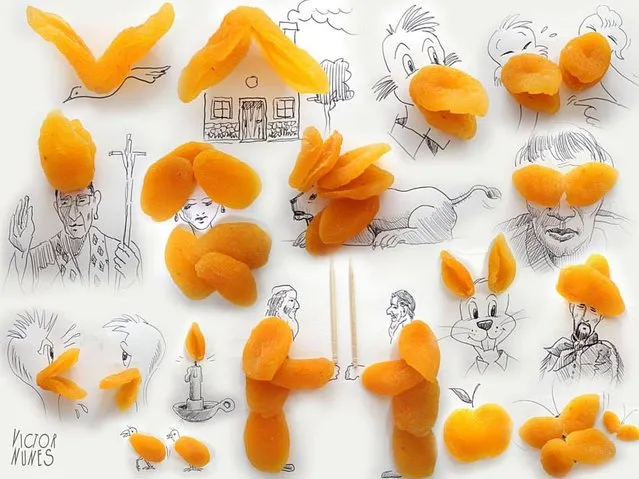
Food In Faces By Victor Nunes

Artist Victor Nunes combines every-day objects with simple illustrations to turn them into pictures of faces, animals and other playful scenes. His images invite us to look at the world differently and find creative images in our surroundings. Nunes’ art is a great example of pareidolia, which is our propensity to give meaning to random objects (like in this post about seeing faces in random objects). It’s the reason why we associate a smiley face with a human face and why some of Nunes’ pieces of popcorn or bread resemble faces to us.
Details
02 Feb 2014 11:58:00
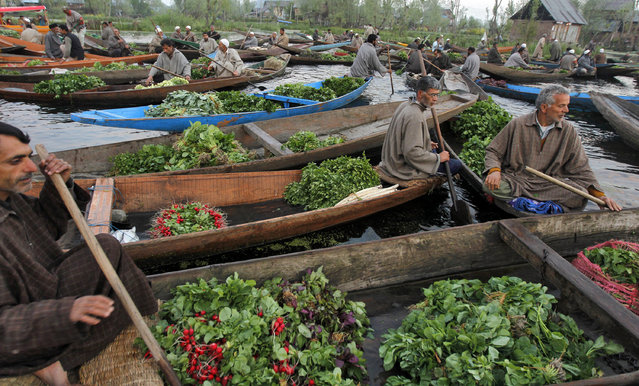
Kashmiri vegetable vendors assemble at a floating market in the interiors of the Dal Lake in Srinagar April 17, 2012. (Photo by Danish Ismail/Reuters)

Kashmiri vegetable vendors assemble at a floating market in the interiors of the Dal Lake in Srinagar April 17, 2012. (Photo by Danish Ismail/Reuters)
Details
03 Jul 2015 13:11:00
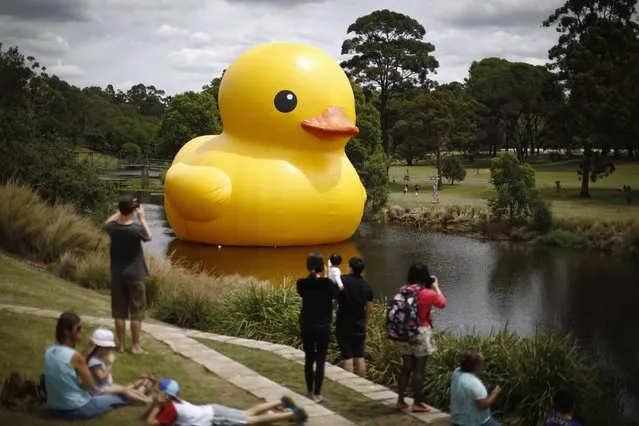
The giant inflatable Rubber Duck installation by Dutch artist Florentijn Hofman floats on the Parramatta River, as part of the 2014 Sydney Festival, in Western Sydney, January 10, 2014. The creation is five stories tall and five stories wide and has been seen floating in various cities around the world since 2007. (Photo by Jason Reed/Reuters)

The giant inflatable Rubber Duck installation by Dutch artist Florentijn Hofman floats on the Parramatta River, as part of the 2014 Sydney Festival, in Western Sydney, January 10, 2014. The creation is five stories tall and five stories wide and has been seen floating in various cities around the world since 2007. (Photo by Jason Reed/Reuters)
Details
19 Aug 2014 10:34:00
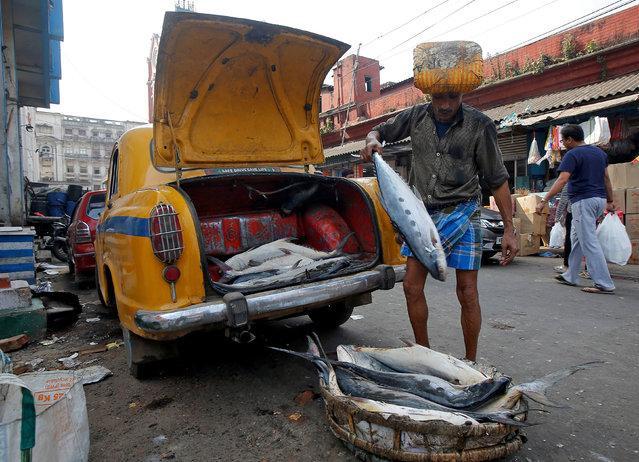
A worker unloads fish from a taxi boot at a fish market in Kolkata, India on February 5, 2018. (Photo by Rupak De Chowdhuri/Reuters)

A worker unloads fish from a taxi boot at a fish market in Kolkata, India on February 5, 2018. (Photo by Rupak De Chowdhuri/Reuters)
Details
06 Feb 2018 07:03:00
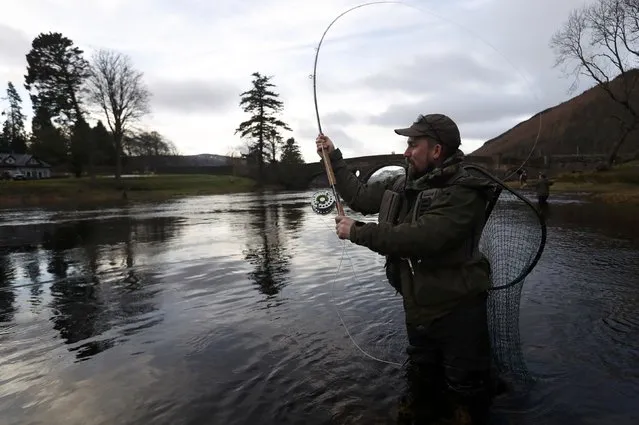
An angler fishes on the opening day of the salmon fishing season on the River Tay at Kenmore in Scotland, Britain January 16, 2017. (Photo by Russell Cheyne/Reuters)

An angler fishes on the opening day of the salmon fishing season on the River Tay at Kenmore in Scotland, Britain January 16, 2017. (Photo by Russell Cheyne/Reuters)
Details
17 Jan 2017 12:18:00
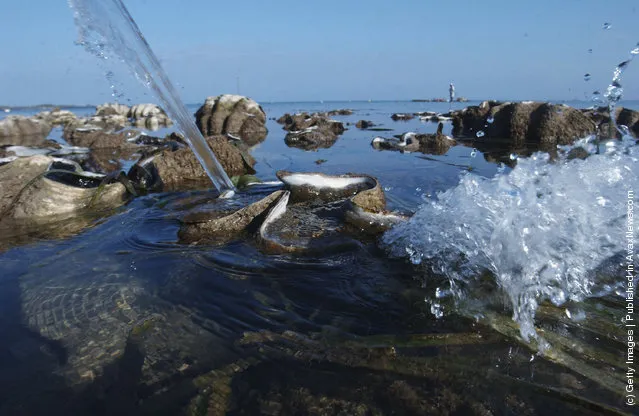
Tridacna Gigas, or Giant Clams

“The giant clam, Tridacna gigas (known as pā’ua in Cook Islands Māori), is the largest living bivalve mollusc. T. gigas is one of the most endangered clam species. It was mentioned as early as 1825 in scientific reports. One of a number of large clam species native to the shallow coral reefs of the South Pacific and Indian oceans, they can weigh more than 200 kilograms (440 lb) measure as much as 120 cm (47 in) across, and have an average lifespan in the wild of 100 years or more”. – Wikipedia

Photo: Tridacna Gigas, or Giant Clams spew water as a traditional fisherman passes by a small sanctuary on January 23, 2004 near Bolinao in the Northern Philippines. The clams, prime builders for coral reefs and providing shelter for spawning fish and other marine life, are exposed by low tides in the sanctuary. Overfishing and pollution throughout the country are not only threatening food security, but are also starting to choke one of the few working clam sanctuaries in the world. (Photo by David Greedy/Getty Images)
Details
01 Oct 2011 13:10:00
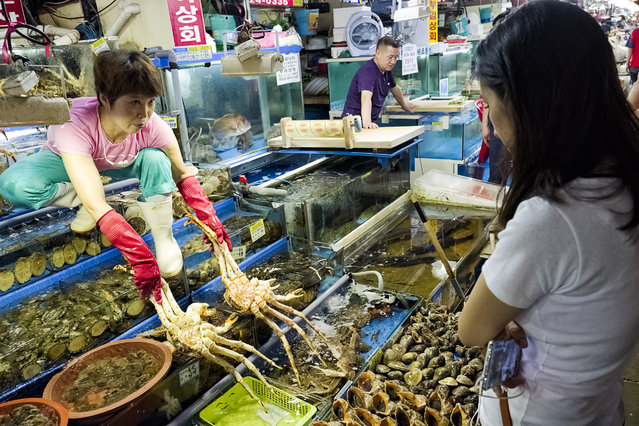
A sales woman of a fish shop shows king crabs to a customer and negotiates the price in Noryangjin Fish Market is seen on August 1, 2015 in Seoul, South Korea. Noryangjin Fish Market was established in 1927 as Gyeongseong Susan in Jung-gu near Seoul Station and moved to its current location in 1971. (Photo by Shin Woong-jae/The Washington Post)

A sales woman of a fish shop shows king crabs to a customer and negotiates the price in Noryangjin Fish Market is seen on August 1, 2015 in Seoul, South Korea. Noryangjin Fish Market was established in 1927 as Gyeongseong Susan in Jung-gu near Seoul Station and moved to its current location in 1971. (Photo by Shin Woong-jae/The Washington Post)
Details
11 Sep 2015 12:21:00
A woman looks at head of bluefin tuna on display in front of a store at Tsukiji fish market in Tokyo, Monday, February 19, 2018.  The large bluefin are particularly valuable in Japan, where they are considered a premium sushi and sashimi fish. A single fish sold for more than $1.75 million at an auction in Japan in 2013. (Photo by Koji Sasahara/AP Photo)

A woman looks at head of bluefin tuna on display in front of a store at Tsukiji fish market in Tokyo, Monday, February 19, 2018. The large bluefin are particularly valuable in Japan, where they are considered a premium sushi and sashimi fish. A single fish sold for more than $1.75 million at an auction in Japan in 2013. (Photo by Koji Sasahara/AP Photo)
Details
06 Mar 2018 00:05:00