Loading...
Done


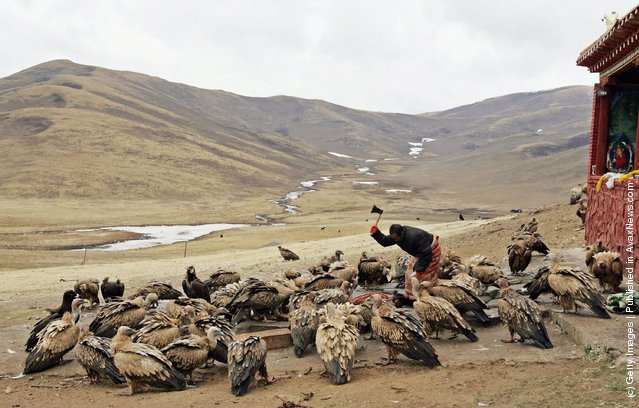
“Sky burial or ritual dissection was once a common funerary practice in Tibet wherein a human corpse is cut in specific locations and placed on a mountaintop, exposing it to the elements or the mahabhuta and animals – especially to birds of prey. The location of the sky burial preparation and place of execution are understood in the Vajrayana traditions as charnel grounds. In Tibet the practice is known as jhator, which literally means, «giving alms to the birds»”. – Wikipedia

Photo: A burial master chops bones of a body to feed vultures during a celestial burial ceremony on April 19, 2006 in Dari County of Guoluo Prefecture, Qinghai Province, northwest China. Celestial burial is a traditional funeral of Tibetan people, which began in the 7th century. (Photo by China Photos/Getty Images)
Details
18 Jun 2011 12:12:00
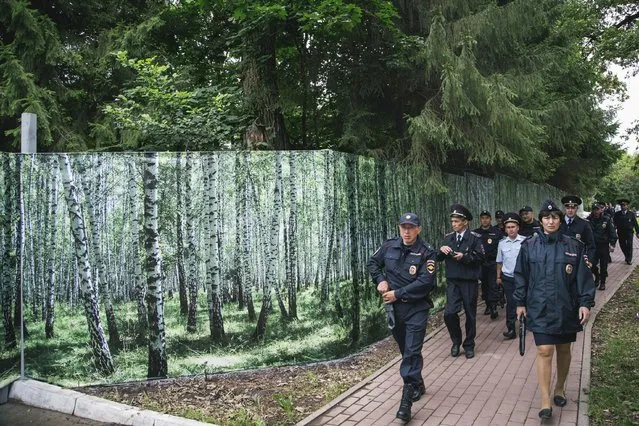
In this photo taken on Sunday, July  5, 2015, police officers walk along a giant poster to give an improved appearance, in downtown Ufa, Russia. Ufa will host SOC (Shanghai Cooperation Organization) and BRICS (Brazil, Russia, India, China and South Africa) summits July 7 to July 9, 2015. (Photo by Vadim Braydov/AP Photo)

In this photo taken on Sunday, July 5, 2015, police officers walk along a giant poster to give an improved appearance, in downtown Ufa, Russia. Ufa will host SOC (Shanghai Cooperation Organization) and BRICS (Brazil, Russia, India, China and South Africa) summits July 7 to July 9, 2015. (Photo by Vadim Braydov/AP Photo)
Details
07 Jul 2015 11:40:00
An explosion at a petrochemical plant is seen in Rizhao, Shandong province, July 16, 2015. According to Xinhua News Agency, a fire broke out after the explosion, which was caused by a liquified hydrocarbon leak at the plant, on Thursday morning. There was no report of casualties yet. (Photo by Reuters/China Daily)

An explosion at a petrochemical plant is seen in Rizhao, Shandong province, July 16, 2015. According to Xinhua News Agency, a fire broke out after the explosion, which was caused by a liquified hydrocarbon leak at the plant, on Thursday morning. There was no report of casualties yet. (Photo by Reuters/China Daily)
Details
17 Jul 2015 14:03:00
Children eat watermelons to meet the “beginning of autumn” at a kindergarten in Handan, China on August 7, 2015. Chinese tradition to eat watermelons or peaches before that day symbolises “biting away summer”. The solar term ‘beginning of autumn’ falls on 8 August this year. (Photo by Xinhua/REX Shutterstock)

Children eat watermelons to meet the “beginning of autumn” at a kindergarten in Handan, China on August 7, 2015. Chinese tradition to eat watermelons or peaches before that day symbolises “biting away summer”. The solar term ‘beginning of autumn’ falls on 8 August this year. (Photo by Xinhua/REX Shutterstock)
Details
11 Aug 2015 14:29:00
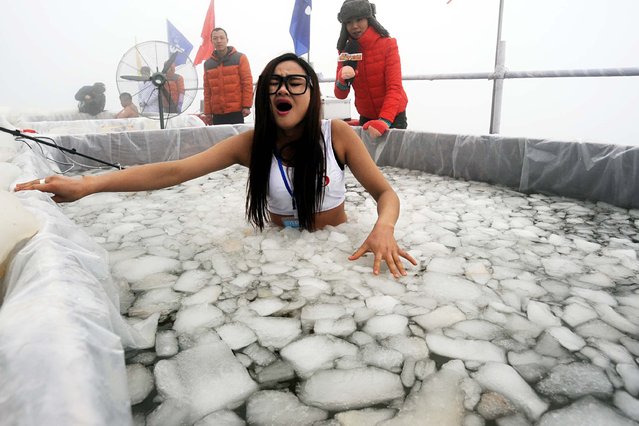
This picture taken on January 25, 2015 shows a participant taking part in an ice water challenge in Zhangjiajie, central China's Hunan province. Participants were required to stay in an ice pond, holding an ice block while eating ice-cream with an electric fan blowing at them. (Photo by AFP Photo/Stringer)

This picture taken on January 25, 2015 shows a participant taking part in an ice water challenge in Zhangjiajie, central China's Hunan province. Participants were required to stay in an ice pond, holding an ice block while eating ice-cream with an electric fan blowing at them. (Photo by AFP Photo/Stringer)
Details
31 Jan 2015 12:58:00
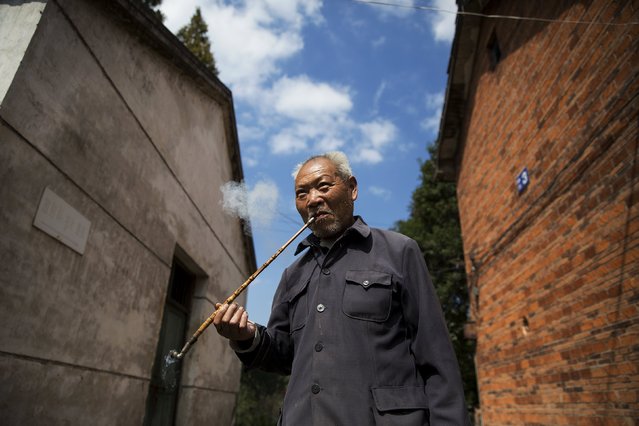
Wang Zhengqing, a 74 year old pneumoconiosis patient, smokes his pipe at Yangjia Hospital in Wuyi County, Zhejiang Province, China October 19, 2015. Former miner Wang was diagnosed with the disease, which is caused by dust inhalation, when he was 24 and has lived at Yangjia Hospital for ten years. (Photo by Damir Sagolj/Reuters)

Wang Zhengqing, a 74 year old pneumoconiosis patient, smokes his pipe at Yangjia Hospital in Wuyi County, Zhejiang Province, China October 19, 2015. Former miner Wang was diagnosed with the disease, which is caused by dust inhalation, when he was 24 and has lived at Yangjia Hospital for ten years. (Photo by Damir Sagolj/Reuters)
Details
31 Oct 2015 08:00:00
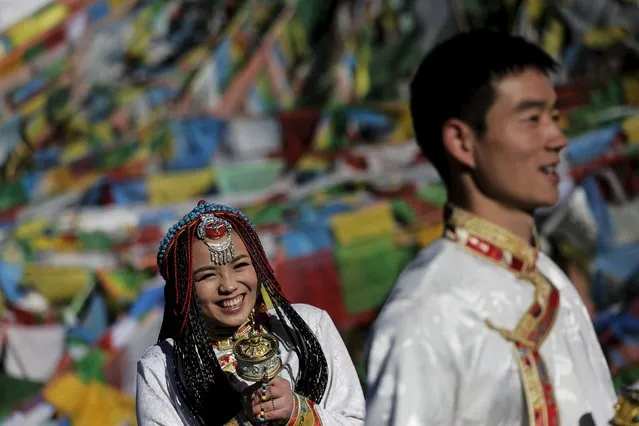
Jing Li (L) and her husband Ke Xu wear Tibetan traditional costumes as they pose for their wedding photos in front of Tibetan prayer flags at the Nianqing Tanggula mountain pass in the Tibet Autonomous Region, China November 18, 2015. (Photo by Damir Sagolj/Reuters)

Jing Li (L) and her husband Ke Xu wear Tibetan traditional costumes as they pose for their wedding photos in front of Tibetan prayer flags at the Nianqing Tanggula mountain pass in the Tibet Autonomous Region, China November 18, 2015. Jing, 22, and her husband Ke Xu, 23, both from Shiyan in northwestern Hubei province live in Tibet for three year. The couple married last month. (Photo by Damir Sagolj/Reuters)
Details
20 Nov 2015 08:05:00
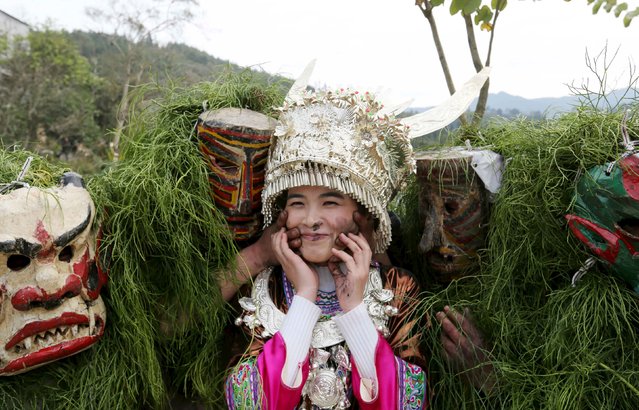
Ethnic Miao men wearing traditional masks smear dust on a woman's face to wish her good luck during local celebration event for Lunar New Year in Liuzhou, Guangxi Zhuang Autonomous Region, China, February 16, 2016. (Photo by Reuters/Stringer)

Ethnic Miao men wearing traditional masks smear dust on a woman's face to wish her good luck during local celebration event for Lunar New Year in Liuzhou, Guangxi Zhuang Autonomous Region, China, February 16, 2016. (Photo by Reuters/Stringer)
Details
19 Feb 2016 13:25:00