Loading...
Done
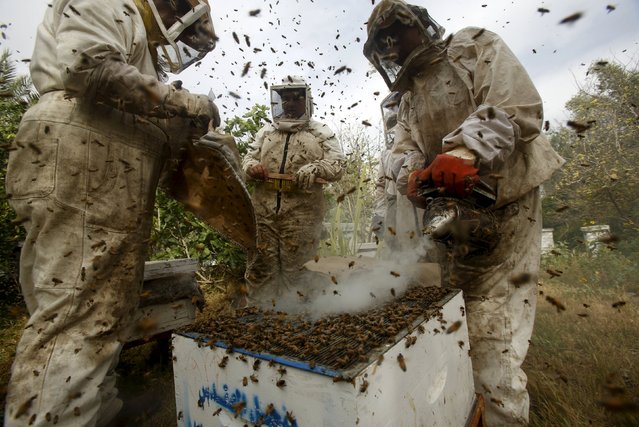
A Palestinian beekeeper uses smoke to calm bees in the process of collecting honey at a farm in Rafah, in the southern Gaza Strip April 11, 2016. (Photo by Suhaib Salem/Reuters)

A Palestinian beekeeper uses smoke to calm bees in the process of collecting honey at a farm in Rafah, in the southern Gaza Strip April 11, 2016. Rateb Samour sees 250 patients a day, whose complaints range from hair loss to cerebral palsy and cancer. He is not a doctor and has never worked in a hospital. Samour inherited the skill of bee-sting therapy from his father. From 2003 the agricultural engineer dedicated all his time to study and develop the alternative-medicine treatment of apitherapy, which uses bee-related products from honey, propolis – or bee glue used to build hives – to venom. (Photo by Suhaib Salem/Reuters)
Details
13 Apr 2016 09:14:00
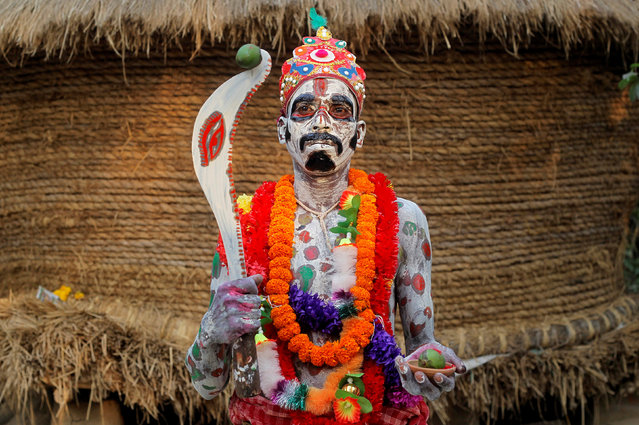
A devotee with his body painted poses as he waits to perform during a ritual as part of the annual Shiva Gajan religious festival at Sona Palasi village, in West Bengal, India, April 11, 2016. Devotees offer sacrifices and perform acts of devotion during the festival in the hopes of winning the favour of Hindu god Shiva and ensuring the fulfillment of their wishes, and also to mark the end of the Bengali calendar year. (Photo by Rupak De Chowdhuri/Reuters)

A devotee with his body painted poses as he waits to perform during a ritual as part of the annual Shiva Gajan religious festival at Sona Palasi village, in West Bengal, India, April 11, 2016. Devotees offer sacrifices and perform acts of devotion during the festival in the hopes of winning the favour of Hindu god Shiva and ensuring the fulfillment of their wishes, and also to mark the end of the Bengali calendar year. (Photo by Rupak De Chowdhuri/Reuters)
Details
13 Apr 2016 09:42:00
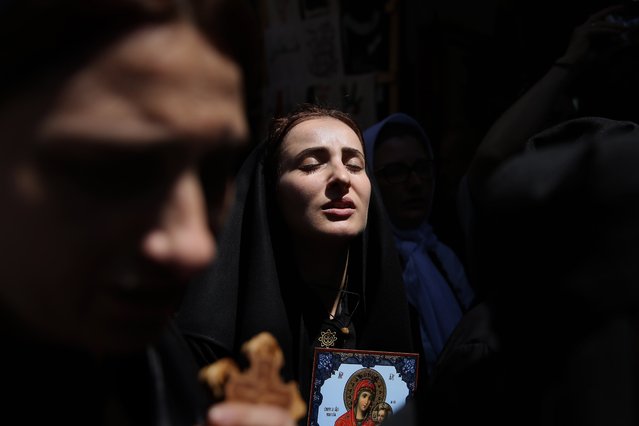
Orthodox Christian pilgrims from Abkhazia walk along the Via Dolorosa (Way of Suffering), during the Good Friday procession in Jerusalem's old city on April 29, 2016. Thousands of pilgrims took part in processions along the route where, according to tradition, Jesus carried the cross during his last days. (Photo by Gali Tibbon/AFP Photo)

Orthodox Christian pilgrims from Abkhazia walk along the Via Dolorosa (Way of Suffering), during the Good Friday procession in Jerusalem's old city on April 29, 2016. Thousands of pilgrims took part in processions along the route where, according to tradition, Jesus carried the cross during his last days. (Photo by Gali Tibbon/AFP Photo)
Details
30 Apr 2016 09:27:00
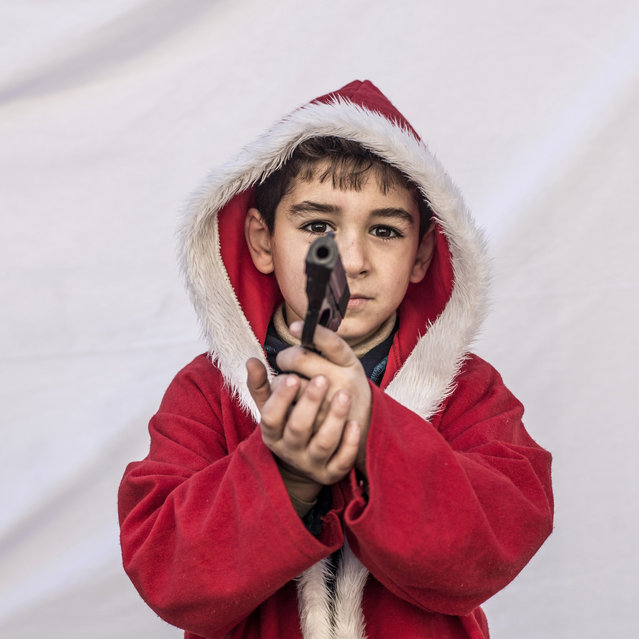
Kayaks, 7, poses for a picture holding toy gun in a camp where Christians displaced by Islamic State militants are living, in Irbil, Iraq, Friday, December 23, 2016. Iraq’s Christians are marking the holiday in his camp for displaced people with a sense of worry and despair,  unable to return to their towns they were forced to flee two years ago by the Islamic State group’s onslaught. (Photo by Manu Brabo/AP Photo)

Kayaks, 7, poses for a picture holding toy gun in a camp where Christians displaced by Islamic State militants are living, in Irbil, Iraq, Friday, December 23, 2016. Iraq’s Christians are marking the holiday in his camp for displaced people with a sense of worry and despair, unable to return to their towns they were forced to flee two years ago by the Islamic State group’s onslaught. (Photo by Manu Brabo/AP Photo)
Details
24 Dec 2016 09:33:00
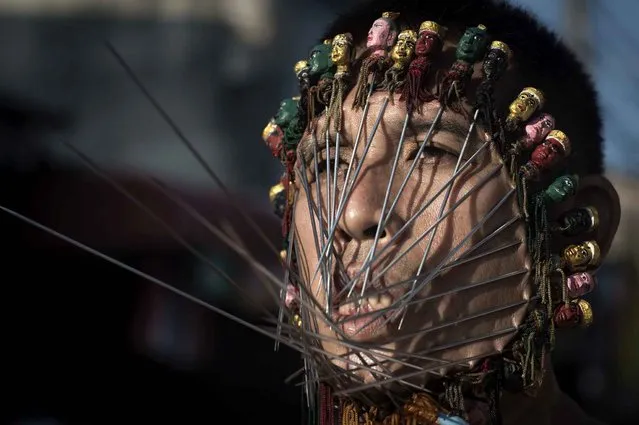
A devotee of the Chinese Jui Tui Shrine has his face pierced with metal rods during a street procession during the annual Vegetarian Festival in the southern Thai town of Phuket on October 19, 2015. During the festival, which begins on the first evening of the ninth lunar month and lasts nine days, religious devotees slash themselves with swords, pierce their cheeks with sharp objects and commit other painful acts to purify themselves, taking on the sins of the community. (Photo by Nicolas Asfouri/AFP Photo)

A devotee of the Chinese Jui Tui Shrine has his face pierced with metal rods during a street procession during the annual Vegetarian Festival in the southern Thai town of Phuket on October 19, 2015. During the festival, which begins on the first evening of the ninth lunar month and lasts nine days, religious devotees slash themselves with swords, pierce their cheeks with sharp objects and commit other painful acts to purify themselves, taking on the sins of the community. (Photo by Nicolas Asfouri/AFP Photo)
Details
21 Oct 2015 08:05:00
Winti spiritual leader Ramon Mac-Nack (2nd L) looks on as as his bride Melissa Karwafodi (2nd R) hands a gourd to a Maroon priest (L) as they are wedded in the first Winti marriage ever to be held in public, in district Para, Suriname, November 16, 2015. (Photo by Ranu Abhelakh/Reuters)

Winti spiritual leader Ramon Mac-Nack (2nd L) looks on as as his bride Melissa Karwafodi (2nd R) hands a gourd to a Maroon priest (L) as they are wedded in the first Winti marriage ever to be held in public, in district Para, Suriname, November 16, 2015. The Winti religion, which formed centuries ago out of elements of different religious traditions that African slaves brought with them to Suriname, was considered a form idolatry and prohibited by law since the days of slavery until it was finally officially recognized in 1971. (Photo by Ranu Abhelakh/Reuters)
Details
27 Nov 2015 05:51:00
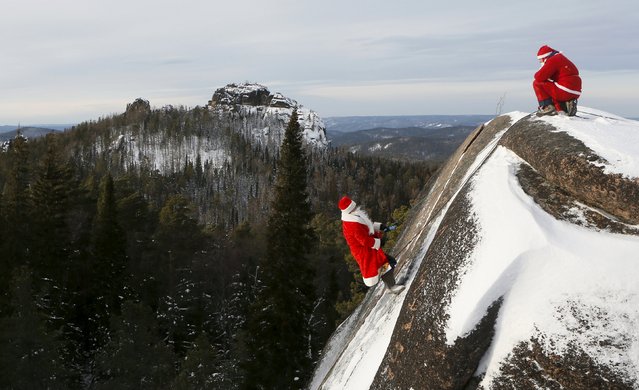
A member of the “Sibspas” Siberian search and rescue group dressed as Santa Claus (R), waits for his team mate, dressed as Father Frost, the Russian equivalent of Santa Claus, as he climbs the rock named “The Fourth Stolb” (the Fourth Pillar) at the Stolby national nature reserve during a training session of the Russian Emergencies Ministry, outside the Siberian city of Krasnoyarsk, Russia December 15, 2015. (Photo by Ilya Naymushin/Reuters)

A member of the “Sibspas” Siberian search and rescue group dressed as Santa Claus (R), waits for his team mate, dressed as Father Frost, the Russian equivalent of Santa Claus, as he climbs the rock named “The Fourth Stolb” (the Fourth Pillar) at the Stolby national nature reserve during a training session of the Russian Emergencies Ministry, outside the Siberian city of Krasnoyarsk, Russia December 15, 2015. (Photo by Ilya Naymushin/Reuters)
Details
16 Dec 2015 12:32:00
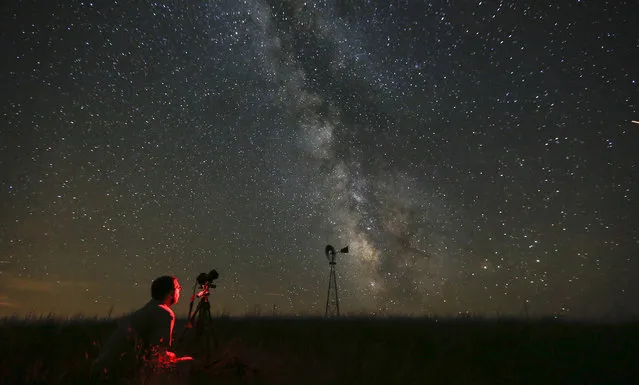
In this Wednesday, July 23, 2014 file photo, Omaha photographer Lane Hickenbottom photographs the night sky in a pasture near Callaway, Neb. With no moon in the sky, the Milky Way was visible to the naked eye. More than one-third of the world’s population can no longer see the Milky Way because of man-made lights, according to a scientific paper by Light Pollution Science and Technology Institute's Fabio Falchi and his team members, published on Friday, June 10, 2016. (Photo by Travis Heying/The Wichita Eagle via AP Photo)

In this Wednesday, July 23, 2014 file photo, Omaha photographer Lane Hickenbottom photographs the night sky in a pasture near Callaway, Neb. With no moon in the sky, the Milky Way was visible to the naked eye. More than one-third of the world’s population can no longer see the Milky Way because of man-made lights, according to a scientific paper by Light Pollution Science and Technology Institute's Fabio Falchi and his team members, published on Friday, June 10, 2016. (Photo by Travis Heying/The Wichita Eagle via AP Photo)
Details
11 Jun 2016 12:37:00