An employee of a bakery talks on his mobile while balancing on his head a tray of freshly baked bread from a local bakery in a street in Cairo, Egypt, January 12, 2016. (Photo by Asmaa Waguih/Reuters)
Miss Brazil Julia Gama reacts after her team won the tug of war event during the Miss World sports competition at the Lee Valley sports complex in north London, November 26, 2014. Contestants from 126 countries are in London to compete in the 2014 Miss World competition. (Photo by Andrew Winning/Reuters)
A woman stands in front of graffiti depicting Venezuela's late former President Hugo Chavez, right, and revolutionary hero Simon Bolivar, in downtown Caracas, Venezuela, Wednesday, October 25, 2017. (Photo by Rodrigo Abd/AP Photo)
A young Thai man jumps in the air and cheers as his rocket takes off at the Bun Bang Fai Rocket Festival on May 10, 2015 in Yasothon, Thailand. During the Bun Bang Fai rocket festival, Thai residents launch enormous home-made rockets into the air to gain Buddhist merit and to celebrate the beginning of the rainy season. (Photo by Taylor Weidman/Getty Images)
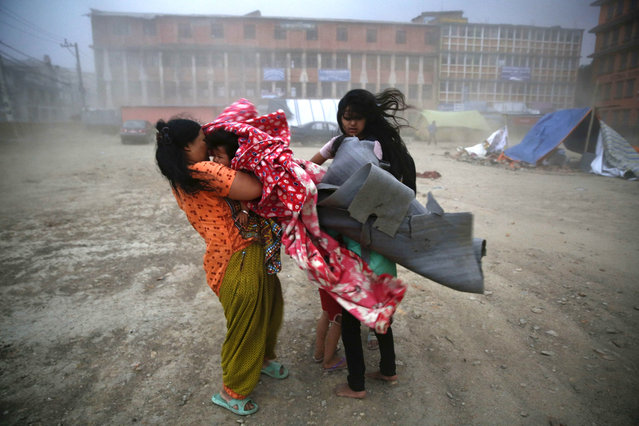
A storm whips through a tented area occupied by Nepalese earthquake survivors as a mother grabs her infant child and runs to find shelter in Kathmandu, Nepal 23 May 2015. Nepalese, who lost their homes in earthquake and fear aftershocks, have been living in temporary shelter in open ground which they had to flee because of the heavy rain and powerful wind. (Photo by Narendra Shrestha/EPA)
Kosovar Bosnian women help the bride Sellma Demirovic (C) to be dressed with traditional clothes on her wedding day for a traditional ceremony in the village of Donje Ljubinje, Kosovo, 14 August 2021. (Photo by Valdrin Xhemaj/EPA/EFE)
This Thursday, January 22, 2015 photo made with a long exposure shows the glow from a Noctiluca scintillans algal bloom along the seashore in Hong Kong. The luminescence, also called Sea Sparkle, is triggered by farm pollution that can be devastating to marine life and local fisheries, according to University of Georgia oceanographer Samantha Joye. Noctiluca itself does not produce neurotoxins like other similar organisms do. But its role as both prey and predator tends can eventually magnify the accumulation of toxins in the food chain, according to R. Eugene Turner at Louisiana State University. (Photo by Kin Cheung/AP Photo)