Loading...
Done
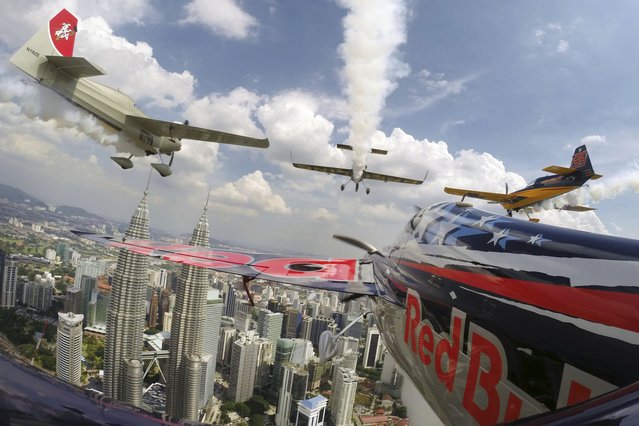
Kirby Chambliss of the United States flies in formation with Matt Hall of Australia, Yoshihide Muroya of Japan and Nigel Lamb of Britain prior to the third stage of the Red Bull Air Race World Championship in front of the Petronas Towers in Kuala Lumpur, Malaysia, on May 15, 2014. (Photo by Joerg Mitter/Red Bull via Reuters)

Kirby Chambliss of the United States flies in formation with Matt Hall of Australia, Yoshihide Muroya of Japan and Nigel Lamb of Britain prior to the third stage of the Red Bull Air Race World Championship in front of the Petronas Towers in Kuala Lumpur, Malaysia, on May 15, 2014. (Photo by Joerg Mitter/Red Bull via Reuters)
Details
17 May 2014 12:56:00
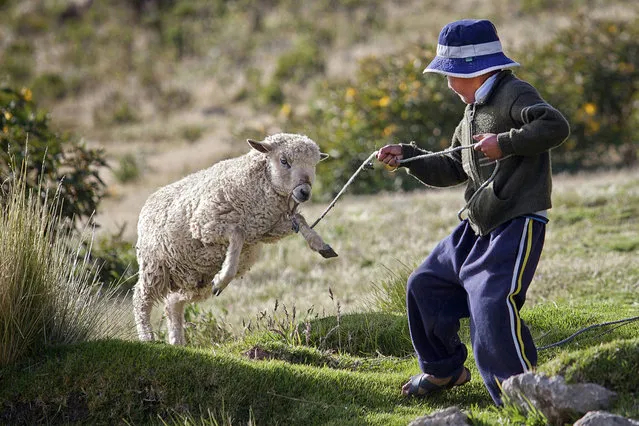
“The Challenge!” Young boy relishes in a game of tug of war before school. Photo location:  Lake Titicaca, Peru. (Photo and caption by Paul Heyman/National Geographic Photo Contest)

“The Challenge!” Young boy relishes in a game of tug of war before school. Photo location: Lake Titicaca, Peru. (Photo and caption by Paul Heyman/National Geographic Photo Contest)
Details
18 Jun 2014 12:40:00
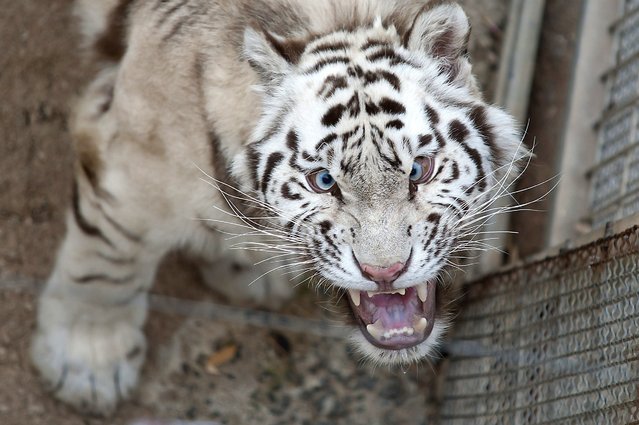
A Siberian tiger at a photographer for getting too much in its face  during the presentation of two new Siberian tigers at Cabarceno Natural Reserve in Cabarceno, northern Spain, 21 July 2014. (Photo by Pedro Puente Hoyos/EPA)

A Siberian tiger at a photographer for getting too much in its face during the presentation of two new Siberian tigers at Cabarceno Natural Reserve in Cabarceno, northern Spain, 21 July 2014. (Photo by Pedro Puente Hoyos/EPA)
Details
26 Jul 2014 12:19:00
British rally driver Kris Meeke jumps his Citroen over a brow during the fifth special stage of the World Rally Championship (WRC) Rally of Australia, near Bellingen on the New South Wales central coast on September 12, 2014. (Photo by William West/AFP Photo)

British rally driver Kris Meeke jumps his Citroen over a brow during the fifth special stage of the World Rally Championship (WRC) Rally of Australia, near Bellingen on the New South Wales central coast on September 12, 2014. (Photo by William West/AFP Photo)
Details
13 Sep 2014 12:01:00
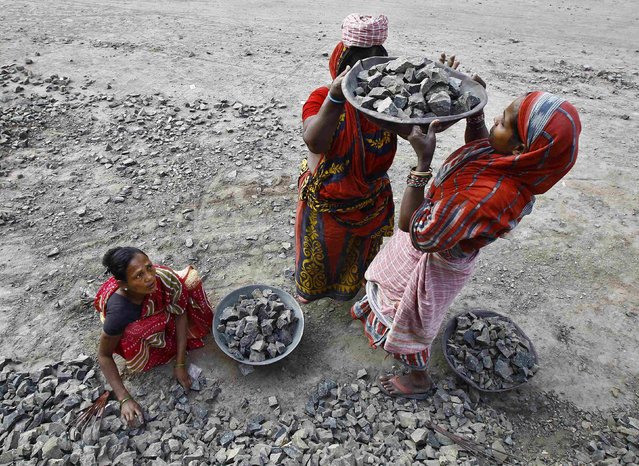
Women labourers work at the construction site of a road in Kolkata January 8, 2015. Across towns and cities in India, it is not uncommon to see women cleaning building sites, carrying bricks and or shoveling gravel - helping construct the infrastructure necessary for the country's economic and social development. (Photo by Rupak De Chowdhuri/Reuters)

Women labourers work at the construction site of a road in Kolkata January 8, 2015. Across towns and cities in India, it is not uncommon to see women cleaning building sites, carrying bricks and or shoveling gravel – helping construct the infrastructure necessary for the country's economic and social development. They help build roads, railway tracks, airports, and offices. They lay pipes for clean water supplies, cables for telecommunications, and dig the drains for sewage systems. But although women make up at least 20 percent of India's 40 million construction workers, they are less recognized than male workers with lower pay and often prone to safety hazards and sexual harassment. They are often unaware of their rights or scared to complain, say activists now trying to campaign for better treatment of women in the construction industry. (Photo by Rupak De Chowdhuri/Reuters)

Details
15 Jan 2015 13:47:00
While the lido was described as bringing “modernism to the masses” on the British coast it was just the latest example of a trend that had been developing since Victorian times – transforming seaside towns into resorts for leisure and entertainment. In the latter half of the nineteenth century, the fashion was for local authorities to build great piers stretching from the promenade out into the sea

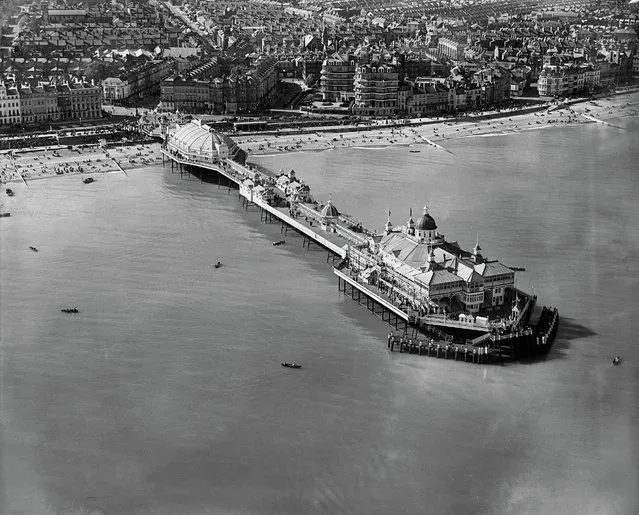
While the lido was described as bringing “modernism to the masses” on the British coast it was just the latest example of a trend that had been developing since Victorian times – transforming seaside towns into resorts for leisure and entertainment. In the latter half of the nineteenth century, the fashion was for local authorities to build great piers stretching from the promenade out into the sea. The Eastbourne Pier, pictured here in May 1931, was erected between 1866 and 1870 to an ingenious design by Eugenius Birch, which saw the structure sitting on special cups allowing the supporting struts to “move” in bad weather. Arranged on the pier's 1,000-foot length were kiosks, a theatre, a ballroom and a camera obscura. 1931. (Photo by Aerofilms Collection via “A History of Britain From Above”)
Details
25 Feb 2014 12:59:00
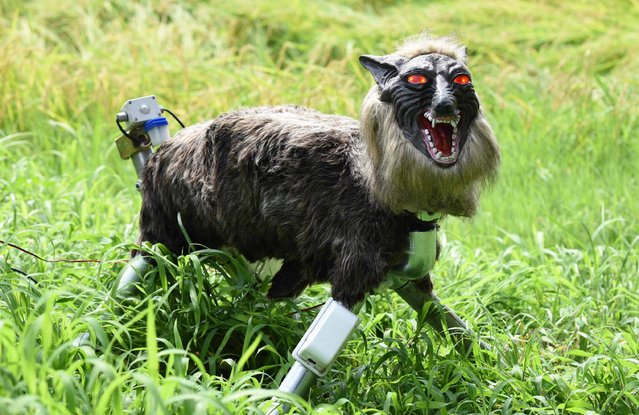
A wolf-like robot “Super Monster Wolf” stands beside a rice field to drive away wild animals that cause damages to crops in Kisarazu, Chiba prefecture, on August 25, 2017. The agricultural coopetative association JA Kisarazu-shi introduced the 65cm-long and 50cm-high robot recently on a trial basis which can detect wild animals such as boars and deers with an infrared ray sensor when they approach and intimidates them, flashing the red LED eyes and blaring 48 types of sounds including a wolf growl and human voice. (Photo by Toru Yamanaka/AFP Photo)

A wolf-like robot “Super Monster Wolf” stands beside a rice field to drive away wild animals that cause damages to crops in Kisarazu, Chiba prefecture, on August 25, 2017. The agricultural coopetative association JA Kisarazu-shi introduced the 65cm-long and 50cm-high robot recently on a trial basis which can detect wild animals such as boars and deers with an infrared ray sensor when they approach and intimidates them, flashing the red LED eyes and blaring 48 types of sounds including a wolf growl and human voice. (Photo by Toru Yamanaka/AFP Photo)
Details
27 Aug 2017 07:17:00
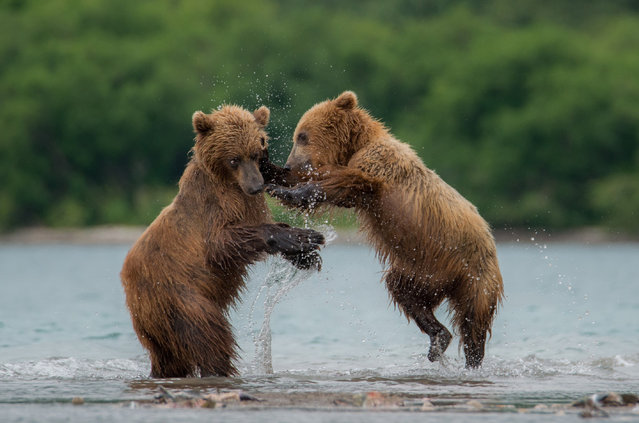
Kamchatka brown bears at Kurile Lake in Kamchatka peninsula’s volcanic terrain, Russia on August, 2017. Kamchatka brown bears are generally not dangerous to humans, and only 1% of encounters result in attack. (Photo by Igor Ivanko/Anadolu Agency/Getty Images)

Kamchatka brown bears at Kurile Lake in Kamchatka peninsula’s volcanic terrain, Russia on August, 2017. Kamchatka brown bears are generally not dangerous to humans, and only 1% of encounters result in attack. (Photo by Igor Ivanko/Anadolu Agency/Getty Images)
Details
03 Sep 2017 07:17:00