Loading...
Done
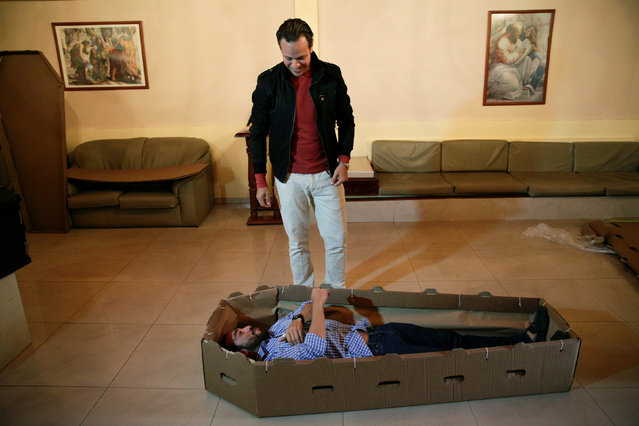
Elio Angulo (bottom C) lies inside a cardboard coffin next to Alejandro Blanchard as they introduce their product to potential customers at a mortuary in Valencia, in the state of Carabobo, Venezuela August 25, 2016. (Photo by Marco Bello/Reuters)

Elio Angulo (bottom C) lies inside a cardboard coffin next to Alejandro Blanchard as they introduce their product to potential customers at a mortuary in Valencia, in the state of Carabobo, Venezuela August 25, 2016. When Venezuelan entrepreneurs Alejandro Blanchard and Elio Angulo decided to create cardboard coffins, they were looking for an ecological selling point to compete against classic wood and brass caskets. Three years on, with the oil-rich country mired in deep economic crisis, their “bio-coffins” are becoming a viable option because of high prices for wooden coffins and shortages of brass ones. (Photo by Marco Bello/Reuters)
Details
27 Aug 2016 11:18:00
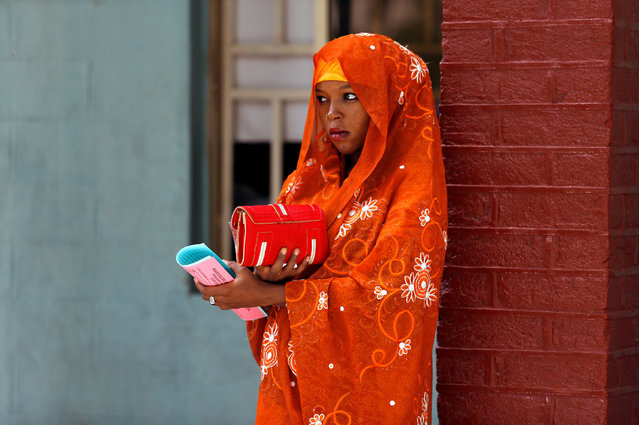
A woman waits at a polio immunisation health centre, in Maiduguri, Borno State, Nigeria, August 29, 2016. Nigeria's military has liberated large swathes of land from Boko Haram but a ride with an army convoy, all guns firing for fear of ambush, shows how far the northeast is from normality after a brutal Islamist insurgency that has displaced millions. The moment military convoys leave the relative safety of Bama, Borno state's second town, soldiers in the lead vehicle open fire with a heavy cannon into the scrub along the road to pre-empt attacks by remaining fighters from the Islamist group. (Photo by Afolabi Sotunde/Reuters)

A woman waits at a polio immunisation health centre, in Maiduguri, Borno State, Nigeria, August 29, 2016. Nigeria's military has liberated large swathes of land from Boko Haram but a ride with an army convoy, all guns firing for fear of ambush, shows how far the northeast is from normality after a brutal Islamist insurgency that has displaced millions. (Photo by Afolabi Sotunde/Reuters)
Details
08 Sep 2016 09:45:00
Employees stand near an airframe for the second Antonov-225 Mriya plane at Antonov aircraft plant in Kiev, Ukraine, September 7, 2016. Ukraine hopes to attract $500 million of investment from China to complete an updated version of the world's biggest aircraft, the Antonov-225 Mriya, the president of manufacturer Antonov said on Wednesday. The Antonov-225 is a cargo plane designed as part of the former Soviet Union's space programme. The only one completed is still in use and can carry up to 250 tonnes up to 4,000 km (2,485 miles). Work to manufacture a second plane was started in 1988 and never completed, but Antonov has now found a potential investor in the Aerospace Industry Corporation of China (AICC). (Photo by Valentyn Ogirenko/Reuters)

Employees stand near an airframe for the second Antonov-225 Mriya plane at Antonov aircraft plant in Kiev, Ukraine, September 7, 2016. Ukraine hopes to attract $500 million of investment from China to complete an updated version of the world's biggest aircraft, the Antonov-225 Mriya, the president of manufacturer Antonov said on Wednesday. (Photo by Valentyn Ogirenko/Reuters)
Details
08 Sep 2016 10:07:00
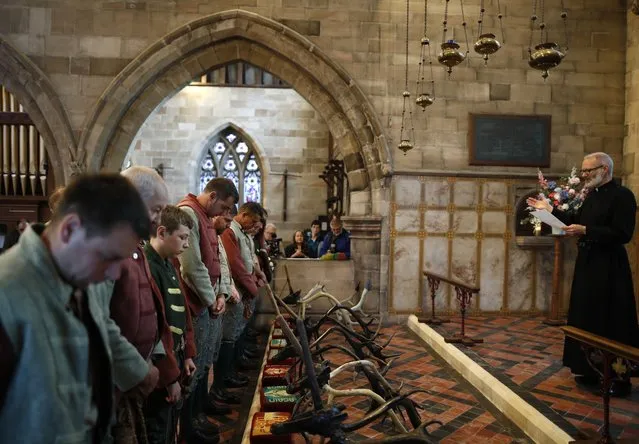
Reverend Simon Davis prays with the dancers before the Abbots Bromley Horn Dance in Abbots Bromley, Britain, September 12, 2016. The Abbots Bromley Horn Dance is an English folk dance dating back to the Middle Ages. The dance takes place each year in Abbots Bromley, a village in Staffordshire, England. The modern version of the dance involves reindeer antlers, a hobby horse, Maid Marian, and a Fool. According to some, the use of antlers suggests an Anglo-Saxon origin along with other native Anglo-Saxon traditions that have survived into modern times in various forms. (Photo by Darren Staples/Reuters)

Reverend Simon Davis prays with the dancers before the Abbots Bromley Horn Dance in Abbots Bromley, Britain, September 12, 2016. The Abbots Bromley Horn Dance is an English folk dance dating back to the Middle Ages. (Photo by Darren Staples/Reuters)
Details
13 Sep 2016 09:36:00
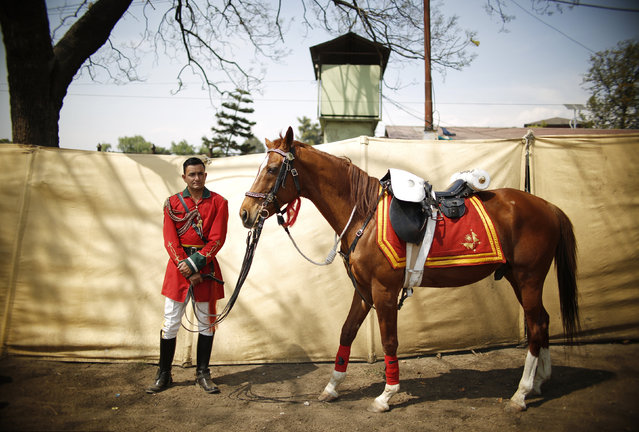
A Nepalese army solder stand next to a horse during the “Ghodejatra” Horse Race festival, which is organised by the Nepal Army, in Kathmandu, Nepal, April 7, 2016. Ghode Jatra, the horse racing festival of Nepal, celebrated on the New Moon day of mid March or early April is among the important celebrations of the Kathmandu Valley. exists a tree in the South-East part of the Tundikhel where Gurumapa supposed to be resides. (Photo by Navesh Chitrakar/Reuters)

A Nepalese army solder stand next to a horse during the “Ghodejatra” Horse Race festival, which is organised by the Nepal Army, in Kathmandu, Nepal, April 7, 2016. Ghode Jatra, the horse racing festival of Nepal, celebrated on the New Moon day of mid March or early April is among the important celebrations of the Kathmandu Valley. Grand horse parade including various acrobatic style of shows are performed by Nepal military at Tundikhel-a fenced parade ground located in the heart of Kathmandu city. (Photo by Navesh Chitrakar/Reuters)
Details
08 Apr 2016 14:33:00
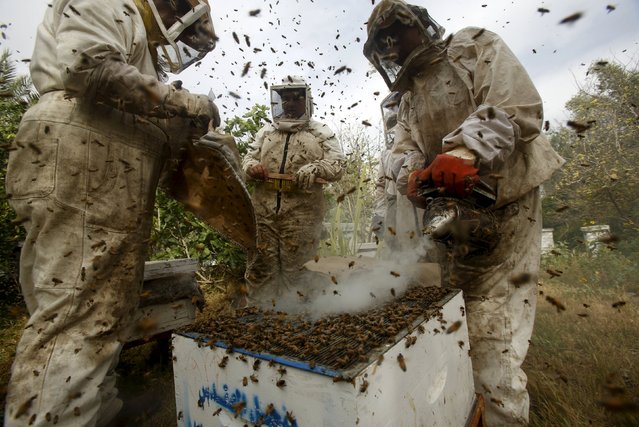
A Palestinian beekeeper uses smoke to calm bees in the process of collecting honey at a farm in Rafah, in the southern Gaza Strip April 11, 2016. (Photo by Suhaib Salem/Reuters)

A Palestinian beekeeper uses smoke to calm bees in the process of collecting honey at a farm in Rafah, in the southern Gaza Strip April 11, 2016. Rateb Samour sees 250 patients a day, whose complaints range from hair loss to cerebral palsy and cancer. He is not a doctor and has never worked in a hospital. Samour inherited the skill of bee-sting therapy from his father. From 2003 the agricultural engineer dedicated all his time to study and develop the alternative-medicine treatment of apitherapy, which uses bee-related products from honey, propolis – or bee glue used to build hives – to venom. (Photo by Suhaib Salem/Reuters)
Details
13 Apr 2016 09:14:00
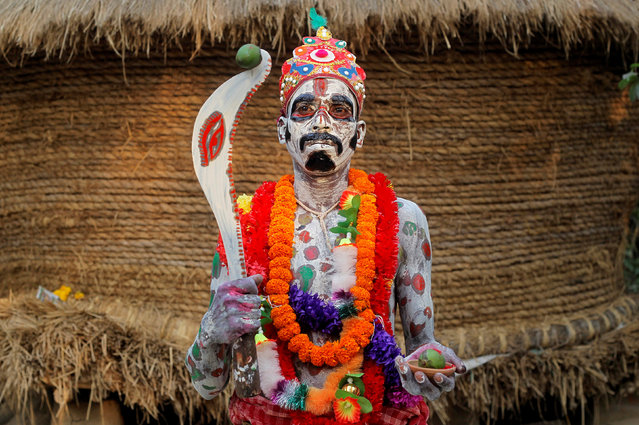
A devotee with his body painted poses as he waits to perform during a ritual as part of the annual Shiva Gajan religious festival at Sona Palasi village, in West Bengal, India, April 11, 2016. Devotees offer sacrifices and perform acts of devotion during the festival in the hopes of winning the favour of Hindu god Shiva and ensuring the fulfillment of their wishes, and also to mark the end of the Bengali calendar year. (Photo by Rupak De Chowdhuri/Reuters)

A devotee with his body painted poses as he waits to perform during a ritual as part of the annual Shiva Gajan religious festival at Sona Palasi village, in West Bengal, India, April 11, 2016. Devotees offer sacrifices and perform acts of devotion during the festival in the hopes of winning the favour of Hindu god Shiva and ensuring the fulfillment of their wishes, and also to mark the end of the Bengali calendar year. (Photo by Rupak De Chowdhuri/Reuters)
Details
13 Apr 2016 09:42:00
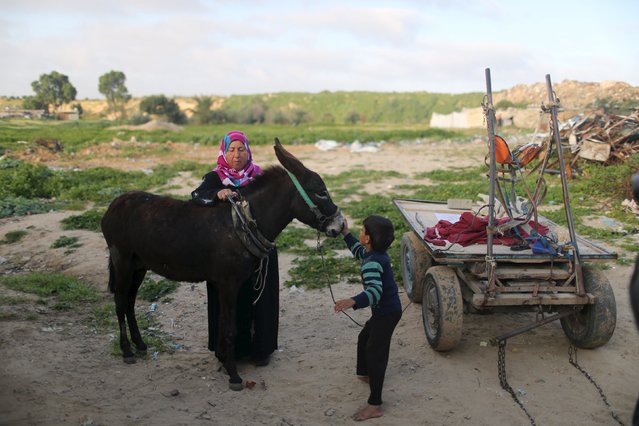
Palestinian woman Jihan Abu Muhsen prepares her donkey with her son Kareem before going work collecting bricks for sale from sites of demolished buildings, at her dwelling in Khan Younis in the southern Gaza Strip March 8, 2016. Abu Muhsen gathers bricks from the sites of demolished buildings and sells them to recycling factories. She earns around 20 shekels ($5) a day and her 10-year-old son Mohammad helps her when he is not at school. (Photo by Ibraheem Abu Mustafa/Reuters)

Palestinian woman Jihan Abu Muhsen prepares her donkey with her son Kareem before going work collecting bricks for sale from sites of demolished buildings, at her dwelling in Khan Younis in the southern Gaza Strip March 8, 2016. Abu Muhsen gathers bricks from the sites of demolished buildings and sells them to recycling factories. She earns around 20 shekels ($5) a day and her 10-year-old son Mohammad helps her when he is not at school. (Photo by Ibraheem Abu Mustafa/Reuters)
Details
19 Apr 2016 13:32:00