Loading...
Done
Kenyan photographer and art director Barbara Minishi (L) takes pictures of her room mate and fashion stylist Wambui Thimba (R) wearing a creation by a Kenyan fashion designer on the rooftop of their apartment in Nairobi, Kenya, on June 1, 2020. After their scheduled works was cancelled due to the spread of the COVID-19 coronavirus, Minishi and Thimba have started their own project called “the Kenya Fashion & Style Diary in 21 days” to showcase a Kenyan fashion brand everyday for 3 weeks on social networking services since May 22, 2020 by only shooting at their apartment. (Photo by Yasuyoshi Chiba/AFP Photo)

Kenyan photographer and art director Barbara Minishi (L) takes pictures of her room mate and fashion stylist Wambui Thimba (R) wearing a creation by a Kenyan fashion designer on the rooftop of their apartment in Nairobi, Kenya, on June 1, 2020. After their scheduled works was cancelled due to the spread of the COVID-19 coronavirus, Minishi and Thimba have started their own project called “the Kenya Fashion & Style Diary in 21 days” to showcase a Kenyan fashion brand everyday for 3 weeks on social networking services since May 22, 2020 by only shooting at their apartment. (Photo by Yasuyoshi Chiba/AFP Photo)
Details
03 Jul 2020 00:05:00
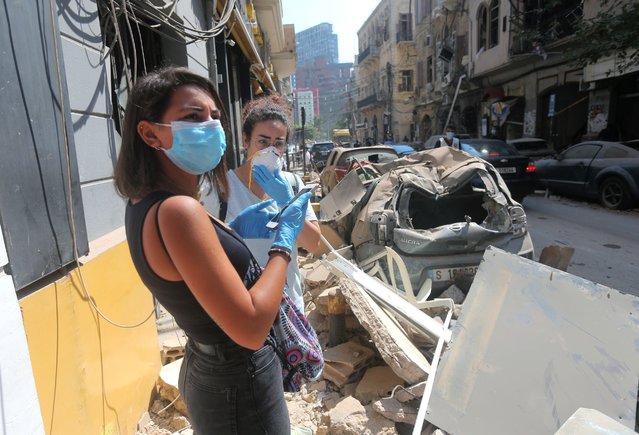
Young Lebanese women wearing protective masks and gloves against the coronavirus pandemic, stand on August 5, 2020 amid the rubble in Beirut's Gimmayzeh commercial district which was heavily damaged by the previous day's powerful explosion that tore through Lebanon's capital, resulting from the ignition of a huge depot of ammonium nitrate at the city's main port. Rescuers searched for survivors in Beirut after a cataclysmic explosion at the port sowed devastation across entire neighbourhoods, killing more than 100 people, wounding thousands and plunging Lebanon deeper into crisis. The blast, which appeared to have been caused by a fire igniting 2,750 tonnes of ammonium nitrate left unsecured in a warehouse, was felt as far away as Cyprus, some 150 miles (240 kilometres) to the northwest. (Photo by AFP Photo/Stringer)

Young Lebanese women wearing protective masks and gloves against the coronavirus pandemic, stand on August 5, 2020 amid the rubble in Beirut's Gimmayzeh commercial district which was heavily damaged by the previous day's powerful explosion that tore through Lebanon's capital, resulting from the ignition of a huge depot of ammonium nitrate at the city's main port. Rescuers searched for survivors in Beirut after a cataclysmic explosion at the port sowed devastation across entire neighbourhoods, killing more than 100 people, wounding thousands and plunging Lebanon deeper into crisis. The blast, which appeared to have been caused by a fire igniting 2,750 tonnes of ammonium nitrate left unsecured in a warehouse, was felt as far away as Cyprus, some 150 miles (240 kilometres) to the northwest. (Photo by AFP Photo/Stringer)
Details
10 Aug 2020 00:05:00
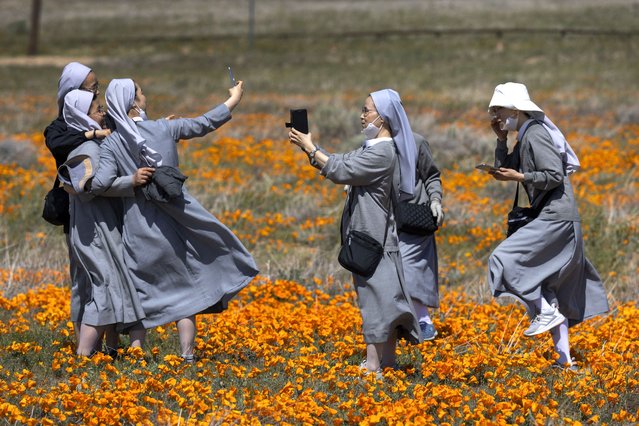
People walk in a field of California poppies and other wildflowers outside of the Antelope Valley California Poppy Reserve, after recent rains moved the region's second-driest winter on record up to its seventh-driest, near Lancaster, California, on April 2, 2022. The California Department of Water Resources reported that about one-third of the Sierra Nevada snowpack's water equivalency melted last week under higher-than-normal temperatures, leaving the statewide snow-water equivalent at 38% of normal for the date. (Photo by David Mcnew/AFP Photo)

People walk in a field of California poppies and other wildflowers outside of the Antelope Valley California Poppy Reserve, after recent rains moved the region's second-driest winter on record up to its seventh-driest, near Lancaster, California, on April 2, 2022. The California Department of Water Resources reported that about one-third of the Sierra Nevada snowpack's water equivalency melted last week under higher-than-normal temperatures, leaving the statewide snow-water equivalent at 38% of normal for the date. (Photo by David Mcnew/AFP Photo)
Details
12 Apr 2022 06:02:00
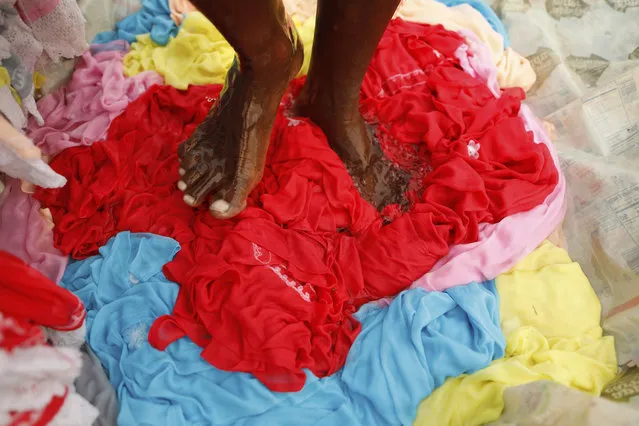
A dhobi, or a washerman washes cloths on the banks of the River Gomti in Lucknow, India, Saturday, September 12, 2020. Dhobis are traditional laundry workers who wash clothes by hand and dry them in the sun, an occupation which has been in existence for generations. Most cities in India have a Dhobi Ghat, or washermen's area, where the city's pile of clothes is laundered. This practice is still popular in India, despite of modern technology. Around 1,000 families work in Lucknow's Dhobi Ghat. However, in light of the novel coronavirus, their wages have decreased drastically. With each family earning around US$100-200 per month. (Photo by Rajesh Kumar Singh/AP Photo)

A dhobi, or a washerman washes cloths on the banks of the River Gomti in Lucknow, India, Saturday, September 12, 2020. Dhobis are traditional laundry workers who wash clothes by hand and dry them in the sun, an occupation which has been in existence for generations. Most cities in India have a Dhobi Ghat, or washermen's area, where the city's pile of clothes is laundered. This practice is still popular in India, despite of modern technology. Around 1,000 families work in Lucknow's Dhobi Ghat. However, in light of the novel coronavirus, their wages have decreased drastically. With each family earning around US$100-200 per month. (Photo by Rajesh Kumar Singh/AP Photo)
Details
25 Sep 2020 00:03:00
A CIT guard carries his gun handgun while bringing a bag containing cash inside an armoured vehicle during a money collection in Johannesburg's CBD, on December 8, 2020. As the Christmas festive season approaches, cash-in-transit (CIT) companies are gearing up as they continue to be target of crime, with about 3000 money vans traveling daily nationwide. Despite the COVID-19 lockdown, there have been 260 cash-in-transit heist incidents in South Africa this year, with 19 CIT crew members killed. Cash-in-transit heists in the country are often military-style planned operations with criminals recurring to bomb making and assault rifles attacks. (Photo by Michele Spatari/AFP Photo)

A CIT guard carries his gun handgun while bringing a bag containing cash inside an armoured vehicle during a money collection in Johannesburg's CBD, on December 8, 2020. As the Christmas festive season approaches, cash-in-transit (CIT) companies are gearing up as they continue to be target of crime, with about 3000 money vans traveling daily nationwide. Despite the COVID-19 lockdown, there have been 260 cash-in-transit heist incidents in South Africa this year, with 19 CIT crew members killed. Cash-in-transit heists in the country are often military-style planned operations with criminals recurring to bomb making and assault rifles attacks. (Photo by Michele Spatari/AFP Photo)
Details
18 Dec 2020 00:01:00
A surfer falls from their board a day after Tropical Storm Hilary swept through the area with large waves hitting south-facing beaches in Huntington Beach, California, on August 21, 2023. Tropical Storm Hilary drenched Southern California with record rainfall, shutting down schools, roads and businesses before edging in on Nevada on August 21, 2023. California Governor Gavin Newsom had declared a state of emergency over much of the typically dry area, where flash flood warnings remained in effect until this morning. (Photo by Frederic J. Brown/AFP Photo)

A surfer falls from their board a day after Tropical Storm Hilary swept through the area with large waves hitting south-facing beaches in Huntington Beach, California, on August 21, 2023. Tropical Storm Hilary drenched Southern California with record rainfall, shutting down schools, roads and businesses before edging in on Nevada on August 21, 2023. California Governor Gavin Newsom had declared a state of emergency over much of the typically dry area, where flash flood warnings remained in effect until this morning. (Photo by Frederic J. Brown/AFP Photo)
Details
01 Sep 2023 03:34:00
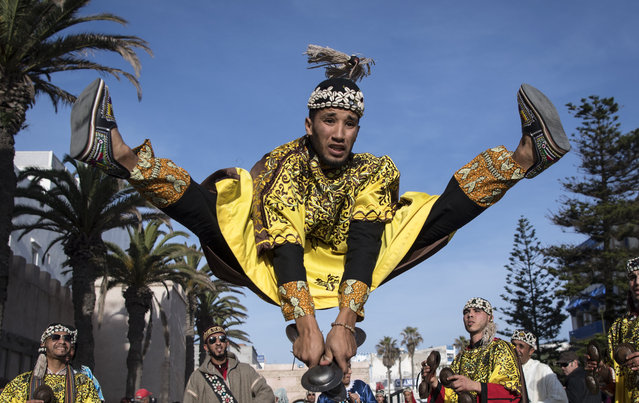
A Gnawa traditional group performs in the city of Essaouira on December 14, 2019, to celebrate the decision of adding the Gnawa culture to UNESCO's list of Intangible Cultural Heritage of Humanity. Gnawa culture, a centuries-old Moroccan practice rooted in music, African rituals and Sufi traditions, was added to UNESCO's list of Intangible Cultural Heritage of Humanity earlier in the week. Gnawa refers to a “set of musical productions, fraternal practices and therapeutic rituals where the secular mixes with the sacred”, according to the nomination submitted by Morocco. Often dressed in colourful outfits, Gnawa musicians play the guenbri, a type of lute with three strings, accompanied by steel castanets called krakebs. (Photo by Fadel Senna/AFP Photo)

A Gnawa traditional group performs in the city of Essaouira on December 14, 2019, to celebrate the decision of adding the Gnawa culture to UNESCO's list of Intangible Cultural Heritage of Humanity. Gnawa culture, a centuries-old Moroccan practice rooted in music, African rituals and Sufi traditions, was added to UNESCO's list of Intangible Cultural Heritage of Humanity earlier in the week. Gnawa refers to a “set of musical productions, fraternal practices and therapeutic rituals where the secular mixes with the sacred”, according to the nomination submitted by Morocco. Often dressed in colourful outfits, Gnawa musicians play the guenbri, a type of lute with three strings, accompanied by steel castanets called krakebs. (Photo by Fadel Senna/AFP Photo)
Details
18 Dec 2019 00:05:00
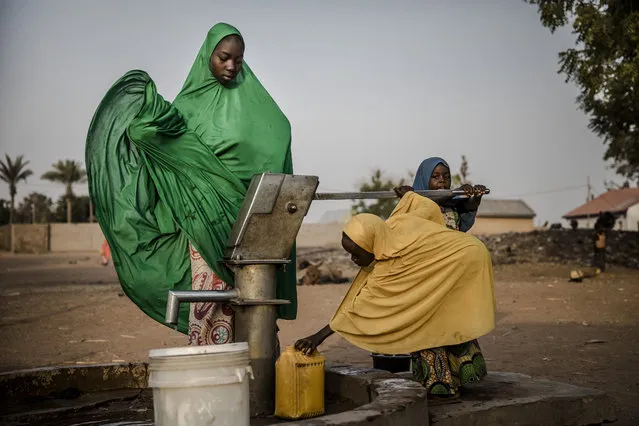
Camp dwellers pump water from a well at Malkohi refugee camp in Jimeta, Adamawa State, Nigeria on February 19, 2019, four days ahead of the country's General elections set for February 23 after a last-minute rescheduling. Malkohi is a camp for internal displaced who fled their homes as Boko Haram insurgents advanced across north-eastern Nigeria. From their homes on the outskirts of Yola, capital of presidential candidate Atiku Abubakar's home state Adamawa, Malkohi residents say they feel forgotten. (Photo by Luis Tato/AFP Photo)

Camp dwellers pump water from a well at Malkohi refugee camp in Jimeta, Adamawa State, Nigeria on February 19, 2019, four days ahead of the country's General elections set for February 23 after a last-minute rescheduling. Malkohi is a camp for internal displaced who fled their homes as Boko Haram insurgents advanced across north-eastern Nigeria. From their homes on the outskirts of Yola, capital of presidential candidate Atiku Abubakar's home state Adamawa, Malkohi residents say they feel forgotten. (Photo by Luis Tato/AFP Photo)
Details
02 Mar 2019 00:05:00