Loading...
Done
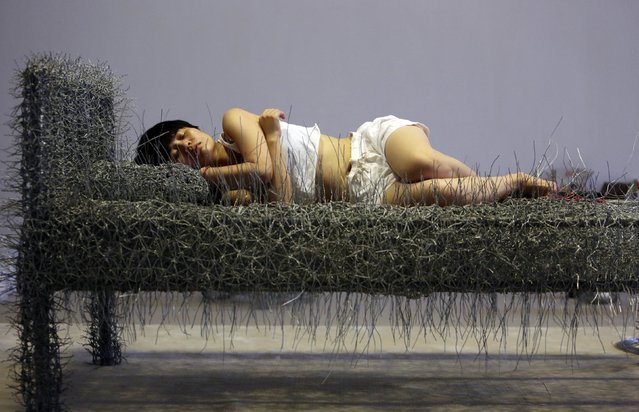
Chinese artist Zhou Jie takes a nap on an unfinished iron wire bed, one of her sculpture works, after lunch at Beijing Now Art Gallery, in Beijing August 11, 2014. Zhou started her art project titled “36 Days” on August 9, in which she would live inside an exhibition hall with an unfinished iron wire bed, some iron wire sculptures in the shape of stuffed animal dolls, a certain amount of food and her mobile phone, for 36 days. (Photo by Jason Lee/Reuters)

Chinese artist Zhou Jie takes a nap on an unfinished iron wire bed, one of her sculpture works, after lunch at Beijing Now Art Gallery, in Beijing August 11, 2014. Zhou started her art project titled “36 Days” on August 9, in which she would live inside an exhibition hall with an unfinished iron wire bed, some iron wire sculptures in the shape of stuffed animal dolls, a certain amount of food and her mobile phone, for 36 days. The entire process is open to visitors and she may also interact with them, according to Zhou. (Photo by Jason Lee/Reuters)
Details
22 Aug 2014 12:04:00
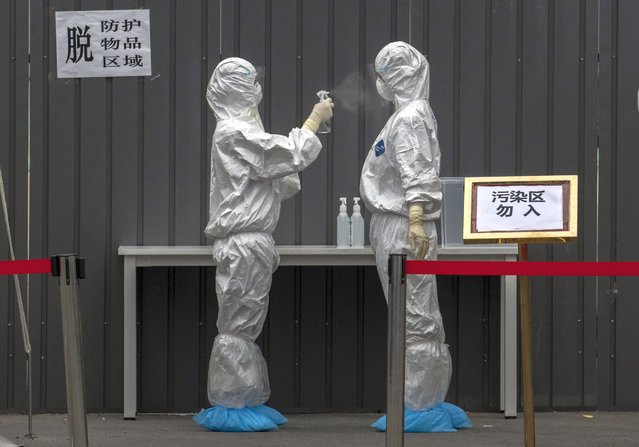
Chinese epidemic control workers wear protective suits as they disinfect each other after performing nucleic acid swab test for COVID-19 on citizens at a government testing site in Xicheng District during an organized tour on June 24, 2020 in Beijing, China. While Chinese government medical officials have said they believe they have controlled the spread, authorities are trying to contain the outbreak linked to the Xinfadi wholesale food market, Beijing's biggest supplier of produce and meat. More than 2.5 million people have undergone nucleic acid tests for COVID-19 at dozens of sites across the city in recent days, with officials using contact tracing to target high and middle risk areas and people who may have had contact with the market or food that came from there. Several neighborhoods have been locked down and a number of other food markets have been closed, The outbreak has triggered fears of a second wave of infection after 56 straight days with no domestically transmitted cases in the capital. (Photo by Kevin Frayer/Getty Images)

Chinese epidemic control workers wear protective suits as they disinfect each other after performing nucleic acid swab test for COVID-19 on citizens at a government testing site in Xicheng District during an organized tour on June 24, 2020 in Beijing, China. While Chinese government medical officials have said they believe they have controlled the spread, authorities are trying to contain the outbreak linked to the Xinfadi wholesale food market, Beijing's biggest supplier of produce and meat. (Photo by Kevin Frayer/Getty Images)
Details
26 Jun 2020 00:01:00
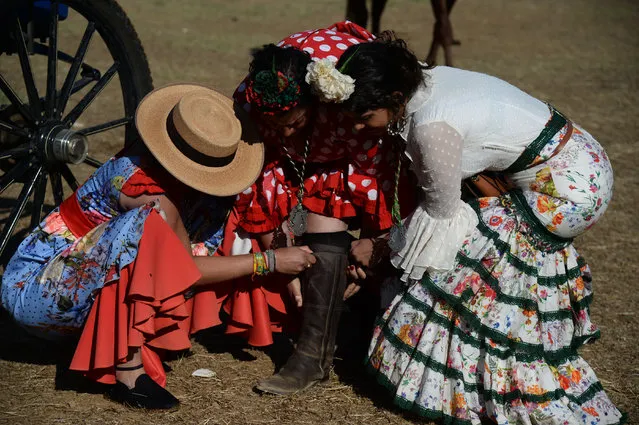
Pilgrims rest on June 6, 2019 in Villamanrique, during a pilgrimage to the village of El Rocio. El Rocio pilgrimage, the largest in Spain, gathers hundreds of thousands of devotees in traditional outfits converging in a burst of colour as they make their way on horseback and on board decorated carriages across the Andalusian countryside. (Photo by Cristina Quicler/AFP Photo)

Pilgrims rest on June 6, 2019 in Villamanrique, during a pilgrimage to the village of El Rocio. El Rocio pilgrimage, the largest in Spain, gathers hundreds of thousands of devotees in traditional outfits converging in a burst of colour as they make their way on horseback and on board decorated carriages across the Andalusian countryside. (Photo by Cristina Quicler/AFP Photo)
Details
08 Jun 2019 00:03:00
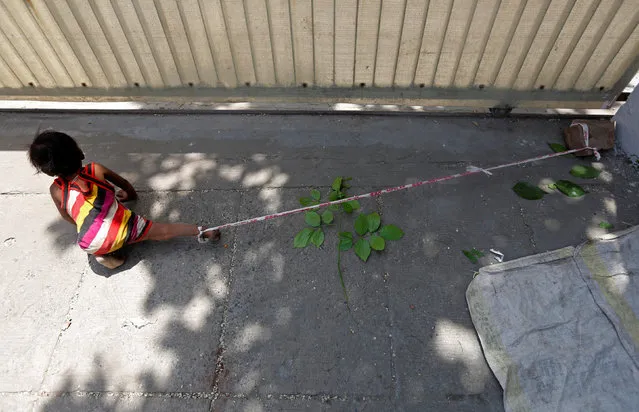
Barrier tape is tied around 15-month-old Shivani's ankle to prevent her from running away, while her mother Sarta Kalara works at a construction site nearby, in Ahmedabad, India, April 19, 2016. Kalara says she has no option but to tether her daughter Shivani to a stone despite her crying, while she and her husband work for 250 rupees ($3.8) each a shift digging holes for electricity cables in the city of Ahmedabad. (Photo by Amit Dave/Reuters)

Barrier tape is tied around 15-month-old Shivani's ankle to prevent her from running away, while her mother Sarta Kalara works at a construction site nearby, in Ahmedabad, India, April 19, 2016. Kalara says she has no option but to tether her daughter Shivani to a stone despite her crying, while she and her husband work for 250 rupees ($3.8) each a shift digging holes for electricity cables in the city of Ahmedabad. (Photo by Amit Dave/Reuters)
Details
23 May 2016 09:15:00
English television personality, presenter and model Olivia Attwood looked chic in a Miu Miu camel mini skirt, priced at £900 and a pair of black knee-high boots from the same high-end collection, for a whopping £1,600. (Photo by oliviajade_attwood/Instagram)

English television personality, presenter and model Olivia Attwood looked chic in a Miu Miu camel mini skirt, priced at £900 and a pair of black knee-high boots from the same high-end collection, for a whopping £1,600. (Photo by oliviajade_attwood/Instagram)
Details
21 May 2023 04:17:00
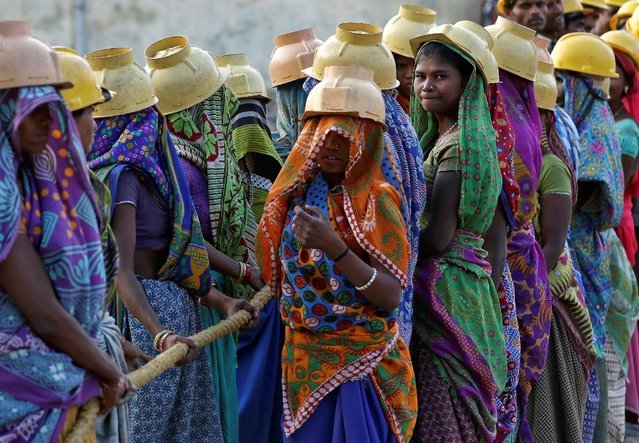
Female labourers wearing helmets take a break from laying underground electricity cables in Ahmedabad, India, March 7, 2016. (Photo by Amit Dave/Reuters)

Female labourers wearing helmets take a break from laying underground electricity cables in Ahmedabad, India, March 7, 2016. (Photo by Amit Dave/Reuters)
Details
01 Jun 2016 12:06:00
A woman with high heels walks on a sidewalk which is renovated on August 10, 2017 in downtown Moscow, as the city continues with preparations for next year's FIFA World Cup. (Photo by Mladen Antonov/AFP Photo)

A woman with high heels walks on a sidewalk which is renovated on August 10, 2017 in downtown Moscow, as the city continues with preparations for next year's FIFA World Cup. (Photo by Mladen Antonov/AFP Photo)
Details
03 Jun 2018 00:01:00
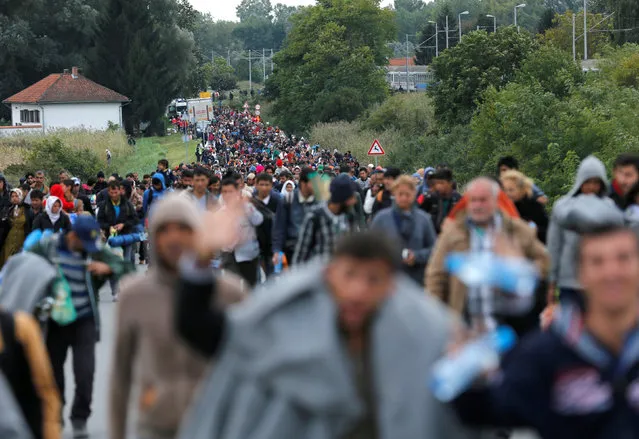
A year after hundreds of thousands of migrants and refugees snaked their way across southeastern Europe and onto television screens worldwide, the roads through the Balkans are now clear, depriving an arguably worsening tragedy of its poignant visibility. Europe's migrant crisis is at the very least numerically worse than it was last year. More people are arriving and more are dying. (Photo by Antonio Bronic/Reuters)

A year after hundreds of thousands of migrants and refugees snaked their way across southeastern Europe and onto television screens worldwide, the roads through the Balkans are now clear, depriving an arguably worsening tragedy of its poignant visibility. Reuters photographer, Antonio Bronic revisiting the people-packed locations where he and his colleagues captured last year's diaspora, found empty roads, unencumbered railway tracks and bucolic countryside. (Photo by Antonio Bronic/Reuters)


Details
12 Aug 2016 12:10:00