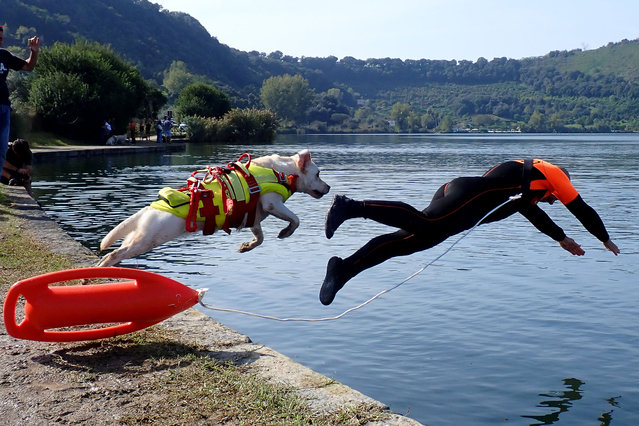
Volunteer of the SICS “Italian rescue dog school”, during a water rescue training session, inside the Averno lake in Pozzuoli. Italy, on October 26, 2024. (Photo by Vincenzo Izzo/Sipa USA)
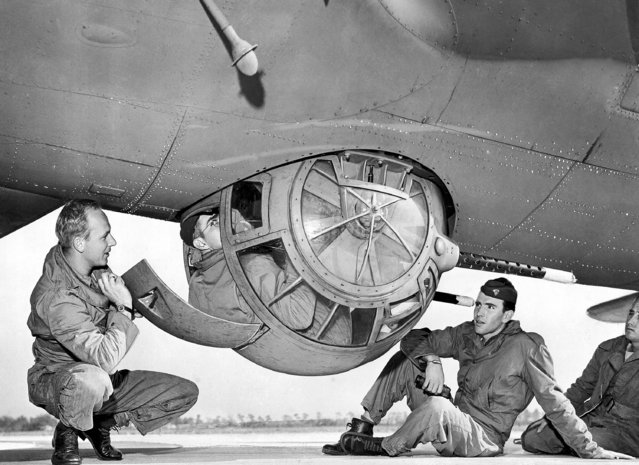
Private Harold L. Langhofer edges into the ball-turret, March 9, 1943. Curled in this position, he can turn the turret so that it fires in any direction. The turret can also be swung around so that the hatch opens into the plane, and the gunner can crawl into it while the Flying Fortress is in motion. (Photo by AP Photo)
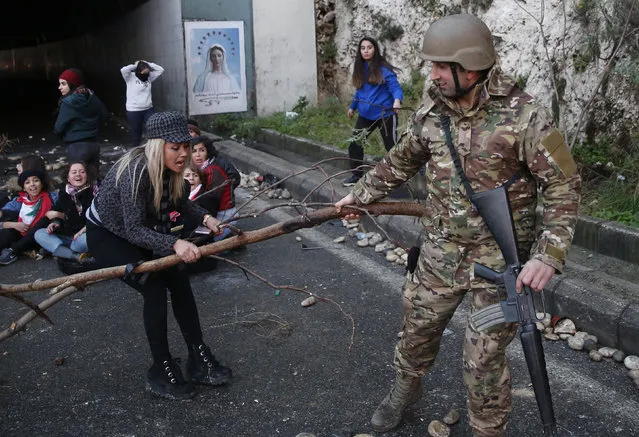
An army soldier takes a tree branch from an anti-government protester who is blocking a major highway that links the capital Beirut to northern Lebanon, in the town of Nahr el-Kalb, north of Beirut, Lebanon, Friday, January 3, 2020. Lebanon is facing its worst economic crisis in decades, while protests against corruption and mismanagement have gripped the country since October. (AP Photo/Hussein Malla)
A market trader in Gaibandha in Bangladesh on September 25, 2019, surrounded by bottle gourd vegetables, which sell for around 3p ($ 0.04) each. (Photo by Solent News)
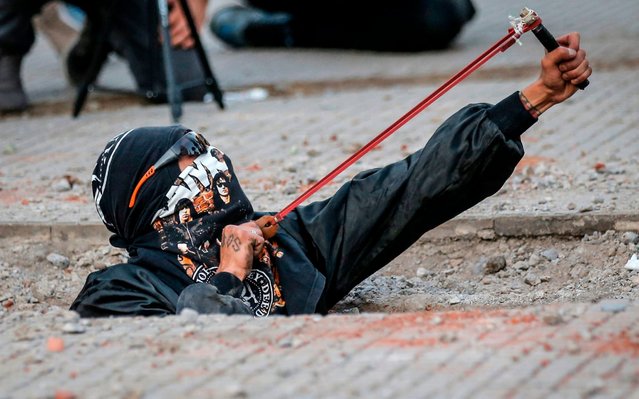
A feminist activist uses a slingshot during a protest against gender violence and patriarchy in Santiago on November 29, 2019. Furious Chileans have since October 18 been protesting social and economic inequality, and against an entrenched political elite that comes from a small number of the wealthiest families in the country, among other issues. (Photo by Javier Torres/AFP Photo)
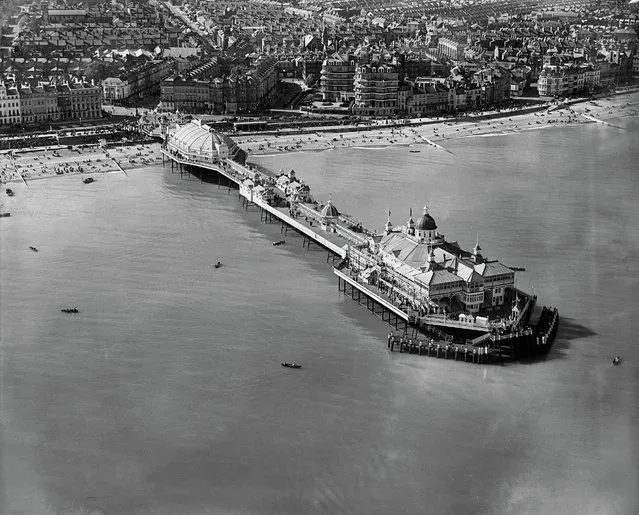
While the lido was described as bringing “modernism to the masses” on the British coast it was just the latest example of a trend that had been developing since Victorian times – transforming seaside towns into resorts for leisure and entertainment. In the latter half of the nineteenth century, the fashion was for local authorities to build great piers stretching from the promenade out into the sea. The Eastbourne Pier, pictured here in May 1931, was erected between 1866 and 1870 to an ingenious design by Eugenius Birch, which saw the structure sitting on special cups allowing the supporting struts to “move” in bad weather. Arranged on the pier's 1,000-foot length were kiosks, a theatre, a ballroom and a camera obscura. 1931. (Photo by Aerofilms Collection via “A History of Britain From Above”)