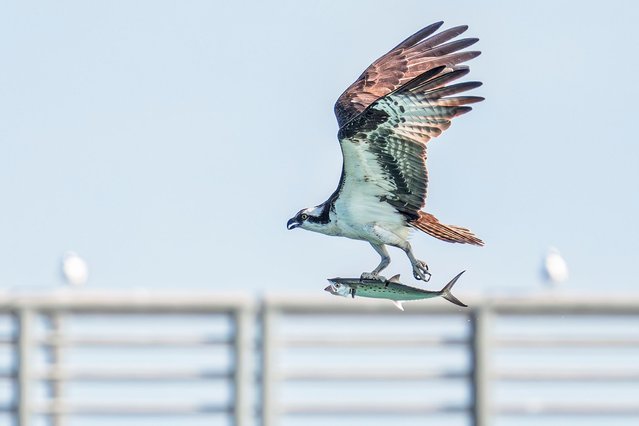
An osprey flies with a fish in its talons at the Sebastian Inlet State Park in Melbourne Beach, Florida on April 1, 2025. (Photo by Ronen Tivony/ZUMA Press Wire/Rex Features/Shutterstock)
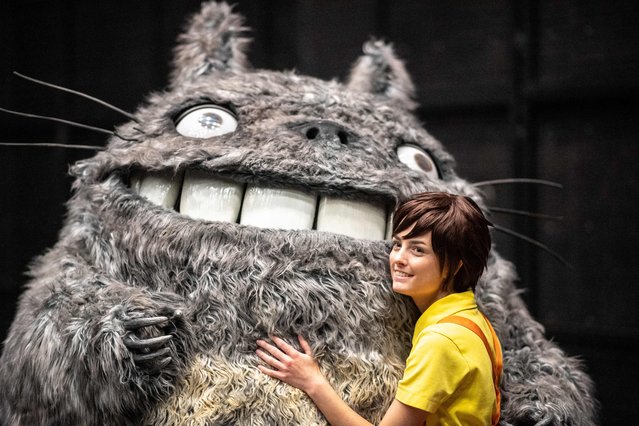
Sweden's Henrik Pilerud, inside the Totoro costume, and his team member Victoria Christensen (R) pose during an interview with AFP ahead of a rehearsal before the world cosplay championship 2024 during the World Cosplay Summit in Nagoya on August 3, 2024. (Photo by Philip Fong/AFP Photo)
Sweden's Sweden's Henrik von Eckermann, riding King Edward, during the Equestrian Team Jumping finals, at the 2024 Summer Olympics, Friday, August 2, 2024, in Versailles, France. (Photo by Mosa'ab Elshamy/AP Photo)
Chinese aids activists hand out condoms in a subway train in Wuhan, central China's Hubei province on December 1, 2014. The World Health Organization issued a call to action to China on December 1, 2014 over HIV/AIDS as government figures said nearly half a million people are living with the disease or its precursor, with hundreds of thousands more thought to be undiagnosed. (Photo by AFP Photo)
Storm clouds blanket the sky over Great American Ball Park as Starlin Castro #13 of the Chicago Cubs fields a ground ball in the fifth inning against the Cincinnati Reds as on July 7, 2014 in Cincinnati, Ohio. (Photo by Jamie Sabau/Getty Images)
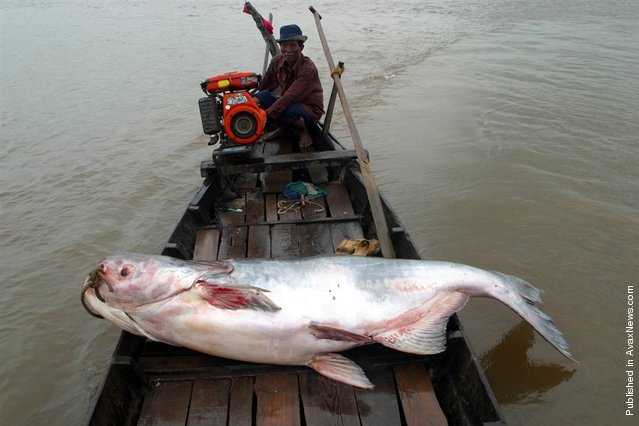
Among the fish populations that could be harmed by the Xayaburi dam in Laos is the critically endangered Mekong giant catfish, considered by the Guinness Book of World Records to be the world’s largest freshwater fish. The fish, which grows to 650 pounds and about 10 feet long, is only found in the Mekong River. It is migratory, moving between downstream habitats in Cambodia upstream to northern Thailand and Laos each year to spawn. Some experts fear the Xayaburi dam could block the migration and drive the giant catfish to extinction. (Photo by Courtesy of Zeb Hogan/University of Nevada, Reno)
Rohingya refugee sisters Nur Kaida (R) and Ruhana hug each other at their shelter at the Palongkhali refugee camp near Cox's Bazar, Bangladesh December 21, 2017. (Photo by Marko Djurica/Reuters)
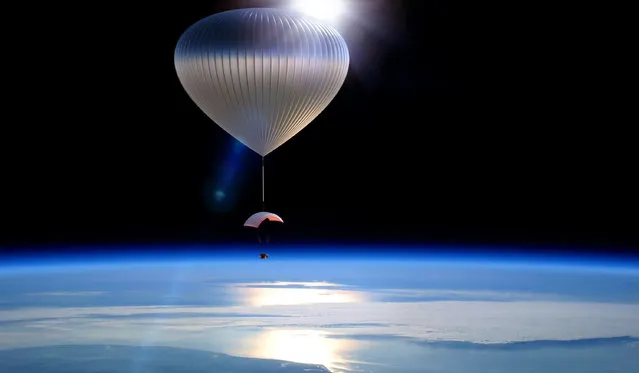
This undated image provided by World View shows World View capsule and balloon spacecraft that will rise to 100,000 feet above Earth for passengers to see the curvature of the planet and the blackness of space. Space tourism companies are employing designs including winged vehicles, vertical rockets with capsules and high-altitude balloons. While developers envision ultimately taking people to orbiting habitats, the moon or beyond, the immediate future involves short flights into or near the lowest reaches of space without going into orbit. (Photo by World View via AP Photo)