Loading...
Done
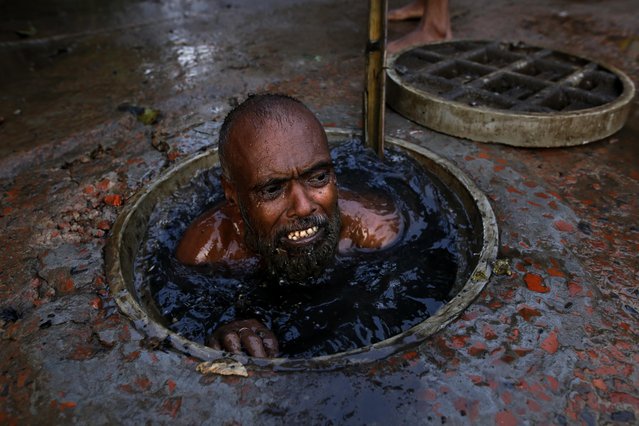
Men are sent down into the sludge to clear the sewers in the Bangladeshi capital Dhaka on May 23, 2018. One man holds his nose as he goes under to scoop blockages out for no more than $10a day. (Photo by Rehman Asad/Barcroft Media)

Men are sent down into the sludge to clear the sewers in the Bangladeshi capital Dhaka on May 23, 2018. The people who do the work aren’t even given any protective clothing or goggles and have to dig out the clogged-up muck with a stick or their bare hands. (Photo by Rehman Asad/Barcroft Media)
Details
26 May 2018 00:05:00
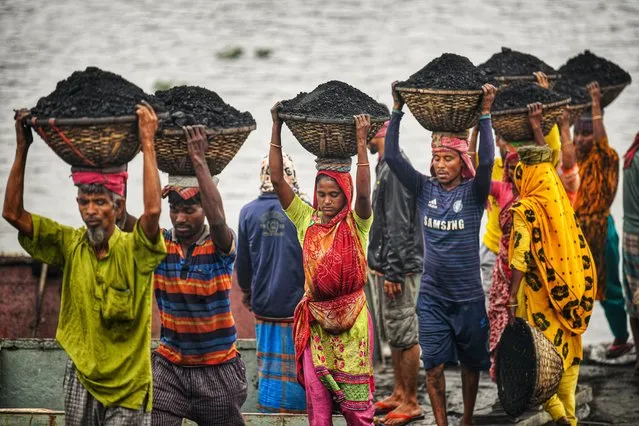
Bangladeshi day labourers carry baskets of coal from a cargo ship in Gabtoli, Dhaka on January 2, 2022. They are earning around $1 every 30 baskets of coal unloaded from the ship. (Photo by Piyas Biswas/SOPA Images/Rex Features/Shutterstock)

Bangladeshi day labourers carry baskets of coal from a cargo ship in Gabtoli, Dhaka on January 2, 2022. They are earning around $1 every 30 baskets of coal unloaded from the ship. (Photo by Piyas Biswas/SOPA Images/Rex Features/Shutterstock)
Details
27 Jan 2022 07:07:00
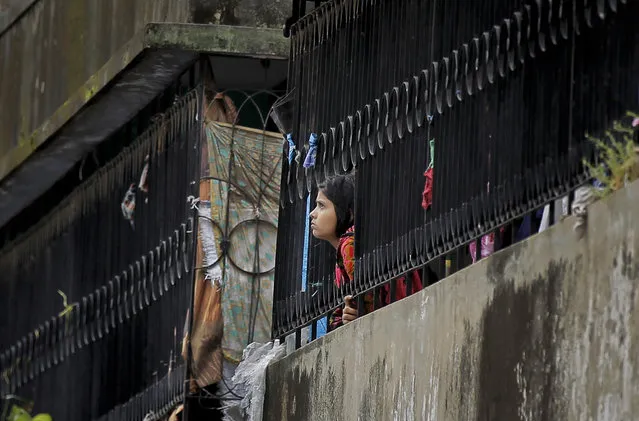
A Bangladeshi girl watches from a nearby building after a five-story building was raided by police in Dhaka, Bangladesh, Tuesday, July 26, 2016. (Photo by AP Photo)

A Bangladeshi girl watches from a nearby building after a five-story building was raided by police in Dhaka, Bangladesh, Tuesday, July 26, 2016. Police in Bangladesh's capital raided a five-story building Tuesday that was used as a den by suspected Islamic militants, killing nine of them, the country's police chief said. Police said they belonged to a Bangladeshi group blamed for an attack on a Dhaka cafe earlier this month in which 20 hostages, mostly foreigners, were killed and had been planning another large-scale assault. (Photo by AP Photo)
Details
27 Jul 2016 08:59:00
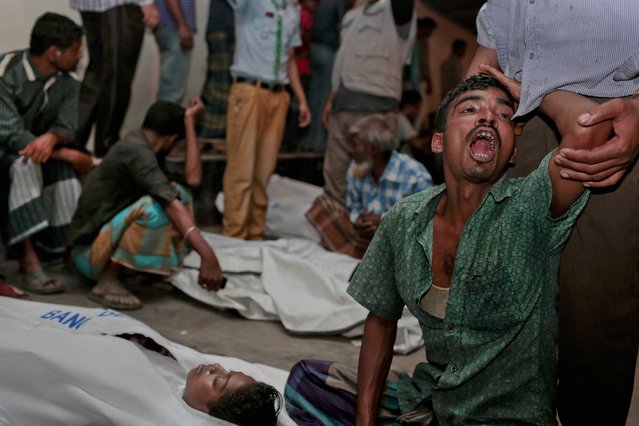
Bangladeshi relatives wail near bodies of victims after a river ferry carrying about 100 passengers capsized Sunday after being hit by a cargo vessel,in Manikganj district, about 40 kilometers (25 miles) northwest of Dhaka, Bangladesh, Sunday, February 22, 2015. (Photo by A. M. Ahad/AP Photo)

Bangladeshi relatives wail near bodies of victims after a river ferry carrying about 100 passengers capsized Sunday after being hit by a cargo vessel,in Manikganj district, about 40 kilometers (25 miles) northwest of Dhaka, Bangladesh, Sunday, February 22, 2015. (Photo by A. M. Ahad/AP Photo)
Details
23 Feb 2015 12:47:00
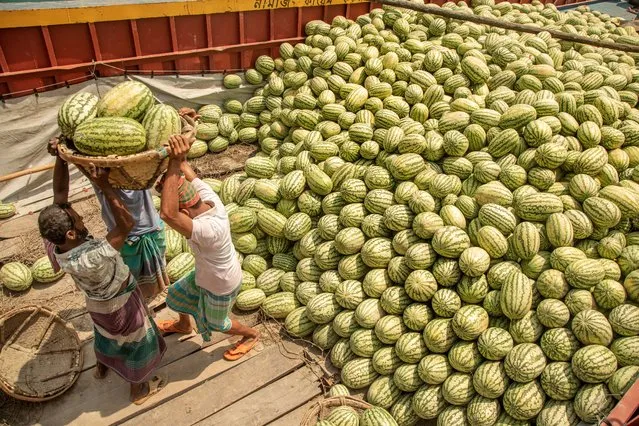
Bangladeshi laborers unload watermelons from a boat at the Buriganga River in Dhaka, Bangladesh, 03 April 2024. Watermelon is in harvesting season and is filling the city markets as it arrives from the southern part of Bangladesh. According to the Department of Agriculture Extension (DAE), Barishal has set an ambitious goal to expand watermelon cultivation to 54,002 hectares across six high-yielding districts in the division, which is 14 percent higher than last year. (Photo by Monirul Alam/EPA/EFE)

Bangladeshi laborers unload watermelons from a boat at the Buriganga River in Dhaka, Bangladesh, 03 April 2024. Watermelon is in harvesting season and is filling the city markets as it arrives from the southern part of Bangladesh. According to the Department of Agriculture Extension (DAE), Barishal has set an ambitious goal to expand watermelon cultivation to 54,002 hectares across six high-yielding districts in the division, which is 14 percent higher than last year. (Photo by Monirul Alam/EPA/EFE)
Details
19 Apr 2024 00:22:00
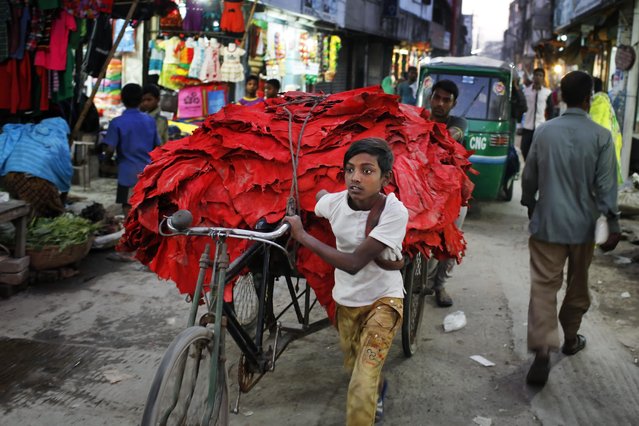
In this Thursday, February 9, 2017 photo, a Bangladeshi boy pulls a rickshaw loaded with strips of leather at the highly polluted Hazaribagh tannery area in Dhaka, Bangladesh. Hazardous, heavily polluting tanneries with workers as young as 14 supplied leather to companies that make shoes and handbags for Western brands, a nonprofit group that investigates supply chains says. (Photo by A.M. Ahad/AP Photo)

In this Thursday, February 9, 2017 photo, a Bangladeshi boy pulls a rickshaw loaded with strips of leather at the highly polluted Hazaribagh tannery area in Dhaka, Bangladesh. Hazardous, heavily polluting tanneries with workers as young as 14 supplied leather to companies that make shoes and handbags for Western brands, a nonprofit group that investigates supply chains says. (Photo by A.M. Ahad/AP Photo)
Details
25 Mar 2017 08:02:00
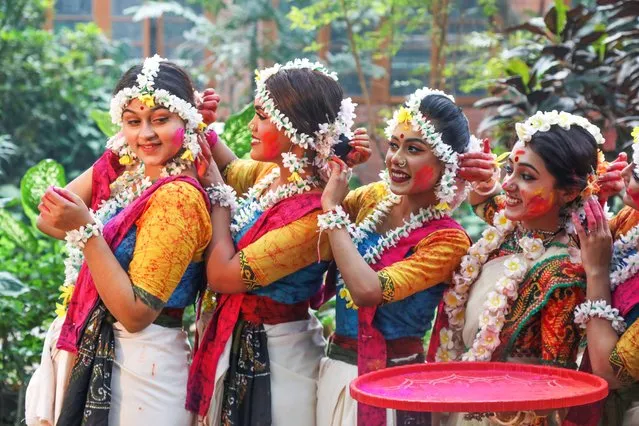
Bangladeshi artists wear floral attire as they join celebrations of the spring festival “Basanta Utsav” at the Faculty of Fine Arts of the University of Dhaka, in Bangladesh, 14 February 2024. The Bashanta Utshab, or Spring Festival, is a local traditional festival which marks the beginning of the Spring Season while young people also celebrate it along with Valentine's Day. (Photo by Monirul Alam/EPA/EFE)

Bangladeshi artists wear floral attire as they join celebrations of the spring festival “Basanta Utsav” at the Faculty of Fine Arts of the University of Dhaka, in Bangladesh, 14 February 2024. The Bashanta Utshab, or Spring Festival, is a local traditional festival which marks the beginning of the Spring Season while young people also celebrate it along with Valentine's Day. (Photo by Monirul Alam/EPA/EFE)
Details
05 Mar 2024 08:10:00
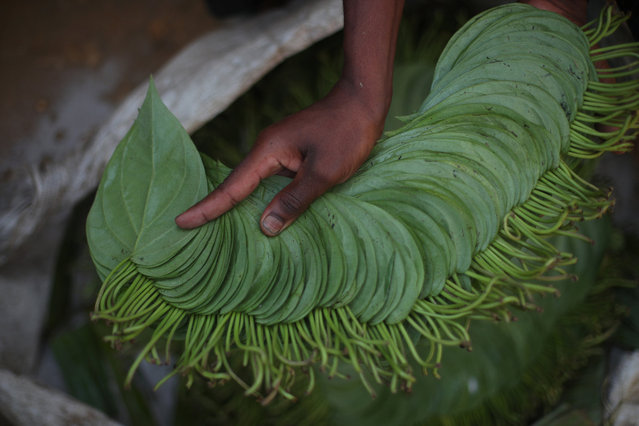
Faruk, 17, a Rohingya refugee trader holds betel leaves which are on sale at a stall in Palong Khali refugee camp near Cox's Bazar, Bangladesh, November 3, 2017. He left his village in Myanmar when the military opened fire towards the Rohingya. “I buy this betel leaf from Palong Khali market, in one bundle there are 160 pieces, I buy it for 80 taka and I sell it for 100 taka. Bangladeshi's and I sell for the same rate in the camp. Outside in the local market it is 80 taka per bundle. My problem is that I don't have money so I can't buy anything to eat, I can't buy fish to eat”, he said. (Photo by Hannah McKay/Reuters)

Faruk, 17, a Rohingya refugee trader holds betel leaves which are on sale at a stall in Palong Khali refugee camp near Cox's Bazar, Bangladesh, November 3, 2017. He left his village in Myanmar when the military opened fire towards the Rohingya. “I buy this betel leaf from Palong Khali market, in one bundle there are 160 pieces, I buy it for 80 taka and I sell it for 100 taka (1 Bangladeshi Taka = 0.012 US Dollar). Bangladeshi's and I sell for the same rate in the camp. Outside in the local market it is 80 taka per bundle. My problem is that I don't have money so I can't buy anything to eat, I can't buy fish to eat”, he said. (Photo by Hannah McKay/Reuters)
Details
27 Nov 2017 08:54:00