Loading...
Done
Bo (pictured) is president and co-founder of Grown Men On Bikes (GMOB), one of the oldest groups at Slow Roll. Bo spent $1,300 getting a one-off low-rider custom bike build – but that’s just the start. “Once I go back in it’s going to get big”, he says. “I’m going to get a custom seat, wheels, paint” … The finished bike could cost around $3,000 – but would still be far cheaper than pimping a car. “This is much better. It’s a community. We party”. (Photo by Nick Van Mead)

“We take rusty old junk and we put love into it”. The old Motor City has a unique style in bicycles these days: from fat wheels and fake fuel tanks to stretched cycles with powerful sound systems – and even a family-sized BBQ. “Detroit’s custom bike scene developed alongside Slow Roll, a weekly cycle ride started in 2010 by Jason Hall and Mike MacKool. Now upwards of 2,000 people turn up each Monday to cruise a different part of the city. The week I go the crowd seems evenly split between black and white, male and female, city and suburbs. It’s the most inclusive cycle event I’ve ever witnessed”. (Photo by Jason Walker/Slow Roll Monday Nights)
Details
03 Nov 2016 12:33:00
A model wears a floral headdress at the Royal Horticultural Society's Chelsea Flower show in London, Britain, May 22, 2017. (Photo by Dylan Martinez/Reuters)

A model wears a floral headdress at the Royal Horticultural Society's Chelsea Flower show in London, Britain, May 22, 2017. The prestigious Chelsea Flower Show, held annually since 1913 in the Royal Hospital Chelsea grounds, is open to the public from the 23rd to the 27th of May, 2017. (Photo by Dylan Martinez/Reuters)
Details
25 May 2017 08:31:00
Royal Hindu Cremation Held In Bali

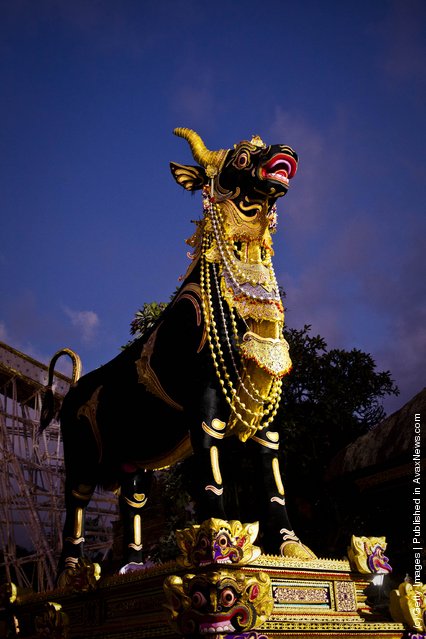
A black bull sarcophagus stands at Puri Ubud during the Hindu Royal cremation – also know as the Pengabenan – for the late Anak Agung Niang Rai, mother of Gianyar Regent, Tjokorda Oka Artha Ardana Sukawati, at Puri Ubud in Gianyar Bali on August 17, 2011 in Ubud, Bali, Indonesia. Niang Rai died in a Denpasar hospital in May; her actual cremation will take place on August 18 and will involve a nine level, 24m high 'bade' or body carring tower, made by upto 100 volunteers from 14 local villages. It will be carried to the cremation by 4500 Ubud residents. (Photo by Ulet Ifansasti/Getty Images)
Details
19 Aug 2011 09:30:00
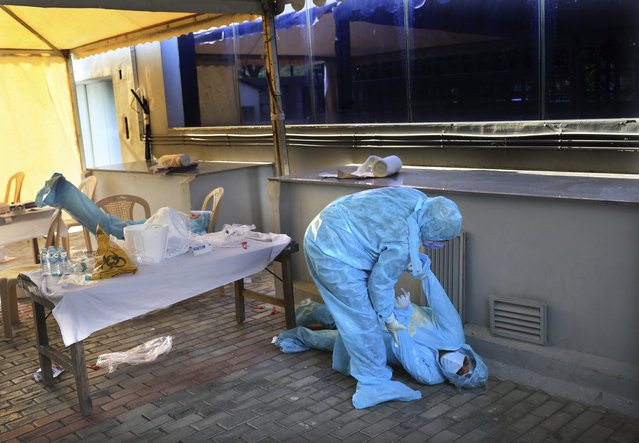
In this April 27, 2020 photo, a health worker helps another as she fainted because of exhaustion and long working hours during a swab test drive for COVID 19, in New Delhi, India. Two and a half months of nationwide lockdown kept numbers of infections relatively low in India. But with restrictions easing in recent weeks, cases have shot up, raising questions about whether authorities have done enough to avert catastrophe. Half of Delhi’s 8,200 hospital beds dedicated to COVID-19 patients are already full and officials are projecting more than half a million cases in the city alone by July 31. (Photo by Manish Swarup/AP Photo)

In this April 27, 2020 photo, a health worker helps another as she fainted because of exhaustion and long working hours during a swab test drive for COVID 19, in New Delhi, India. Two and a half months of nationwide lockdown kept numbers of infections relatively low in India. But with restrictions easing in recent weeks, cases have shot up, raising questions about whether authorities have done enough to avert catastrophe. Half of Delhi’s 8,200 hospital beds dedicated to COVID-19 patients are already full and officials are projecting more than half a million cases in the city alone by July 31. (Photo by Manish Swarup/AP Photo)
Details
08 Jan 2021 00:01:00
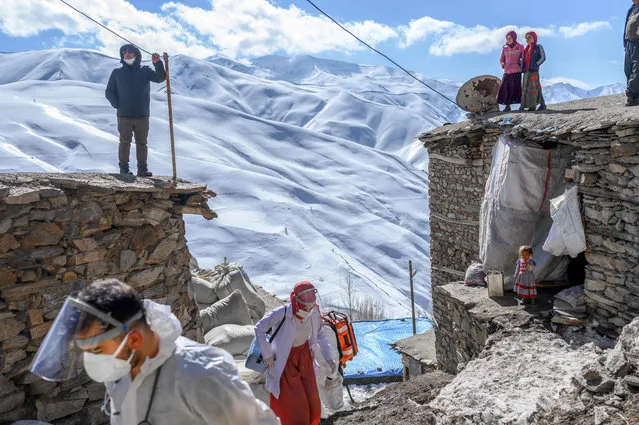
In this photograph taken on February 15, 2021, doctor Sergen Saracoglu (L) and nurse Yilzdiz Ayten (C) from the Bahcesaray public hospital vaccination team, arrive at the village of Guneyyamac in eastern Turkey, as part of an expedition to vaccinate residents of 65 years old or above with Sinovac's CoronaVac Covid-19 vaccine. Turkey's population of more than 83 million is spread out across Europe and Asia and covers some seemingly impregnable terrain. The vaccination effort with China's CoronaVac jab kicked off with a bang in mid-January when Turkey inoculated more than half a million people in the first few days. But it slowed down considerably when doctors left the big cities and tried to reach remote places such as Imamli and Ozbeyli – two ethnically Kurdish hamlets of a few hundred herders and farmers each. (Photo by Bulent Kilic/AFP Photo)

In this photograph taken on February 15, 2021, doctor Sergen Saracoglu (L) and nurse Yilzdiz Ayten (C) from the Bahcesaray public hospital vaccination team, arrive at the village of Guneyyamac in eastern Turkey, as part of an expedition to vaccinate residents of 65 years old or above with Sinovac's CoronaVac Covid-19 vaccine. (Photo by Bulent Kilic/AFP Photo)
Details
18 Mar 2021 09:32:00
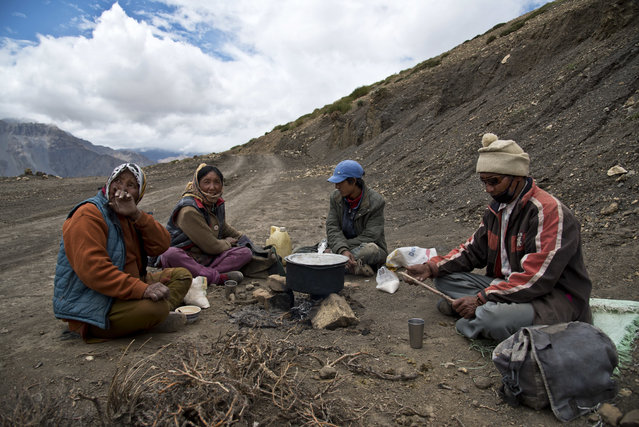
In this August 17, 2016, photo, from left to right, Chhering Chodom, 60, Tashi Yangzom, 50, Lobsang Chhering, 27, and Dorje Tandup, 58, drink milk tea on the side of the road. For centuries, the sleepy valley nestled in the Indian Himalayas remained a hidden Buddhist enclave forbidden to outsiders. Enduring the harsh year-round conditions of the high mountain desert, the people of Spiti Valley lived by a simple communal code – share the Earth's bounty, be hospitable to neighbors, and eschew greed and temptation at all turns. That's all starting to change, for better or worse. Since India began allowing its own citizens as well as outsiders to visit the valley in the early 1990s, tourism and trade have boomed. And the marks of modernization, such as solar panels, asphalt roads and concrete buildings, have begun to appear around some of the villages that dot the remote landscape at altitudes above 4,000 meters (13,000 feet). (Photo by Thomas Cytrynowicz/AP Photo)

In this August 17, 2016, photo, from left to right, Chhering Chodom, 60, Tashi Yangzom, 50, Lobsang Chhering, 27, and Dorje Tandup, 58, drink milk tea on the side of the road. For centuries, the sleepy valley nestled in the Indian Himalayas remained a hidden Buddhist enclave forbidden to outsiders. Enduring the harsh year-round conditions of the high mountain desert, the people of Spiti Valley lived by a simple communal code – share the Earth's bounty, be hospitable to neighbors, and eschew greed and temptation at all turns. That's all starting to change, for better or worse. (Photo by Thomas Cytrynowicz/AP Photo)
Details
15 Sep 2016 09:22:00
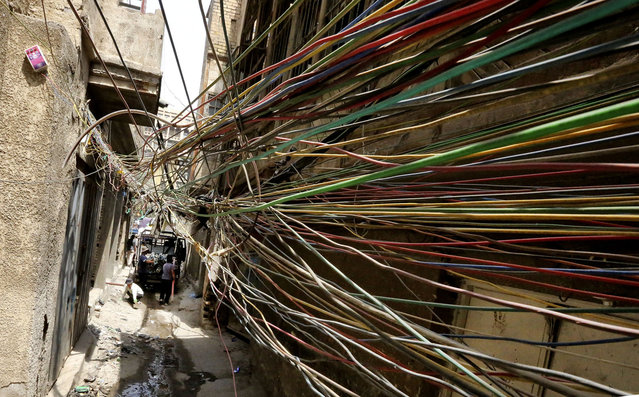
A picture taken on April 27, 2021, shows the electrical wires running between homes in the capital Baghdad's Murabaa neighbourhood. Between January and March alone, the interior ministry recorded 7,000 fires, the deadliest of which erupted on Sunday in a Covid-19 hospital in Baghdad. Eighty-two people died and 100 others were injured in the inferno, which sparked shock and outrage in the country. Baghdad, a sprawling metropolis of 10 million people, has the tragic distinction of being the Iraqi city hit by the most fires every year. (Photo by Sabah Arar/AFP Photo)

A picture taken on April 27, 2021, shows the electrical wires running between homes in the capital Baghdad's Murabaa neighbourhood. Between January and March alone, the interior ministry recorded 7,000 fires, the deadliest of which erupted on Sunday in a Covid-19 hospital in Baghdad. Eighty-two people died and 100 others were injured in the inferno, which sparked shock and outrage in the country. Baghdad, a sprawling metropolis of 10 million people, has the tragic distinction of being the Iraqi city hit by the most fires every year. (Photo by Sabah Arar/AFP Photo)
Details
06 May 2021 08:26:00
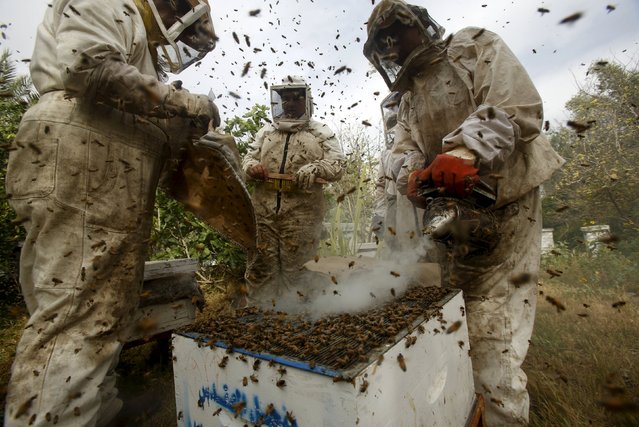
A Palestinian beekeeper uses smoke to calm bees in the process of collecting honey at a farm in Rafah, in the southern Gaza Strip April 11, 2016. (Photo by Suhaib Salem/Reuters)

A Palestinian beekeeper uses smoke to calm bees in the process of collecting honey at a farm in Rafah, in the southern Gaza Strip April 11, 2016. Rateb Samour sees 250 patients a day, whose complaints range from hair loss to cerebral palsy and cancer. He is not a doctor and has never worked in a hospital. Samour inherited the skill of bee-sting therapy from his father. From 2003 the agricultural engineer dedicated all his time to study and develop the alternative-medicine treatment of apitherapy, which uses bee-related products from honey, propolis – or bee glue used to build hives – to venom. (Photo by Suhaib Salem/Reuters)
Details
13 Apr 2016 09:14:00