Loading...
Done
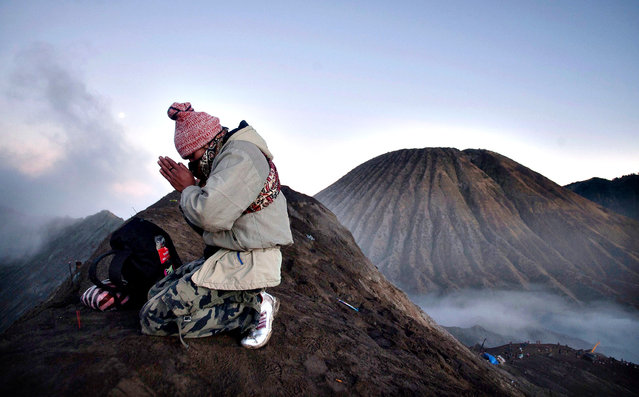
A Tengger tribesman prays at Mount Bromo during the annual Kasada ceremony in East Java on August 12, 2014. The Kasada ceremony is a festival held every 14th day of the Kasada month in the traditional Hindu lunar calender to honour Sang Hyang Widhi (God Almighty) and is based on the legend of Roro Anteng and Joko Seger from the Majapahit Kingdom, from which their Tengger tribe name originates. (Photo by Juni Kriswanto/AFP Photo)

A Tengger tribesman prays at Mount Bromo during the annual Kasada ceremony in East Java on August 12, 2014. The Kasada ceremony is a festival held every 14th day of the Kasada month in the traditional Hindu lunar calender to honour Sang Hyang Widhi (God Almighty) and is based on the legend of Roro Anteng and Joko Seger from the Majapahit Kingdom, from which their Tengger tribe name originates. Hundreds of worshippers from the Tengger tribe offer food and livestock as a symbolic sacrifice which they throw into the crater for the blessings of safety and prosperity to their familyies and community. (Photo by Juni Kriswanto/AFP Photo)
Details
16 Aug 2014 11:19:00
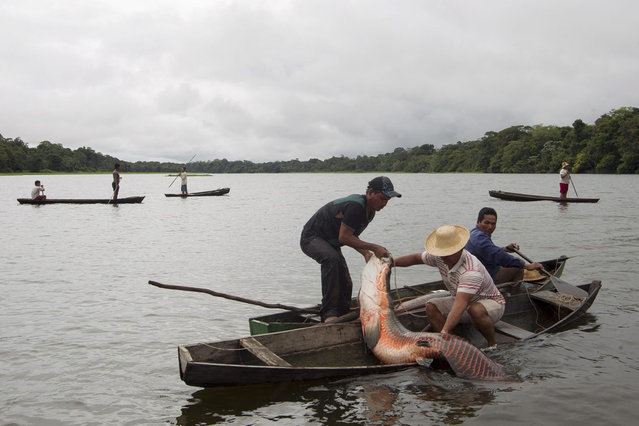
Villagers from the Porto Novo community load into their canoes arapaima or pirarucu, the largest freshwater fish species in South America and one of the largest in the world, while fishing in Poco Fundo lake along a branch of the Solimoes river, one of the main tributaries of the Amazon, in the Mamiraua nature reserve near Fonte Boa about 600 km (373 miles) west of Manaus, November 26, 2013. (Photo by Bruno Kelly/Reuters)

Villagers from the Porto Novo community load into their canoes arapaima or pirarucu, the largest freshwater fish species in South America and one of the largest in the world, while fishing in Poco Fundo lake along a branch of the Solimoes river, one of the main tributaries of the Amazon, in the Mamiraua nature reserve near Fonte Boa about 600 km (373 miles) west of Manaus, November 26, 2013. Catching the arapaima, a fish that is sought after for its meat and is considered by biologists to be a living fossil, is only allowed once a year by Brazil's environmental protection agency. The minimum size allowed for a fisherman to keep an arapaima is 1.5 meters (4.9 feet). (Photo by Bruno Kelly/Reuters)
Details
17 Dec 2013 08:03:00
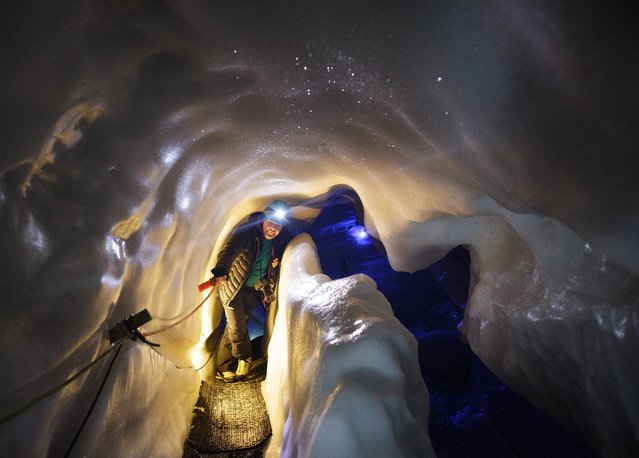
A tourist walks inside the Ice Palace glacier hollow at Hintertux glacier, located at around 3250 meters above sea level, in Zillertal, Austria, 02 March, 2016. The hollow's temperature remains constant at 0 degrees Celsius, in summer and winter alike, and is also used by the University of Innsbruck for scientific research projects. (Photo by Lisi Niesner/EPA)

A tourist walks inside the Ice Palace glacier hollow at Hintertux glacier, located at around 3250 meters above sea level, in Zillertal, Austria, 02 March, 2016. The hollow's temperature remains constant at 0 degrees Celsius, in summer and winter alike, and is also used by the University of Innsbruck for scientific research projects. (Photo by Lisi Niesner/EPA)
Details
03 Mar 2016 11:44:00
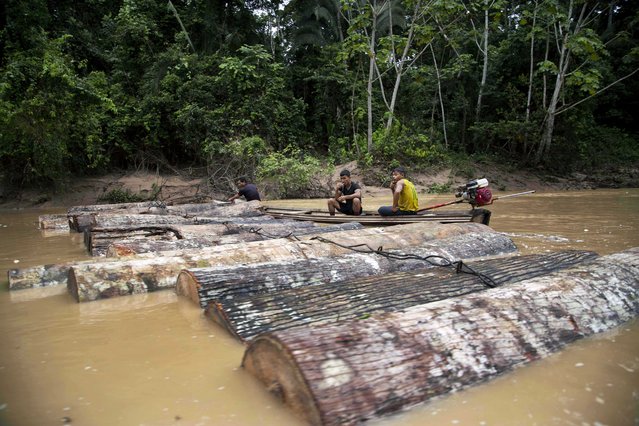
In this March 17, 2015 photo, Ashaninka Indian men, identified by locals as illegal loggers, tie tree trunks together to move them along the Putaya River near the hamlet of Saweto, Peru. Illegal logging persists unabated in this remote Amazon community where four indigenous leaders who resisted it were slain in September. The Putaya River is the waterway that transports felled trees, cut both legally and illegally, to the city of Pucallpa. (Photo by Martin Mejia/AP Photo)

In this March 17, 2015 photo, Ashaninka Indian men, identified by locals as illegal loggers, tie tree trunks together to move them along the Putaya River near the hamlet of Saweto, Peru. Illegal logging persists unabated in this remote Amazon community where four indigenous leaders who resisted it were slain in September. The Putaya River is the waterway that transports felled trees, cut both legally and illegally, to the city of Pucallpa. (Photo by Martin Mejia/AP Photo)
Details
27 Mar 2015 12:40:00
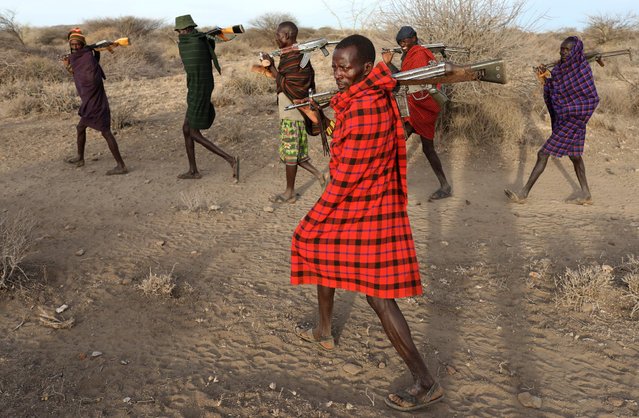
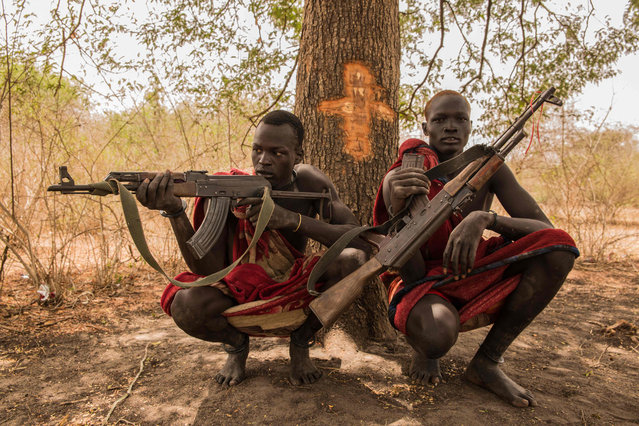
Turkana tribesmen walk with guns in order to protect their cattle from rival Pokot and Sambur tribesmen near Baragoy, Kenya February 14, 2017. Cattle rustling and competition for grazing have long troubled northern Kenya, but severe drought and political rivalries ahead of the elections have exacerbated the situation between ethnic tribes. (Photo by Goran Tomasevic/Reuters)

Turkana tribesmen walk with guns in order to protect their cattle from rival Pokot and Sambur tribesmen near Baragoy, Kenya February 14, 2017. Cattle rustling and competition for grazing have long troubled northern Kenya, but severe drought and political rivalries ahead of the elections have exacerbated the situation between ethnic tribes. (Photo by Goran Tomasevic/Reuters)
Details
16 Feb 2017 00:01:00
Sudanese cattle keepers from Dinka tribe Makal Maker (R) and Achiek Butich pose with the guns for their protection at their cattle camp in Mingkaman, Lakes State, South Sudan, on March 2, 2018. (Photo by  Stefanie Glinski/AFP Photo)

Sudanese cattle keepers from Dinka tribe Makal Maker (R) and Achiek Butich pose with the guns for their protection at their cattle camp in Mingkaman, Lakes State, South Sudan, on March 2, 2018. (Photo by Stefanie Glinski/AFP Photo)
Details
16 Mar 2018 00:05:00
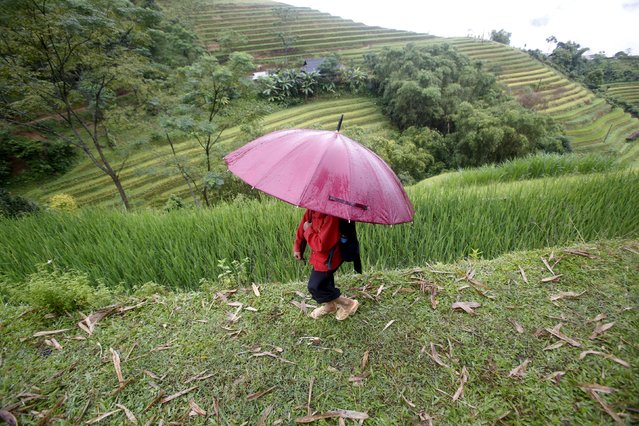
A pupil of the Dao ethnic tribe returns home from school along a hillside path at Suoi Thau village in Hoang Su Phi district of Vietnam's northern province of Ha Giang, located at the border with China, September 18, 2015. (Photo by Reuters/Kham)

A pupil of the Dao ethnic tribe returns home from school along a hillside path at Suoi Thau village in Hoang Su Phi district of Vietnam's northern province of Ha Giang, located at the border with China, September 18, 2015. (Photo by Reuters/Kham)
Details
22 Nov 2015 08:06:00
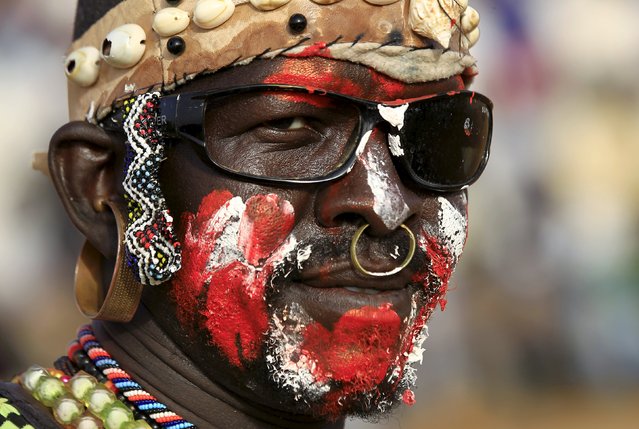
A wrestler from the Nuba Mountains tribe is seen during a celebration of their cultural heritage, as part of ongoing events to commemorate the International Day of the World's Indigenous Peoples, in Omdurman August 15, 2015. (Photo by Mohamed Nureldin Abdallah/Reuters)

A wrestler from the Nuba Mountains tribe is seen during a celebration of their cultural heritage, as part of ongoing events to commemorate the International Day of the World's Indigenous Peoples, in Omdurman August 15, 2015. The International Day of the World's Indigenous Peoples is observed on August 9 annually. (Photo by Mohamed Nureldin Abdallah/Reuters)
Details
16 Aug 2015 12:48:00