Loading...
Done
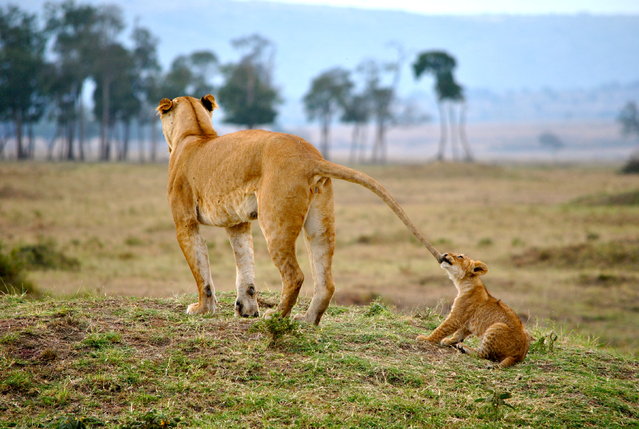
“A Mothers Tail”. A baby cub pulls on his mother's tail to get attention. Photo location: Masai Mara, Kenya. (Photo and caption by Tori Marsh/National Geographic Photo Contest)

“A Mothers Tail”. A baby cub pulls on his mother's tail to get attention. Photo location: Masai Mara, Kenya. (Photo and caption by Tori Marsh/National Geographic Photo Contest)
Details
21 Oct 2014 12:40:00
A baby giant panda plays at Chengdu Research Base of Giant Panda Breeding in Chengdu, Sichuan province, China, January 22, 2017. (Photo by Jason Lee/Reuters)

A baby giant panda plays at Chengdu Research Base of Giant Panda Breeding in Chengdu, Sichuan province, China, January 22, 2017. (Photo by Jason Lee/Reuters)
Details
23 Jan 2017 10:04:00
A baby otter has its first health checkup at Chester zoo, England on May 2, 2018. It was among five pups being weighed and microchipped. (Photo by Peter Byrne/PA Wire)

A baby otter has its first health checkup at Chester zoo, England on May 2, 2018. It was among five pups being weighed and microchipped. (Photo by Peter Byrne/PA Wire)
Details
06 May 2018 00:03:00
Catholic faithfuls hold figurines of baby Jesus during a religious procession on Holy Innocents Day in Antiguo Cuscatlan, El Salvador, December 28, 2016. (Photo by Jose Cabezas/Reuters)

Catholic faithfuls hold figurines of baby Jesus during a religious procession on Holy Innocents Day in Antiguo Cuscatlan, El Salvador, December 28, 2016. (Photo by Jose Cabezas/Reuters)
Details
30 Dec 2016 10:12:00
In this Tuesday, February 5, 2019, photo, fire-eater performs during celebrations of the Lunar New Year in the Chinatown district of Manila, Philippines. This year is the Year of the Earth Pig in the Chinese Lunar calendar and is supposed to represent abundance, diligence and generosity. (Photo by Bullit Marquez/AP Photo)

In this Tuesday, February 5, 2019, photo, fire-eater performs during celebrations of the Lunar New Year in the Chinatown district of Manila, Philippines. This year is the Year of the Earth Pig in the Chinese Lunar calendar and is supposed to represent abundance, diligence and generosity. (Photo by Bullit Marquez/AP Photo)
Details
07 Feb 2019 08:22:00
In this Friday, February 1, 2019, photo, Filipino-Chinese display piggy banks at the start of celebrations leading to next week's Lunar New Year in Chinatown, Manila, Philippines. This year is the Year of the Earth Pig on the Lunar calendar and is supposed to represent abundance, diligence and generosity. (Photo by Bullit Marquez/AP Photo)

In this Friday, February 1, 2019, photo, Filipino-Chinese display piggy banks at the start of celebrations leading to next week's Lunar New Year in Chinatown, Manila, Philippines. This year is the Year of the Earth Pig on the Lunar calendar and is supposed to represent abundance, diligence and generosity. (Photo by Bullit Marquez/AP Photo)
Details
09 Feb 2019 00:05:00
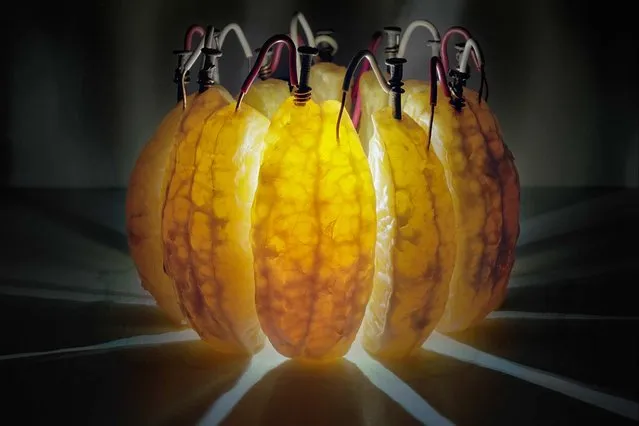
Wedges of an orange generate enough current and electrical juice – 3.5 volts – to power an LED. The fruit’s citric acid helps electrons flow from galvanized nails to copper wire in this 14-hour exposure. This image was published in September’s Visions of Earth, a trio of photos that appear in each issue of National Geographic. (Photo by Caleb Charland/National Geographic)

Wedges of an orange generate enough current and electrical juice – 3.5 volts – to power an LED. The fruit’s citric acid helps electrons flow from galvanized nails to copper wire in this 14-hour exposure. This image was published in September’s Visions of Earth, a trio of photos that appear in each issue of National Geographic. (Photo by Caleb Charland/National Geographic)
Details
06 Jan 2014 12:09:00
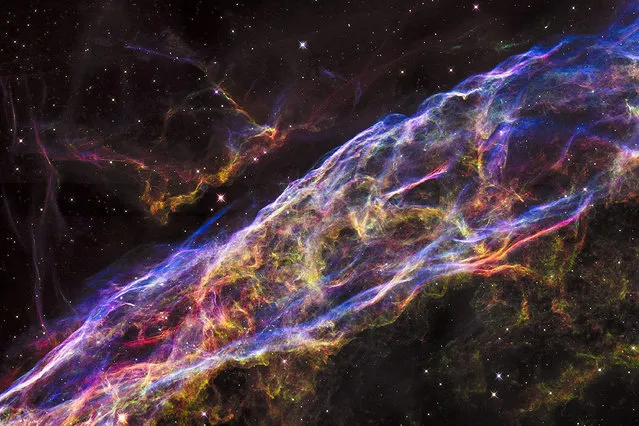
A small section of the expanding remains of the Veil Nebula, a massive star that exploded about 8,000 years ago. The entire nebula is 110 light-years across, covering six full moons on the sky as seen from Earth, and resides about 2,100 light-years away in the constellation Cygnus, the Swan. (Photo by Reuters/NASA/ESA/Hubble)

A small section of the expanding remains of the Veil Nebula, a massive star that exploded about 8,000 years ago. The entire nebula is 110 light-years across, covering six full moons on the sky as seen from Earth, and resides about 2,100 light-years away in the constellation Cygnus, the Swan. (Photo by Reuters/NASA/ESA/Hubble)

Details
29 Feb 2016 11:30:00