Loading...
Done
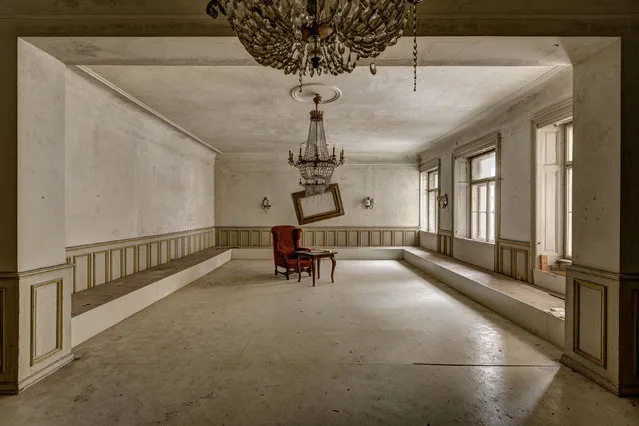
Grand banqueting halls, opulent lobbies and vast ballrooms; you could easily be forgiven for thinking this was a collection of photographs was documenting some of Europe’s grandest hotels. However, a closer look will reveal the majestic rooms to be engulfed in swathes of dust and moss; hotels that once hosted royals and high society abandoned to the elements. (Photo by Thomas Windisch/Caters News)

Grand banqueting halls, opulent lobbies and vast ballrooms; you could easily be forgiven for thinking this was a collection of photographs was documenting some of Europe’s grandest hotels. However, a closer look will reveal the majestic rooms to be engulfed in swathes of dust and moss; hotels that once hosted royals and high society abandoned to the elements. This is the latest result of urban exploration photography, going beyond “no entry” signs to capture images of dilapidated buildings across Europe. IT worker Thomas Windisch, from Graz in Austria, indulged his passion for photography by traveling across the continent, visiting over 100 abandoned hotels along the way. Here: inside a hotel in Austria. (Photo by Thomas Windisch/Caters News)
Details
24 Mar 2015 10:26:00
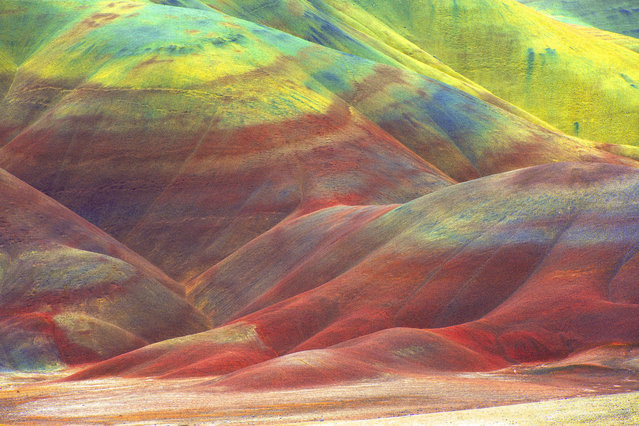
Layers of breathtaking colour streak the rolling hills of this vast desert, making the landscape appear as though it has been tie-dyed. The natural phenomenon, nicknamed the “Painted Desert”, was formed when the area was once a river floodplain. (Photo by Mark Brodkin/Solent News/SIPA Press)

Layers of breathtaking colour streak the rolling hills of this vast desert, making the landscape appear as though it has been tie-dyed. The natural phenomenon, nicknamed the “Painted Desert”, was formed when the area was once a river floodplain. Each colour corresponds to a different underground geological feature – rocks which have seemingly dyed the layers of earth above. Formed from volcanic activity, the hills at the John Day Fossil Beds National Monument in East Central Oregon, USA, are almost bursting with colour. Pictured: The colourful hills at the John Day Fossil Beds National Monument in East Central Oregon, USA. (Photo by Mark Brodkin/Solent News/SIPA Press)
Details
30 Jul 2014 11:00:00
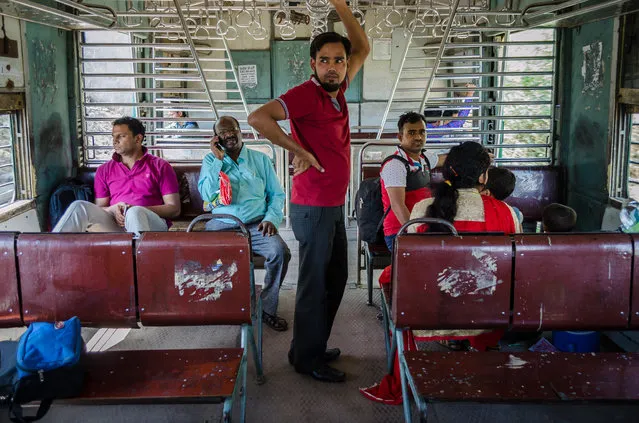
Indian passengers travel on a local train in New Delhi, India, October 2017. (Photo by Ankur Dutta/Barcroft Media)

Indian passengers travel on a local train in New Delhi, India, October 2017. Constructed in 1975 to bypass the crowded and passenger-heavy Old Delhi, New Delhi and Hazrat Nizamuddin railway stations, the railway line once used to be the lifeline of the capital. (Photo by Ankur Dutta/Barcroft Media)
Details
02 Nov 2017 08:49:00
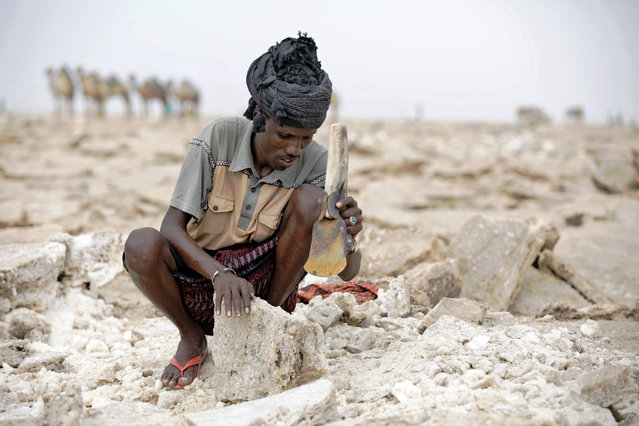
A man shaves blocks of salt from the Danakil Depression on 28 March 2017, in Afar, Ethiopia. (Photo by Zacharias Abubeker/AFP Photo)

A man shaves blocks of salt from the Danakil Depression on 28 March 2017, in Afar, Ethiopia. Every morning, hundreds of men converge on a dry lakebed in a remote corner of Ethiopia, where they cleave the ground open with handaxes to extract salt, just as their fathers and grandfathers once did. (Photo by Zacharias Abubeker/AFP Photo)
Details
19 Apr 2017 08:57:00
De Markies – The Mobile Home

The mobile home “De Markies” was an entry in the “Temporary Living” competition 1985 and was conceived as a mobile home. Onthe road it measures 2.00 m by 4.50 m, and once it has arrived at its destination its floorspace can be increased threefold in a matter of seconds. “De Markies” was awarded the Public Prize at the Rotterdam Design Prize 1996. For further information please visit Bothlink.
Details
29 Jul 2013 12:16:00
The Songkran festival

“The Songkran festival is celebrated in Thailand as the traditional New Year's Day from 13 to 15 April. It coincides with the New Year of many calendars of South and Southeast Asia. The most obvious celebration of Songkran is the throwing of water upon others. Thais roam the streets with containers of water or water guns. In addition, many Thais will have small bowls of beige colored talc sold cheaply and mixed with water which is then smeared on the faces and bodies of random passerbys as a blessing for the new year” – Wikipedia. (Photo by Seua Yai)
Details
23 Oct 2013 12:00:00
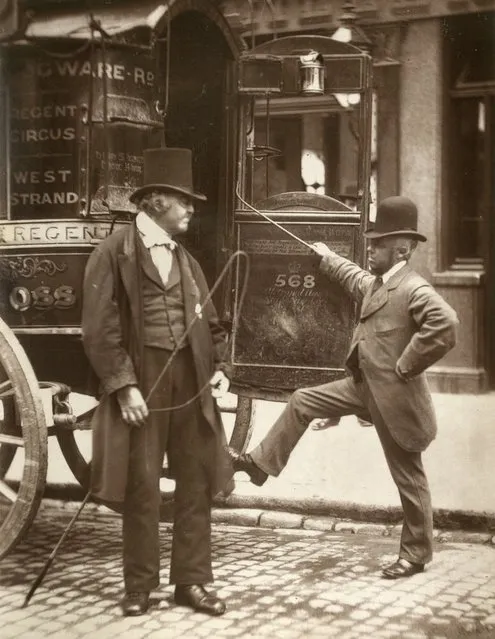
Ex Omnibus Driver. (Photo by John Thomson/LSE Digital Library)

“John Thomson (14 June 1837 – 29 September 1921) was a pioneering Scottish photographer, geographer and traveller. He was one of the first photographers to travel to the Far East, documenting the people, landscapes and artifacts of eastern cultures. Upon returning home, his work among the street people of London cemented his reputation, and is regarded as a classic instance of social documentary which laid the foundations for photojournalism. He went on to become a portrait photographer of High Society in Mayfair, gaining the Royal Warrant in 1881”. – Wikipedia. Photo: Ex Omnibus Driver. (Photo by John Thomson/LSE Digital Library)
Details
10 Feb 2013 17:30:00
“Stonedog”. (Photo by Vincent Bal/The Guardian)

Earlier this year, Belgian film-maker and artist Vincent Bal stumbled upon an uncanny resemblance to an elephant in the shadow of his tea cup. This gave him the idea for Shadowology, a series of doodles that interact with the shadows of simple, everyday objects: a banknote, some ice cubes and a flower, for example, can turn into a church, a woman and a hippy. “I draw a few lines and I get my image. It’s really the shadows that inspire me”, Bal says. Here: “Stonedog”. (Photo by Vincent Bal/The Guardian)
Details
02 Oct 2016 08:28:00