Loading...
Done
Art By Pascal Campion

Pascal Campion is a French-American illustrator and animator. He studied narrative illustration at Arts Decoratifs de Strasbourg, in France. He revels in the company of his wife and daughter and finds it very hard to write about himself. He works in a studio with high ceilings in
San Francisco. Pascal has worked in a wide variety of media, from games, music videos, feature films to books.
Details
20 Sep 2013 10:28:00
Cats By Kim Haskins

Kim Haskins was born in 1981 in Hitchin, Hertfordshire. Throughout school she was known as the class artist - the one who drew pictures in other peoples’ exercise books, made posters for school plays, designed t-shirts etc. Even growing up she pictures always fell into one of two categories: humorous or still life.
Details
06 Feb 2014 13:50:00
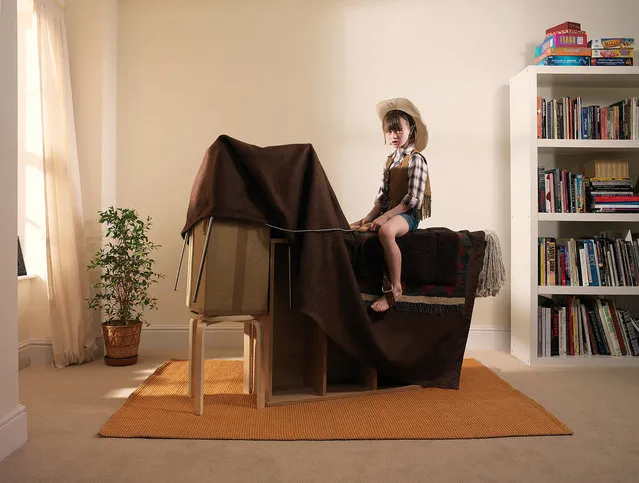
Kids At Home and At Play by Tim MacPherson

Tim Macpherson is a UK based advertising photographer who started his career shooting Editorial for magazines. His works are published in best advertising photographers book Lurzers. He works for The sunday times, Nikon, phillips etc. Photoset is short, but very creative.
Details
25 Jun 2015 05:37:00
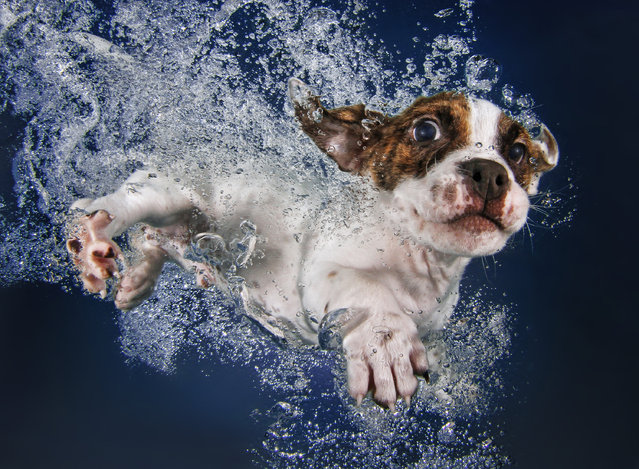
“Underwater Puppies”: Popcicle. (Photo by Seth Casteel)

Seth Casteel is an award-winning photographer and the New York Times Best Selling Author of Underwater Dogs. His new book, Underwater Puppies, was published September 16, 2014. Photo: “Underwater Puppies”: Popcicle. (Photo by Seth Casteel)
Details
17 Sep 2014 13:02:00
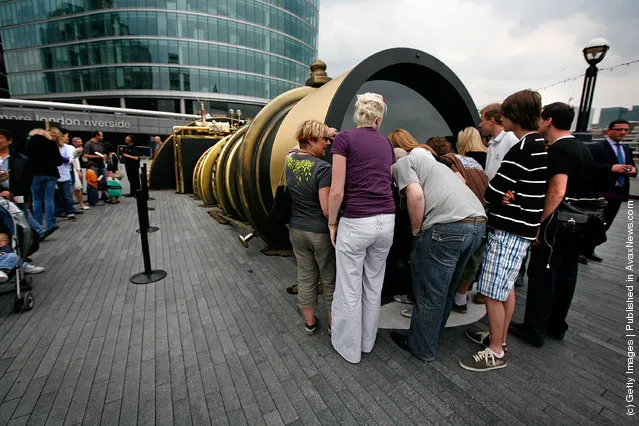
Telectroscope

“The telectroscope (also referred to as “electroscope”) was the first non-working prototype (i.e. conceptual model) of a television or videophone system. The term was used in the 19th century to describe science-based systems of distant seeing. The name and its concept came into being not long after the telephone was patented in 1876, and its original concept evolved from that of remote facsimile reproductions onto paper, into the live viewing of remote images”. – Wikipedia

Photo: Visitors to London wave to people they can see in New York as they peer through the Telectroscope situated by Tower Bridge on May 23, 2008 in London, England. The device named the Telectroscope provides a live visual link up between London and New York, to another Telectroscope by Brooklyn Bridge. (Photo by Cate Gillon/Getty Images)
Details
16 Sep 2011 12:19:00
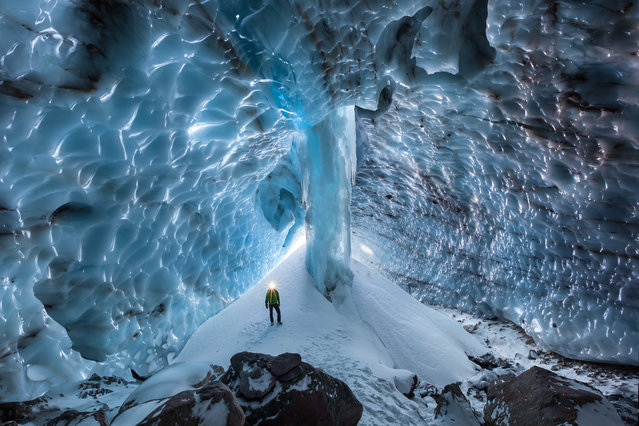
On the western side of Mount Hood lies the longest glacier cave system in the contiguous United States. In 2012, these caves were mapped to a combined length of 7,166.8 feet by cave explorers Brent McGregor and Eddy Cartaya. Currently, the total passage length is hundreds of feet less. Glaciers are frozen rivers; they are always moving and changing. In the past five years, we have seen the caves melt, shrink and collapse in a dramatic way. The caves are formed by water carving away at the ice. (Photo and caption by Josh Hydeman)

On the western side of Mount Hood lies the longest glacier cave system in the contiguous United States. In 2012, these caves were mapped to a combined length of 7,166.8 feet by cave explorers Brent McGregor and Eddy Cartaya. Currently, the total passage length is hundreds of feet less. Glaciers are frozen rivers; they are always moving and changing... (Photo and caption by Josh Hydeman)
Details
22 Mar 2015 11:05:00
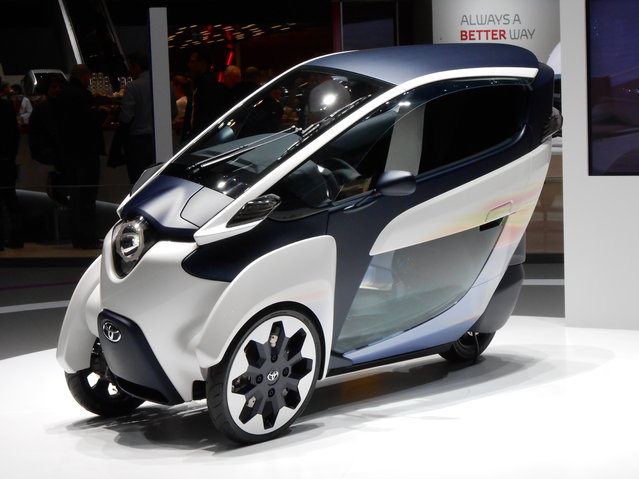
Toyota revealed its i-Road concept, a three-wheeled all-electric motorcycle of sorts that seats two. The unique design is only 33 inches wide, which would make it tops in buzzing in through and around traffic. An Active Lean system tilts the i-Road through corners like a motorbike, while the cabin (which seats two in a tandem layout) is fully enclosed. Maximum range is about 30 miles. (Photo by Luis Fernando Ramos/G1)

Toyota revealed its i-Road concept, a three-wheeled all-electric motorcycle of sorts that seats two. The unique design is only 33 inches wide, which would make it tops in buzzing in through and around traffic. An Active Lean system tilts the i-Road through corners like a motorbike, while the cabin (which seats two in a tandem layout) is fully enclosed. Maximum range is about 30 miles. (Photo by Luis Fernando Ramos/G1)
Details
08 Mar 2013 12:29:00
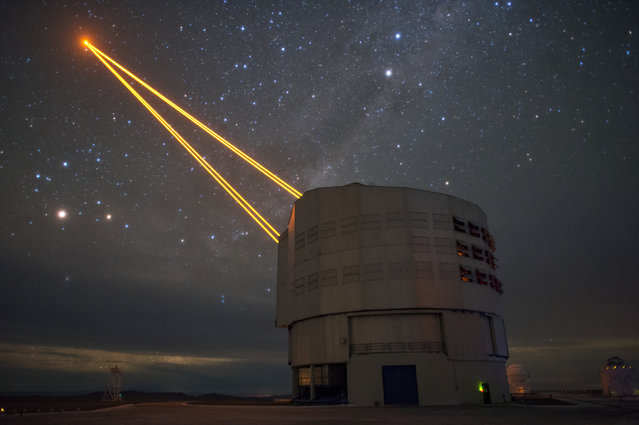
Four pillars of light from the 4 Laser Guide Star Facility on ESO's Very Large Telescope (VLT) are shown reaching into the Chilean night sky in this image from ESO Photo Ambassador Fred Kamphues, on September 2, 2016. The lasers are a key part of the adaptive optics system on the VLT. Adaptive optics allows astronomers to drastically reduce the atmospheric distortion present at even the best sites in the world for astronomy, including Paranal in Chile, the home of the VLT. (Photo by F. Kamphues/ESO)

Four pillars of light from the 4 Laser Guide Star Facility on ESO's Very Large Telescope (VLT) are shown reaching into the Chilean night sky in this image from ESO Photo Ambassador Fred Kamphues, on September 2, 2016. The lasers are a key part of the adaptive optics system on the VLT. Adaptive optics allows astronomers to drastically reduce the atmospheric distortion present at even the best sites in the world for astronomy, including Paranal in Chile, the home of the VLT. (Photo by F. Kamphues/ESO)
Details
23 Feb 2017 00:06:00